
The PE Compliance Trap: Navigating State Fitness Mandates
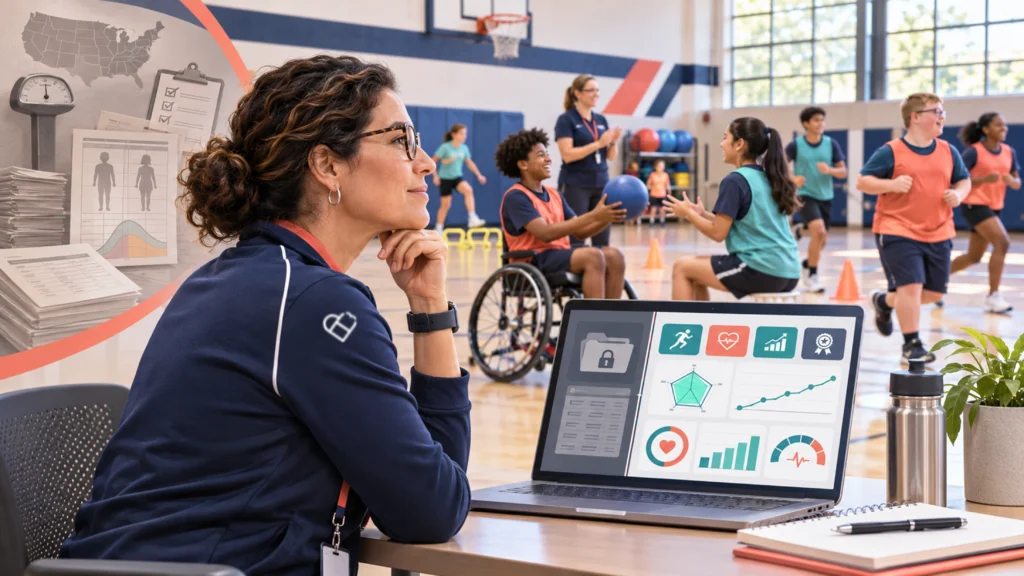
Talk to almost any K–12 physical education teacher today, and they will tell you the same thing: tracking a student’s Body Mass Index (BMI) as a graded metric is a relic of the past. The pedagogy has moved on. Educators know that stepping on a scale in the middle of the gymnasium does nothing to build a lifelong love of movement. But there is a glaring disconnect between the gymnasium floor and the statehouse. While teachers have evolved, many state legislatures and legacy reporting systems have not. Across the country, district coordinators find themselves caught in a “compliance trap.” They are forced to navigate outdated state mandates—often tied directly to their funding—that still explicitly require standardized fitness testing batteries heavily weighted toward body composition. How do PE departments stay compliant with the law without compromising the psychological well-being of their students? The Science vs. The Statute To understand the friction, we have to look at the data. A review of the 2026 National PE Policy Tracker reveals a patchwork of state mandates. Some states have aggressively modernized their physical education requirements, while others still enforce legacy statutes that mandate traditional fitness testing and body composition reporting. The problem is that these legacy statutes directly contradict modern pediatric sports psychology. When a state mandate forces a district to prioritize body composition, it inadvertently works against the ultimate goal of public health funding: creating active adults. Research consistently shows that hyper-focusing on weight and BMI during adolescence triggers fitness anxiety and disengagement. Instead of inspiring students to move more, forcing compliance on body composition metrics actively decreases the likelihood that those students will participate in recreational physical activity after graduation. The Playbook: Navigating Mandates Ethically If your district is legally required to collect this data, you cannot simply ignore the mandate. However, you can control how that data is collected, stored, and emphasized. Here is a playbook for district coordinators to navigate the compliance trap ethically: 1. Wall Off the Required Data If your state requires body composition reporting, treat that data strictly as a compliance exercise, not an educational one. Isolate it completely from a student’s grade. More importantly, ensure your software infrastructure supports strict data isolation. Collecting sensitive health metrics requires rigorous adherence to FERPA and SOPPA. The data should be securely aggregated for state reporting and immediately walled off so it does not become a focal point for the student or the teacher. 2. Shift the Spotlight to Process Metrics You may have to report on mandated metrics, but you get to choose what your department celebrates. Shift the instructional spotlight entirely toward process-oriented assessments. Utilize the TGMD-3 to track mastery of fundamental motor skills, and use assessments like the PACER to track progressive cardiovascular effort. When you build your district dashboards, populate them with these growth curves. Prove your program’s efficacy by showing how students are improving their functional movement, rather than how their body composition is changing. 3. Modernize Your Data Collection The biggest hidden cost of legacy state mandates is the administrative burden. Teachers spend hours recording required fitness scores on clipboards, eating into valuable instructional time. By adopting modern data collection tools—such as AI-powered paper scanners that instantly digitize scoresheets and automated roster integrations—departments can fulfill state reporting requirements in a fraction of the time. Compliance Without Compromise Physical education departments should not have to choose between securing their state funding and protecting their students’ mental health. By understanding the policy landscape, strictly isolating sensitive data, and focusing daily instruction on effort and skill rather than arbitrary physical metrics, district coordinators can successfully navigate the compliance trap. It is possible to check the state’s boxes while still building a gym environment where every student feels empowered to move.
Student Engagement in PE: How to Beat the November Slump
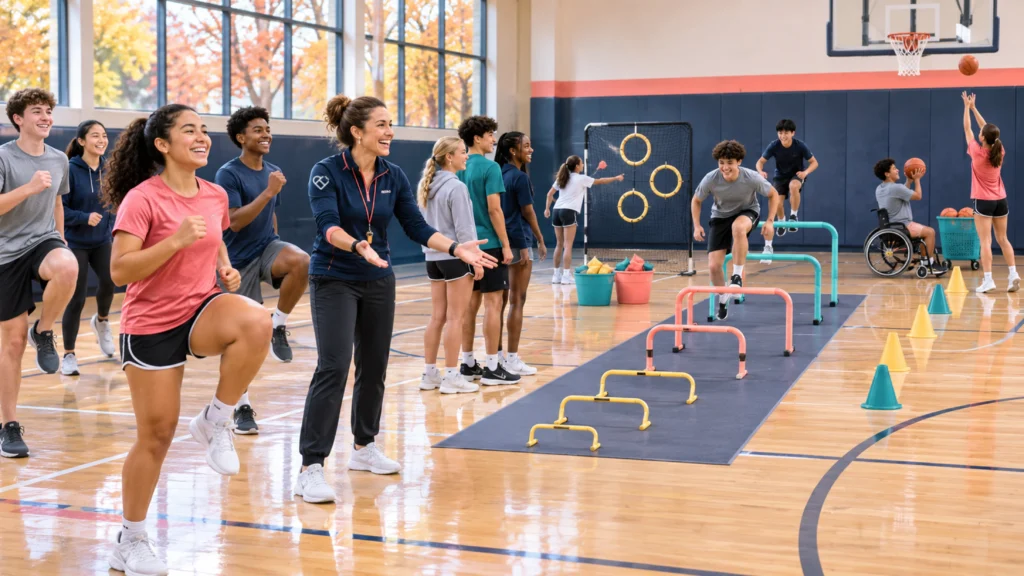
When students seem less enthusiastic about physical education in November, start with three practical adjustments: make it easy to begin moving, offer achievable challenges, and give students meaningful choices. These strategies address classroom routines and motivational needs rather than treating low participation as a problem that simply requires more pressure.psycnet.apa+1 You may recognize the scene: students take longer to get started, familiar activities receive a lukewarm response, and keeping everyone involved requires more prompting than it did in September. Calling this the “November slump” can describe what you notice in your gym. It is not, however, a scientifically established decline that affects every class. Research documents seasonal differences in children’s physical activity, but those patterns vary by age and setting. One large study found seasonal differences among nine-year-olds but not among fifteen-year-olds.pubmed.ncbi.nlm.nih That distinction matters. Instead of assuming the calendar explains disengagement, focus on what you can adjust: how students enter the lesson, how they experience the challenge, and how much ownership they have over participation. The aim is engagement—not simply a louder or busier gym, but students taking part in purposeful movement and making progress toward the learning goal. 1. Make the First Few Minutes Easy to Enter When a class is slow to get started, a familiar movement task gives students a clear first step. Instant activities are short tasks students can begin with minimal instruction. SPARK recommends using familiar opening activities to get students moving and reduce management time once the routine is established.sparkpe Try a Familiar Activity With a Small Twist Choose an opening task students already understand, then change one feature to keep it interesting: These are suggested classroom applications, not individually tested solutions to a seasonal slump. Keep the activity appropriate for your students, available space, and safety procedures. Keep the Opening Connected to the Lesson Use the starter to rehearse something students will need later. If the lesson focuses on passing and moving, begin with partner passing that includes repositioning after each attempt. If the objective is pacing, start with a simple movement task in which students practice selecting and maintaining an appropriate pace. The planning question is straightforward: “Can students begin this task without waiting for a long explanation?” An instant activity should create a clear entry into learning—not become an unrelated game that requires another lengthy transition. 2. Keep the Learning Goal, Adjust the Challenge A student who hesitates to participate may need a more accessible starting point, not a different learning objective. Research on motivation in PE consistently highlights competence: students’ sense that they can act effectively and make progress. A meta-analysis drawing on 265 studies found that satisfaction of competence, autonomy, and relatedness was strongly associated with autonomous motivation—participating through interest or personal value rather than external pressure alone.psycnet.apa For lesson planning, that provides a useful principle: preserve the objective while offering more than one level of challenge. Build a Starting Point and a Progression For example: Learning objective Accessible starting point Optional progression Improve passing accuracy Pass over a shorter distance with suitable equipment Increase distance or add movement Maintain control while dribbling Practice in an open space at a manageable pace Add direction changes or passive opposition Practice sustained movement Select a manageable pace within the task Adjust pace or duration while maintaining control Apply a tactical skill Practice in a simplified small-sided game Add a tactical condition or greater opposition These options are practical examples of applying competence-supportive teaching, not a validated intervention package. Recognize Specific Progress Make feedback about what students did and what they can try next: A recent umbrella review of school-based motivation interventions identified autonomy support, competence development, and positive feedback as recurring features of approaches that improved motivational outcomes.link.springer The point is not to make every task easy. It is to give students a credible route into the challenge and a clear way to progress. 3. Give Students Meaningful Choices When lessons feel repetitive, offer students some influence over how they work toward the objective. Research supports autonomy-supportive teaching in PE. Autonomy means experiencing a sense of ownership or willingness; it does not mean removing structure or allowing students to opt out of learning. Reviews connect support for autonomy, competence, and relatedness with stronger student motivation.psycnet.apa+1 Offer Two Routes to the Same Goal For a lesson on maintaining possession, students might practice through: For an individual skill lesson, students might choose: Keep the objective and success criteria visible. Students should understand what they are learning regardless of the option they select. Make the Choice Real—and Manageable A useful choice changes something students experience, while remaining workable for you. “Choose your starting distance, then move back when you meet the accuracy target” gives students a concrete decision within a clear structure. You do not need six stations or separate lesson plans for every student. Two carefully designed options can provide a practical starting point for applying autonomy-supportive principles. The number of options is a planning decision, not a research-established formula.psycnet.apa Put the Three Strategies Into One Lesson The following example shows how the strategies can work together without adding a separate recovery lesson or unrelated seasonal activity. Example: Passing and Moving to Create Space Learning objective: Students practice moving into an available space after passing. This is an illustrative lesson structure. It applies research-informed principles of competence and autonomy alongside an established instant-activity approach; it has not been tested as a specific “November slump” intervention.psycnet.apa+1 Check Whether Participation Is Improving Use a few simple observations to decide whether the changes are helping your class: These are informal classroom checks, not a validated engagement scale. Look for patterns across several lessons rather than judging the approach from one unusually energetic or difficult day. Keep the monitoring manageable: choose one or two indicators, make a brief note after class, and use that information to adjust the next lesson. Frequently Asked Questions Is the November slump in PE a proven phenomenon? No universal, month-specific drop in PE motivation is established by the evidence cited
Are Students Taking Anything From PE Into Their Everyday Lives?
Students practiced the skill. They participated in the activity. They understood the rules. Now comes a different question: Where could they use what they learned? The answer does not need to be another organized game. A lesson might help a student join a neighborhood activity, modify a game for a younger sibling, choose a manageable pace, or find something enjoyable to do with a friend. Making real-world connections in PE means designing lessons with those possibilities in mind. It does not require homework, daily activity logs, or a new program. It requires making the connection explicit: helping students see how a skill, strategy, or experience could be useful when the teacher, equipment cart, and full class are no longer there. What are real-world connections in PE? Real-world connections in PE show students how classroom learning can apply to everyday movement, recreation, and independent participation. Examples include adapting a game for fewer players, choosing an appropriate challenge, organizing an activity with friends, or recognizing an activity they would enjoy doing again. The central idea is application. Students should have opportunities not only to perform an activity, but also to understand what they could do with it. What does the research support? Research on physical activity interventions supports including strategies such as goal setting, action planning, self-monitoring, feedback, and problem solving. These strategies can help frame lessons that ask students to make choices and consider practical next steps.pmc.ncbi.nlm.nih However, the evidence does not justify promising that a real-world example at the end of a lesson will automatically increase activity outside school. A systematic review of school-based interventions for adolescents ages 15–19 found short-term improvements in seven of ten included trials, but those improvements were not sustained at longer follow-ups. The programs also combined multiple components, making individual effects difficult to isolate.pmc.ncbi.nlm.nih A separate review identified action planning, self-monitoring, and problem solving as potentially promising techniques for maintaining healthier behaviors in adolescents, while emphasizing that the evidence was preliminary.tandfonline The strategies below are practical teaching applications informed by those ideas—not a research-tested package or a guarantee of behavior change. 1. Give every lesson a real-world purpose When planning a lesson, complete this sentence: “Outside this class, students could use this learning to…” Make the answer specific enough to explain to students. “Stay healthy” is a broad aspiration. “Adjust a walking pace so you can keep moving comfortably with someone else” identifies something students can actually use. Lesson focus Possible real-world application Throwing and catching Play a simple game with a friend or sibling Pacing Choose a manageable effort during walking, wheeling, cycling, or another activity Dance Create or follow a short movement sequence at home Balance Design an appropriate balance challenge in an available space Cooperative games Organize an activity that includes people with different skills Strength exercises Select an appropriate version of a movement and perform it with control Not every lesson needs a separate application activity. Sometimes one clear explanation is enough. The planning check is simple: If the only application is “students can do this again in PE,” consider whether the connection could be clearer. 2. Teach an everyday version—not only the full-class version A game that works with a gym, specialized equipment, and 24 classmates may not translate easily to an afternoon with one friend. Show students a smaller version. For example: Then ask: “What would you change if you had fewer people, less space, or different equipment?” Students can practice making those decisions during class. They do not need an outside-school assignment to explore how an activity could work elsewhere. Keep adaptations appropriate to the setting, available equipment, and students’ needs. 3. Let students practice organizing the activity Following directions and organizing an activity are different tasks. Build short opportunities for students to decide: For example, give a small group a familiar activity and ask: “You have four people and one ball. Set up a version everyone can join.” The goal is not to withdraw instruction. Provide a clear structure, observe, and help students revise decisions that make the activity confusing, unsafe, or exclusionary. This gives the real-world connection something concrete: students practice the decisions that would otherwise be made for them. 4. Make student choice part of the learning Instead of limiting choice to “Which station do you want?”, ask students to explain what makes an option suitable. Possible choices include: Follow with a brief question: “What made that a good choice for you today?” This is not a test with one correct preference. A student might choose an activity because it is familiar, social, challenging, or manageable. The practical aim is to help students recognize reasons they might choose movement independently—not simply comply with the activity selected for them. 5. Teach students how to adjust the challenge An everyday activity will not always arrive at the right difficulty. Give students a small set of adjustments they can use: During a lesson, ask students to try an adjustment and explain its effect. “What change made this challenging enough to practice without making it unmanageable?” That question connects skill learning with a decision students could make elsewhere. It also gives them an alternative to the all-or-nothing choice of continuing unchanged or stopping. 6. Use realistic “what if?” problems Real-world connections become more useful when they acknowledge that conditions are rarely perfect. Offer a brief scenario: “You want to play, but only one other person is available.” Or: “You have less space than we used today.” Ask students to suggest and, where appropriate, test an alternative. Other scenarios might include: Problem solving and action planning appear in adolescent behavior-change research, although evidence for maintaining changes remains preliminary. These classroom scenarios offer one practical way to explore those processes.tandfonline Avoid presenting every barrier as something students should solve themselves. Some circumstances require adult support, accessible facilities, or opportunities that are not currently available. 7. Connect lessons with opportunities students can actually access When discussing activities beyond school, avoid assuming that every student has a yard, transportation, paid lessons, or
Beyond the Rep: Teaching Strength in K–12 PE
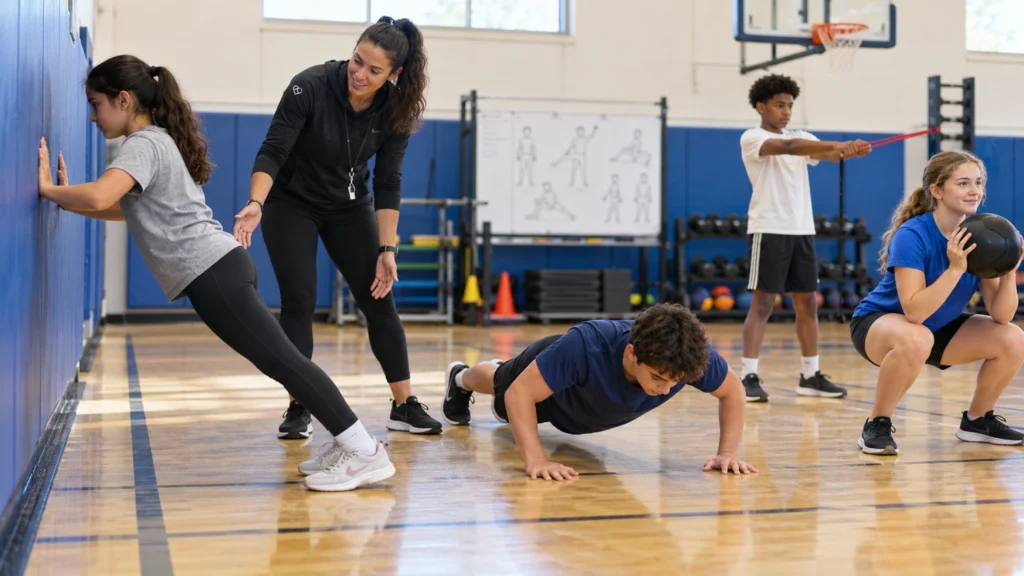
Teaching strength in K–12 PE is not about seeing who can lift the most. It is about helping students move with control, choose appropriate challenges, and understand how to build strength safely. A student finishes ten push-ups. Another completes five against a wall. Which student learned more? The repetition count cannot tell us. We would need to know whether each student understood the movement, selected an appropriate challenge, used feedback, and recognized when to stop. That is the case for strength training education in PE. The goal is not simply to make students exercise harder. It is to teach them how to build strength safely, understand their bodies, and make informed decisions about physical activity. Research supports that approach. The American Academy of Pediatrics’ 2020 clinical report describes youth resistance training as a worthwhile part of school physical education when qualified instruction, appropriate supervision, and technique-driven progression guide participation. Strength training can include bodyweight movements, resistance bands, and other suitable equipment—not just lifting weights.ncys The most important word is education. What Is Strength Training Education in PE? Strength training education in PE teaches students how muscles work against resistance and how to participate safely and effectively. Resistance can come from their own body weight, elastic bands, free weights, or other appropriate equipment.ncys An educational approach goes beyond assigning squats, push-ups, or a circuit. Students learn to: These are proposed learning goals, not a requirement to turn every PE lesson into a weight-room session. A student who can explain why a wall push-up is the right starting point has learned something useful. So has a student who chooses a lighter resistance because the heavier option changes their technique. What Does the Science Say About Youth Strength Training? Children can gain strength before puberty The idea that strength training offers little benefit until adolescence is not supported by the evidence summarized in the AAP report. Children can increase strength before puberty. Early improvements occur largely through neurological adaptations: the nervous system becomes better at recruiting and coordinating the muscles needed for a task. Strength gains do not require large increases in muscle size.ncys For PE teachers, this distinction matters. A strength lesson does not need to pursue bigger muscles to have value. Learning to produce and control force is a meaningful outcome. Appropriately designed training has not been shown to stunt growth Concern about growth plates has shaped many conversations about children and weights. However, the AAP’s review reports that appropriately designed resistance training has no apparent negative effect on linear growth or growth-plate health.ncys That does not mean every exercise, load, or training environment is appropriate. It means the useful question is not, “Are children allowed to strength train?” It is, “Is this activity appropriate for these students, with the instruction and supervision available?” Safety depends on how the program is taught Research summarized by the AAP supports low injury rates in well-supervised youth resistance training that emphasizes correct technique. Poor supervision, inappropriate increases in training load, and unsafe equipment use remain important concerns.ncys “Strength training is safe” is therefore an incomplete message. A more accurate message is: youth strength training can be safe and effective when the program matches students’ abilities and qualified adults teach, supervise, and progress it appropriately.ncys Why Strength Training Education Belongs in PE—not Just Athletics School athletics reaches students who join teams. Physical education has a broader responsibility. The AAP report explicitly discusses resistance training for nonathletes as well as athletes and identifies benefits extending beyond sports performance, including muscular fitness, motor skill development, and physical literacy.ncys That gives PE a different purpose from a competitive strength program. Students do not need to pursue a lifting record to benefit from understanding resistance exercise. They need opportunities to learn what a manageable challenge feels like, how to improve a movement, and how to make responsible choices. Strength training education in PE should therefore be organized around access and learning: The curriculum question is not, “Who is strongest?” It is, “What should every student understand about developing strength?” Strength Training Can Support Confidence—Without Making Appearance the Goal Strength training offers students a concrete way to notice improvement: a movement becomes more controlled, a previously difficult exercise becomes manageable, or a student learns to use unfamiliar equipment. There is research behind the confidence connection. A 2019 systematic review by Collins and colleagues included seven studies involving young people ages 10–16. Its meta-analysis found improvements in resistance-training self-efficacy—confidence in performing resistance training—as well as perceived strength, physical self-worth, and global self-worth.pmc.ncbi.nlm.nih The findings need perspective. Only four studies contributed to the pooled analysis, study quality varied, and the review did not find clear improvements in every outcome, including perceived sport competence or body attractiveness.pmc.ncbi.nlm.nih The practical implication is not that a strength unit will automatically transform every student’s confidence. It is that strength training can provide opportunities to develop confidence in a specific, learnable activity. Teachers can build lessons around evidence students can recognize: “I can choose a variation that works for me.” “I know how to use feedback.” “I can explain when I am ready for a harder challenge.” That is a more useful educational target than asking students to judge their bodies in the mirror. How Strength Training Connects to Lifelong Physical Literacy Physical literacy involves moving with confidence and competence across activities and environments. The AAP identifies resistance training as one component of a broader approach to developing that capacity.ncys In PE, that connection becomes practical when students learn more than an exercise sequence. Consider two outcomes: The second outcome is knowledge the student can apply elsewhere. However, lifelong participation should remain a goal—not an outcome schools promise from a short unit. Research supporting improvements in strength or confidence does not establish that a few PE lessons will produce lifelong exercise habits. The educational opportunity is to give students skills and understanding they can carry forward. What Should Strength Training Look Like Across K–12? The following progression is a curriculum example informed by youth resistance-training principles,
Why Students Need to Experience Productive Struggle in PE
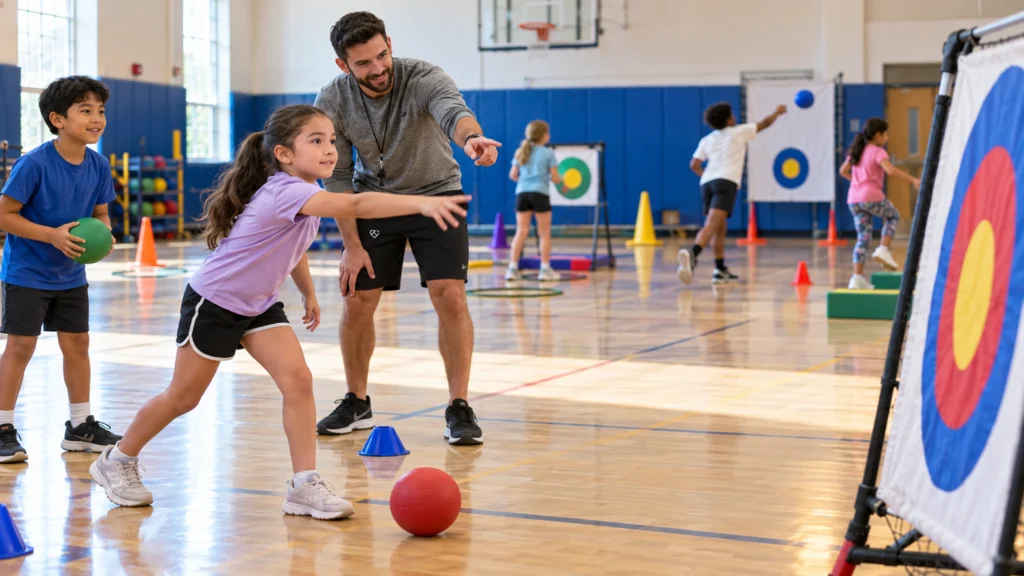
A student misses the catch, retrieves the ball, and tries again. Another misses the catch, looks around to see who noticed, and stops participating. Both students experienced difficulty. Only one is still in a position to learn from it. That difference matters. Productive struggle in PE is not about making activities harder or asking students to tolerate repeated failure. It means giving students a meaningful challenge, a realistic way forward, and enough support to make progress. Motor-learning research and research on student motivation support that combination—not difficulty for its own sake.pubmed.ncbi.nlm.nih+1 The goal is progress, not struggle. What Is Productive Struggle in PE? Productive struggle in PE is a manageable learning challenge in which students can attempt a movement skill, notice what happened, adjust their approach, and try again with appropriate support. For example, a student learning to throw accurately might miss a target, receive a useful cue, move closer, and begin making more controlled throws. The skill still requires effort, but the student has something specific to work on. This approach fits the challenge point framework developed by motor-learning researchers Mark Guadagnoli and Timothy Lee. Their central idea is that the same task presents different challenges to learners with different abilities. A task’s learning value depends on the interaction between its difficulty, the learner’s skill, and the information available during practice.pubmed.ncbi.nlm.nih A basketball pass across the gym might be routine for one student and overwhelming for another. Giving everyone the same task does not give everyone the same learning opportunity. Why Supported Challenge Helps Students Learn 1. Challenge gives students something useful to solve When students already perform a task comfortably, repeating it may serve a purpose—but it may offer little new information. When the task is far beyond their current ability, they may struggle to understand what to change. The challenge point framework proposes that useful practice sits between those extremes: students encounter enough difficulty to learn, without receiving more information than they can interpret and use. It is a framework for designing practice, not a formula that identifies one perfect difficulty level for every student. In PE, that means adjusting the task rather than simply demanding more effort: These are practical applications of the framework. The question is not, “How hard can I make this?” It is, “What challenge can this student learn from?” 2. Confidence grows from evidence of improvement Encouragement matters, but students also need evidence that their actions can produce success. Psychologist Albert Bandura’s self-efficacy theory describes how people develop beliefs about their ability to complete particular tasks. Successful experiences—often called mastery experiences—are an especially influential source of those beliefs. Repeated failure, particularly before confidence is established, can have the opposite effect. That helps explain why supported struggle can build confidence while unsupported struggle can undermine it. Consider a student learning to jump rope. Asking for 20 consecutive jumps immediately may produce repeated failure. Beginning with a single controlled jump, then linking two or three, gives the student a way to experience improvement while still working toward a challenging skill. The useful message is not, “You succeeded because you are naturally athletic.” It is: “You changed your timing, and that helped you clear the rope.” The student now has a reason to believe that a strategy—not luck—can improve the next attempt. 3. Motivation depends on how students experience the challenge Students are not more motivated simply because an activity is difficult. A systematic review and meta-analysis of 265 studies in school physical education found that satisfaction of students’ needs for autonomy, competence, and relatedness was strongly associated with autonomous motivation: participating because an activity feels interesting or personally valuable.findresearcher.sdu For PE teachers, those needs translate into three useful questions: A challenging activity can support these needs when students can select an appropriate starting level, understand the goal, and receive respectful help. Difficulty without those conditions is not the same instructional experience. The evidence supports need-supportive teaching, not the claim that harder tasks automatically increase motivation.findresearcher.sdu 4. Challenge creates opportunities to practice resilience-related skills A missed shot or an unsuccessful balance attempt can become an opportunity to practice responding to a setback: These are useful teaching opportunities, but teachers should avoid overstating the research. A difficult PE lesson does not automatically create lasting resilience or transfer coping skills into every area of a student’s life. Research on the Teaching Personal and Social Responsibility model treats effort, self-direction, supportive relationships, and transfer beyond PE as explicit instructional goals. The implication is important: teachers need to teach and discuss these skills, not assume that physical activity or struggle will develop them on its own.zaguan.unizar Productive Struggle vs. Discouraging Overload A missed attempt does not automatically mean the activity is too difficult. A completed task does not necessarily mean the student felt safe or learned something. The distinction is whether the student still has an accessible route forward. The following table is a practical observation guide informed by motor-learning and motivation research—not a validated diagnostic checklist. What to observe Productive struggle Possible discouraging overload Understanding The student knows the goal and can identify a next step. The student remains confused about what to do or change. Attempts The student tries again and experiments with an adjustment. Attempts become random, rushed, or stop altogether. Feedback The student can use a cue or demonstration. Additional instructions do not help the student act. Progress There are signs of better control, understanding, or consistency. Repeated attempts show no usable progress despite support. Emotional response Frustration occurs, but the student can recover with support. Distress, embarrassment, or withdrawal persists. Student voice The student can explain what feels difficult. The student reports that the task feels impossible, unsafe, or humiliating. Do not treat these observations as labels. A student who withdraws may need clearer directions, an equipment adjustment, less public attention, or a different way to access the activity—not a lecture about persistence. Ask a specific question: “Is the hardest part controlling the ball, understanding the task, or doing it while others watch?”
Why Your PE Class Keeps Stopping—and What to Do Instead.
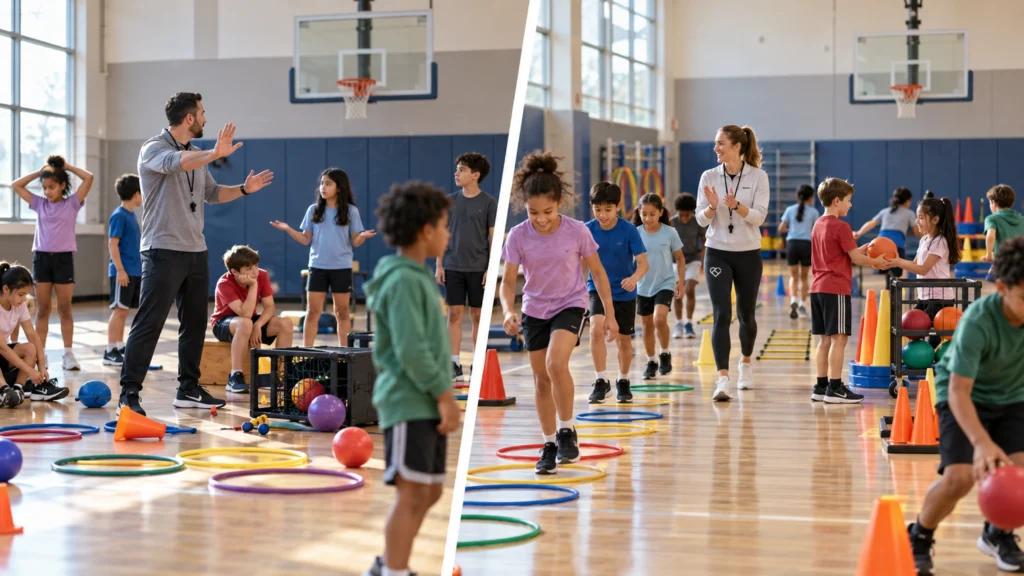
You planned 30 minutes of PE. But students need multiple reminders to enter safely, stop when the signal sounds, listen to directions, share equipment, or transition to the next activity. Before long, a lesson designed to get students moving has turned into a series of stops, corrections, and restarts. If your PE class is losing minutes, the answer is not necessarily to become louder or stricter. The solution is to teach the routines that make active learning possible—then give students enough opportunities to practice them until they become automatic. Whether you teach kindergarten, elementary PE, middle school physical education, or a mixed-grade class, the same truth applies: class management is part of instruction. Students cannot fully participate in a game, skill practice, fitness activity, or station lesson until they know how to enter the space, respond to a signal, handle equipment, transition, work with peers, clean up, and rejoin instruction. This guide explains evidence-based PE classroom management strategies that help teachers protect instructional time without turning physical education into a constant cycle of corrections and consequences. Why PE Classroom Management Is Different Every teacher manages behavior. Physical education teachers manage behavior while students are moving, sharing equipment, navigating space, talking with peers, and making quick decisions. That is especially challenging when PE takes place: In a traditional classroom, students may stay seated in defined locations. In PE, students are expected to move. The goal is not silence or stillness. The goal is safe, purposeful, and increasingly independent movement. That requires a different mindset. The question is not, “How do I make students perfectly quiet?” The question is, “How do I build routines that allow students to move safely, listen briefly, transition efficiently, and stay engaged?” Evidence-based classroom-management frameworks emphasize establishing predictable structure, explicitly teaching expectations, actively supervising students, reinforcing appropriate behavior, and responding to errors in a calm and planned way.dropoutprevention+1 Treat Routines as Skills to Teach Many PE behavior problems are actually routine problems. A student may know that they are supposed to freeze when they hear a whistle. But knowing the rule and performing it successfully are different things. Can the student stop while dribbling a basketball? Can they stop while talking with a friend? Can they stop when excited about a game? Can they stop outdoors, with distractions happening across the field? Those are skills that need to be modeled, practiced, reinforced, and retaught. Instead of assuming students understand expectations after hearing them once, directly teach the procedures that determine whether PE runs smoothly. Essential PE routines to teach Focus first on the routines that protect the most activity time: Use a small number of positively stated expectations that work across every activity and setting. For example: Then define what those expectations look like during the actual routines students perform. PE routine “Be safe” looks like “Be ready” looks like “Be respectful” looks like Stop signal Freeze body and control equipment Eyes on teacher or signal Give others space to stop Transition Walk in the designated area Move directly to the next spot Keep hands and equipment to self Partner work Use equipment safely Stay with assigned partner Take turns and use encouraging words Cleanup Carry equipment safely Put equipment in the correct place Help without grabbing or pushing Research-based PBIS guidance recommends defining a small number of positively stated expectations, explicitly teaching those expectations in the settings where students must use them, and providing continuous reteaching and reinforcement.dropoutprevention+1 Stop Talking So Students Can Move Long explanations are one of the fastest ways to lose a PE class. This does not mean teachers should skip instruction. It means instruction must match the setting, activity, and students’ developmental readiness. Young students—and many older students during highly stimulating activities—often struggle to retain a long sequence of directions before they have a chance to move. A more effective structure is: For example, instead of explaining every detail of a dribbling game before students receive a ball, begin with the simplest action: “Find your own space. Dribble below your waist. Keep your eyes up.” After students have moved for a short period, add the next expectation: “When you hear the whistle, freeze your body, stop the ball, and look at me.” Then practice it. This approach turns listening from a passive demand into an active skill. Students hear a direction, show they understand it, receive feedback, and try again. Keep directions short and visible For many PE activities, students need only three pieces of information before they begin: If students need to remember more than that, consider whether the activity is too complex for the group right now—or whether the directions can be taught in stages. A simpler activity with high participation is usually more valuable than a complicated game that requires constant stopping, clarifying, and redirecting. Practice Procedures Without Turning PE Into Punishment When a class cannot transition, stop safely, or listen long enough for directions, it is reasonable to pause and reteach. That is not wasted time. It is an investment in future activity time. The key is to make reteaching short, specific, and active. Avoid: “You are not listening. We have talked about this a hundred times. Sit down until everyone can behave.” Try: “We need to practice our stop signal again. When you hear one whistle, freeze your body, make your equipment still, and look this way. Let’s show it in five seconds.” Then let students try again. Use “do-over” practice A do-over is not a punishment. It is simply another chance to perform a routine correctly. Examples include: The message should be clear: “We practice routines because they help us have more safe time to move.” That wording matters. Students should understand that following routines does not take away PE. It protects PE. Use Active Supervision, Not Distant Supervision PE teachers cannot manage an active class effectively from one fixed location. Active supervision means deliberately moving, scanning, and interacting while students participate. It is especially important in outdoor spaces, cafeterias, playgrounds, shared gyms, and large
When Your PE Lesson Isn’t Working: How to Pivot Without Losing the Goal
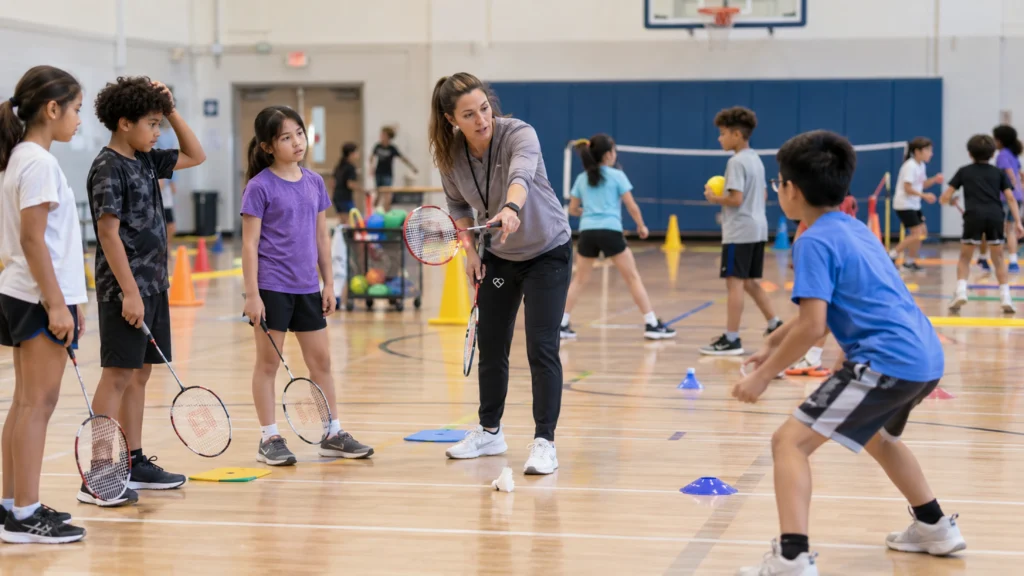
You have the equipment ready. You know how you want to group students. You have a progression in mind and a reasonable estimate of how long each part will take. Then class begins. The directions that seemed clear on paper confuse half the group. Students need another step before they are ready for the game. Or they grasp the skill faster than expected, and the activity you planned for the next fifteen minutes no longer offers much of a challenge. The lesson plan did its job: it helped you prepare. Now the lesson is happening, and you have information you did not have when you wrote it. Good teaching is not following the plan no matter what. It is using the plan’s purpose to decide what to do next. A plan cannot predict every class A lesson plan can account for likely differences in skill, space, equipment, and time. It cannot tell you exactly how students will respond on a particular day. The same activity may work differently across class periods. One group understands a demonstration and gets started. Another needs to see a peer try it first. One class manages a four-person rotation easily; in another, the wait between turns is so long that students lose track of the task. That does not mean planning is pointless. It means the plan is a preparation for teaching, not a script that overrides what you observe. SHAPE America’s instructional guidance calls for PE teachers to adapt lessons for different classes while providing appropriate practice, feedback, inclusion, and safe participation. In other words, responding to the class in front of you is part of teaching the lesson well.shapeamerica Look before you change anything When an activity is not working, it is tempting to call an audible immediately. First, take a moment to identify the problem. Suppose your goal in a badminton lesson is for students to send a shot toward open space. During a modified game, few students appear to be doing it. Why? Those are different problems. They should not all lead to the same adjustment. Watch a few attempts and ask a quick question: “Where were you trying to send it?” You do not need to stop the whole class for a formal assessment. You need enough evidence to choose a useful next step. This is the practical value of formative assessment. Research with PE teachers describes it as clarifying the learning goal, gathering evidence of where students are, and responding in ways that help them move forward. The researchers also found that using that evidence to adjust instruction is challenging—which is a good reason to keep the process simple.journals.sagepub Change what is getting in the way Once you know what the obstacle is, make the smallest useful adjustment. If students need more support: Simplify the task without abandoning the goal. In badminton, a partner feed and a clear target may help students practice placement before returning to gameplay. If students are ready for more: Add a decision, not just more repetitions. Students who can direct a shot toward one target might choose between two areas based on where a partner is positioned. If groups are not working: Change the organization. Smaller groups, clearer roles, or a simpler rotation may give students more chances to practice. If directions are not landing: Pause briefly and show the task. One demonstration and one cue can be more useful than repeating a long explanation. If time is running short: Decide which part of the lesson best serves today’s goal. It is usually better to give students a meaningful chance to apply the skill than to rush through every activity on the page. If space or equipment changes: Adapt the task to what is available, but check spacing, supervision, participation, and required accommodations before restarting. The point is not to have a clever backup game for every situation. It is to understand which condition is preventing learning and adjust that condition. SHAPE America’s guidance emphasizes active practice, appropriate grouping, safe instruction, and inclusion—all useful checks when making a change on the fly.shapeamerica Keep asking what students are learning A class can look busy even when the original learning goal has disappeared. If the badminton goal is to recognize and use open space, switching to an unrelated activity may solve a management problem but leave that goal behind. A smaller court, a controlled feed, or a modified rule might give students a better way to work on it. Ask yourself: Does this adjustment give students a better chance to learn what I intended? Often, the answer is to keep the goal and change the route. But that is not an absolute rule. If the space becomes unsafe or circumstances make the original task unworkable, change course. The goal helps you make a deliberate decision; it should never trap you in a bad one. Prepare a few pivots, not another eight pages Experienced teachers often seem able to adjust instantly because they recognize patterns: This group needs a shorter explanation. That task needs an easier entry point. This rotation is about to fall apart. You can build that kind of readiness without writing an exhaustive plan. For each lesson, consider four questions: A few notes might be enough: Goal: Send a badminton shot toward open space.Watch for: Students choose a target area when given a playable feed.If too hard: Use partner feeds and one visible target.If too easy: Offer two targets and ask students to choose.If groups stall: Switch to pairs with clear hitter and feeder roles. Teachers in a primary PE study reported that assessment connected to clear learning intentions helped their planning and feedback. They also described the burden of excessive paperwork and the importance of keeping students moving. The useful question is not “How much detail can I add to the plan?” It is “What information will help me teach?”dcu Let one class improve the next If you teach multiple sections, a quick note after class can save you from relearning the
Why Making PE Assessment Optional Hurts Students
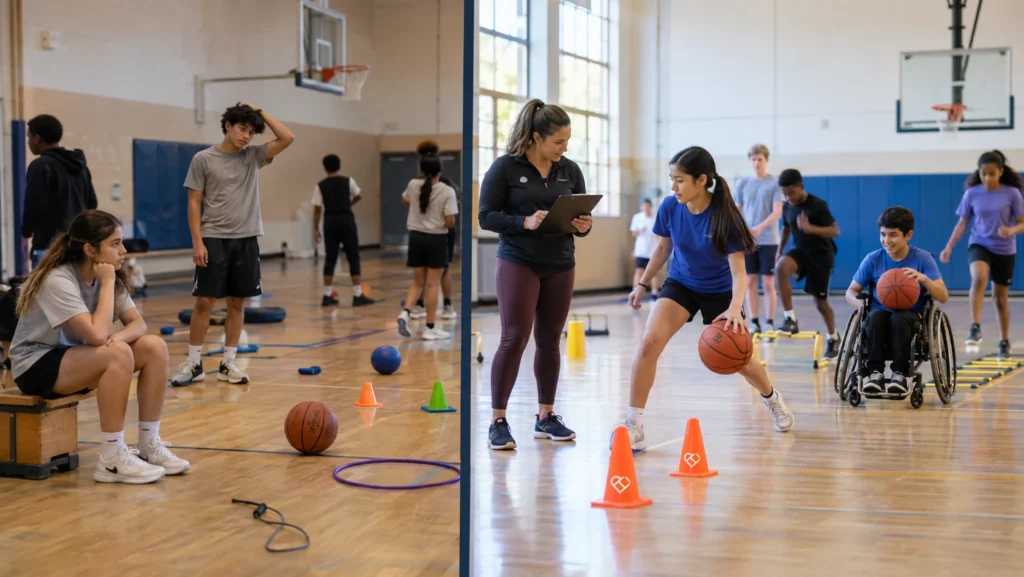
Physical education assessment should not be optional. When states or districts remove the expectation to assess student learning in PE, they may intend to reduce testing pressure or protect instructional time—but the practical result is often less equitable, less effective physical education for the students who need it most. The answer is not to return to public fitness rankings, one-size-fits-all performance tests, or grading students on athletic ability. The better approach is meaningful, developmentally appropriate, standards-based assessment that helps teachers understand what students are learning, identify barriers, provide feedback, and improve instruction. National PE Policy Tracker 2026 PE is a subject where students learn movement skills, fitness knowledge, safety practices, personal goal-setting, cooperation, and lifelong activity habits. If schools say those outcomes matter, they must also have a responsible way to determine whether students are actually learning them. Assessment Is Part of Teaching Assessment is often misunderstood as a final test, a fitness score, or a grade in a digital gradebook. In high-quality physical education, it is much broader. Assessment is the process of gathering evidence about student learning so teachers and students can make better decisions. It can include: The key distinction is this: assessment is not the same as high-stakes testing. A well-designed assessment system supports learning; it does not shame students, sort them by natural ability, or reduce PE to a single fitness number. SHAPE America’s National Physical Education Standards describe PE as a subject in which students develop motor skills, apply movement and fitness knowledge, build social skills through movement, and develop personal skills, goal-setting, reflection, and motivation for lifelong activity. Those are learnable outcomes—and they require evidence of learning.shapeamerica What Happens When PE Assessment Becomes Optional? When a district treats assessment as optional, inconsistent implementation becomes predictable. Some teachers may continue to assess regularly and thoughtfully. Others, often working with large classes, limited planning time, inadequate equipment, or little professional development, may have no structure or support to do so. That inconsistency hurts students in several ways. 1. Students Receive Less Useful Feedback Without assessment, students may participate in activities without knowing what they are trying to improve or whether they are improving. Consider two versions of the same volleyball unit: Without meaningful assessment With meaningful assessment Students rotate through drills and games Students know the lesson target: move into position, use a ready stance, and send a controlled pass to a partner Teacher sees who appears athletic Teacher uses a short rubric or observation checklist tied to the skill criteria Feedback is mostly general: “Good job” or “Try harder” Feedback is specific: “Your platform is too narrow; widen it and angle it toward your target” Grades may reflect participation or compliance Students demonstrate growth, explain technique, and set an improvement goal Students who struggle can disappear in the crowd Teacher identifies who needs a modification, extra practice, or different entry point Students deserve feedback that tells them what they can do now, what they are learning next, and how to improve. Eliminating assessment removes one of the main ways PE becomes instruction rather than supervised recreation. Optional Assessment Can Hide Opportunity Gaps Assessment is also an equity issue. Students arrive in PE with very different experiences. One student may have access to private sports leagues, safe parks, equipment, family transportation, and adults who can teach skills outside school. Another may have none of those opportunities. A student with a disability may need adapted equipment, a different task design, or more time to demonstrate learning. An English learner may benefit from visual cues, demonstrations, and multiple ways to respond. If teachers do not assess learning, they have less information about who is being served well and who is being left behind. This does not mean students should be compared against one another or required to reach identical athletic benchmarks. It means every student should have access to instruction, feedback, and evidence-based opportunities to progress from their own starting point. A standards-based approach asks better questions: Without those questions, inequities are easier to overlook—and harder to correct. It Weakens the Case for PE Subjects that are not assessed are often treated as less essential. When schools do not collect credible evidence of PE learning, it becomes harder for teachers and leaders to show: This matters because PE already competes for time, staffing, facilities, and funding. A program that cannot show what students learn is more vulnerable to being shortened, replaced, or treated as a planning-period convenience. Schools are uniquely positioned to help young people build healthy behaviors. The CDC notes that children and adolescents should get 60 minutes or more of physical activity daily, and it identifies schools as an important setting for supporting physical activity, health, focus, and academic outcomes. PE cannot provide all 60 minutes by itself, but it is the one part of the school day specifically designed to teach students the knowledge, skills, confidence, and habits needed to be active beyond class.cdc “Optional” Often Means Unequal A common rationale for making PE assessment optional is flexibility. Districts may want to honor teacher autonomy, avoid burdensome reporting systems, or reduce concerns about fitness testing. Those concerns are legitimate. But making assessment optional is usually the wrong solution. When assessment is optional: Flexibility should exist in how teachers assess, not in whether student learning matters. A district can establish common learning expectations while allowing teachers to choose appropriate tools: skill rubrics, video reflection, teacher observation, student conferences, fitness knowledge checks, goal-setting logs, or performance tasks. The goal is not uniform paperwork. The goal is valid evidence that students are learning. The Real Problem Is Bad Assessment, Not Assessment Itself Critics are right to reject harmful practices. PE assessment becomes damaging when it is used to embarrass students, reward genetics, penalize disability, reinforce body-size stigma, or create public comparisons. For example, grading a student primarily on how fast they run, how many pull-ups they complete, or whether they reach an arbitrary fitness score is not an equitable measure of learning. Those outcomes may be
PE Funding and Resources: Why Neglect Hurts Students
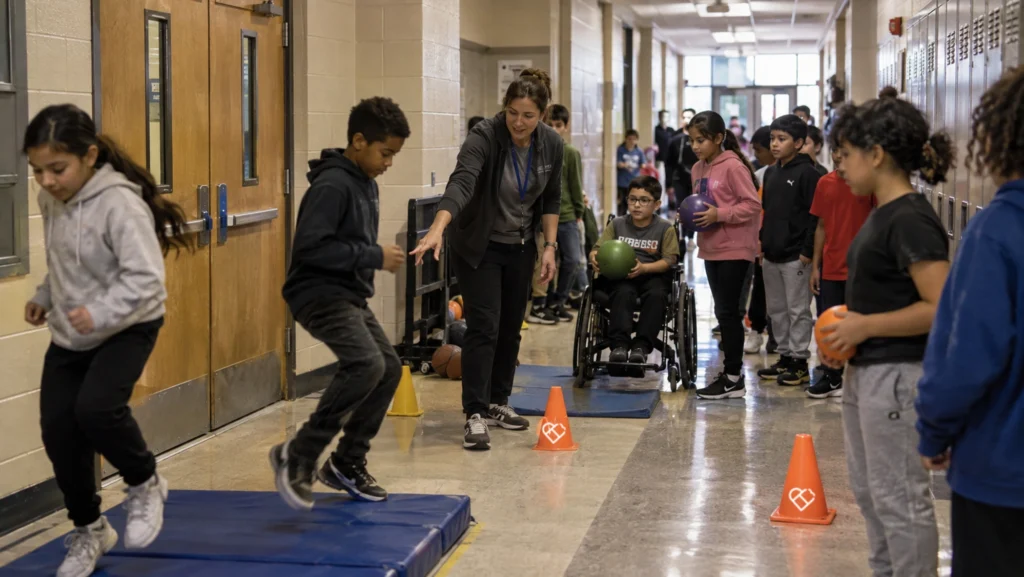
When the gymnasium at one Minnesota school was closed for renovation, the PE teacher didn’t get a backup space. There was no alternative indoor facility. So for an entire school year — plus a month into the next one — classes happened outside. Through snow, rain, thunder, and bitter cold. On indoor days, students squeezed into classrooms, hallways, and stairwells. During testing periods, they had to stay quiet and do silent activities. The gym wasn’t just “shared” with other events — it was gone (SHAPE America, 2022). This is what inadequate PE funding and resources look like in practice. Not always a dramatic crisis — often just a slow erosion of space, equipment, and time that makes quality instruction nearly impossible. And the consequences reach far beyond the gym doors. Quick Answer Inadequate PE funding and resources — broken equipment, no dedicated budget, and shared gym spaces — reduce active learning time, increase off-task behavior, and limit academic benefits. Evidence-based strategies like station-based instruction, protected scheduling, and external grants can help schools mitigate these gaps. PE Funding and Resources: The Scope of the Problem Physical education is required in 83% of countries worldwide. Yet UNESCO calls it a “fringe subject” in many schools, and the PE funding and resources gap is staggering: nearly two-thirds of countries invest less than 2% of their education budgets in PE (UNESCO, 2024). In the U.S., the picture isn’t much better. A national study of K–12 schools found that nearly 30% of schools have no dedicated PE equipment budget at all. Among the schools that do have one, the median is just $500 per year — about $1.30 per student. The researchers didn’t mince words: they called it “a very paltry amount for instructional materials” (ERIC, 2017). A U.S. Government Accountability Office investigation found that officials at 9 of 13 schools visited cited inadequate facilities as a major barrier to teaching PE. Budget cuts in one district had reduced elementary PE to as little as 30 minutes every 2–3 weeks (GAO, 2012). That’s not a program. That’s a token gesture. Broken Equipment Doesn’t Just Slow Things Down — It Changes Behavior Here’s what happens when you don’t have enough gear: kids wait. And when kids wait, they find other things to do. The SHAPE America guide on classroom management in PE is blunt about this. Students who are stationary and waiting start talking, spinning on the floor, touching each other, fiddling with equipment — not because they’re “bad kids,” but because they’re bored and under-stimulated. Inefficient transitions, equipment setup delays, and long lines all feed the same cycle (SHAPE America, 2018). For more on creating evidence-based teaching practices that keep students engaged, check out our guide on PE instructional strategies. The national ERIC study confirms it: lack of adequate equipment was directly associated with management issues and poor student behavior, especially when there wasn’t enough gear for everyone to participate at the same time (ERIC, 2017). But here’s the flip side. When one school received a new curriculum and $3,500 worth of PE equipment, teachers were able to keep students more active, meet their needs better, and generate genuine enthusiasm for PE — from both students and staff. The equipment didn’t solve everything, but it removed a massive barrier (ERIC, 2017). How Much Time Are Kids Actually Moving? Research on PE instructional time is eye-opening. Studies have found that one-third or more of class time is spent on instruction and management tasks — not physical activity. That means in a 40-minute class, kids might be moving for 25 minutes at best, often less (SHAPE America, 2018). When equipment is scarce, that number drops even further. More waiting. Less moving. More behavior issues. Less learning. What About Academics? Some administrators assume that cutting PE time to add more math or reading will boost test scores. The evidence says otherwise. The Institute of Medicine reviewed 14 studies on physical activity during the school day and found that 11 of them showed a positive relationship between physical activity and academic performance. Their conclusion: reducing PE to increase academic instruction “may not have the desired effect” (Institute of Medicine, 2013). At Spooner Middle School, students who got daily outdoor exercise — biking, hiking, cross-country skiing — showed better academic gains, fewer disciplinary problems, and increased classroom attention compared to peers in computer-based interventions. The school repeated the study for two additional years with similar results (SHAPE America, 2024). “We Lost the Gym Again” — When Shared Spaces Steal Instructional Time Every PE teacher knows this one. The gym is booked for a concert. Or an assembly. Or standardized testing. Or construction. Suddenly, your class is in the cafeteria, the hallway, or — if you’re lucky — a stairwell. It’s not a rare occurrence. According to GAO data from 2006, 54.9% of elementary schools used a cafeteria, auditorium, or other multipurpose room for indoor PE. At one school where the gym doubled as the cafeteria, the time needed to set up lunch, serve, and clean up seriously limited PE scheduling (GAO, 2012). An evaluation from Arlington Public Schools found that almost half of elementary teachers lost four to six minutes of instructional time just getting students to and from PE class (Arlington Public Schools, 2023). That’s before any teaching even starts. When PE gets pushed into a hallway or classroom, the lesson doesn’t just shrink — it transforms. You can’t run a soccer unit in a corridor. You can’t do cardiovascular drills between desks. The activity options narrow, and the lesson becomes a management exercise rather than a learning experience. These space constraints also intersect with student behavior and social-emotional learning, as students with fewer movement opportunities often struggle with self-regulation. The Ripple Effect: What Neglect Actually Costs Let’s connect the dots. When PE programs are starved of resources, the impact cascades: Equipment shortages lead to longer wait times, which create the conditions for off-task behavior — not because kids are misbehaving, but because they’re idle (ERIC, 2017; SHAPE
Inclusive Physical Education: How to Teach Extreme Skill Differences
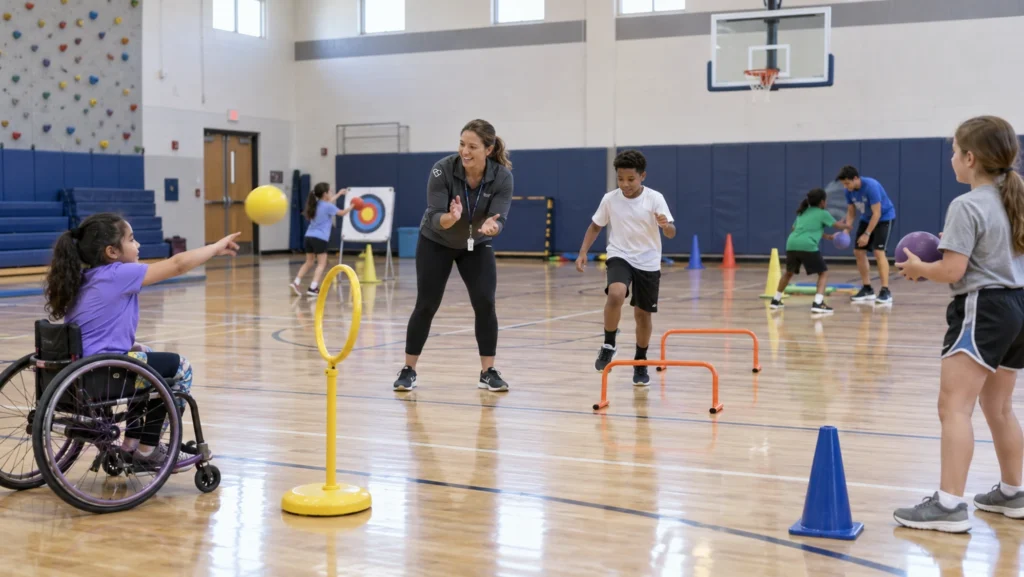
A single physical education class may include a competitive club athlete, a student who is still developing foundational motor skills, a learner with a disability or social-emotional vulnerability, and a student who avoids movement because PE feels embarrassing. The solution is not to create separate lessons for every student. It is to build one shared learning experience with multiple valid entry points, challenge levels, and ways to demonstrate growth. Inclusive physical education means every student has meaningful access to learning, participation, social connection, and progress—not merely a place in the gym. Federal disability protections require equal opportunity in PE and physical activity, while CDC and SHAPE America guidance emphasizes adapting instruction, equipment, environments, rules, and assessment so students can participate alongside peers. The Core Challenge of Mixed-Ability PE Extreme variation in PE is structural, not a sign that a teacher has failed to plan. Students enter class with different: A traditional “one task, one standard, one pace” lesson tends to create predictable problems: Student group What often happens in a uniform lesson What they need instead High-performing athletes They finish early, dominate play, or disengage from repetitive basics Complexity, decision-making, leadership, constraints, and meaningful challenge Students with motor delays or disabilities They wait, fail publicly, receive less practice, or are relegated to peripheral roles Adapted access, sufficient repetitions, appropriate equipment, peer connection, and authentic contribution Social-emotionally vulnerable students They fear mistakes, comparison, elimination, or unwanted attention Psychological safety, predictable routines, choice, private feedback, and self-referenced goals Chronically inactive or disengaged students They opt out, fake participation, avoid games, or experience PE as punishment Early success, relevant options, autonomy, supportive relationships, and nonjudgmental re-entry points The goal is not identical performance. The goal is equitable access to rigorous learning. Every student should work toward the same broad learning intention—for example, “use space to maintain possession” or “send an object accurately to a target”—while using an appropriately challenging version of the task. Use One Objective, Many Entry Points The most effective planning move is to separate the learning target from the task format. For example, instead of planning, “Students will play a 5v5 soccer game,” identify the actual learning goal: “Students will use passing, movement, and space awareness to help their team maintain possession.” Once the objective is clear, create pathways that preserve the learning goal while varying equipment, space, speed, rules, support, or complexity. Build a task progression, not a fixed activity Use a three-level or four-level task design. Avoid labeling groups “advanced,” “average,” or “low.” Use neutral names such as Explore, Build, Apply, and Extend, or let students choose a starting point. Task pathway Example: Passing and receiving lesson Who benefits Explore Pass a larger, softer ball with a partner from a short distance; stop the ball before returning it Students needing more control, reduced speed, or confidence Build Pass and receive while moving through open space; use a defender-free or low-pressure condition Most students developing the skill Apply Play small-sided possession games with constraints such as a three-pass sequence before scoring Students ready to make tactical decisions under pressure Extend Add one-touch options, numerical disadvantage, scanning requirements, weaker-side constraints, or peer-coaching responsibilities Skilled athletes needing cognitive and tactical challenge This approach prevents two common errors: A shared objective with differentiated challenge also aligns with research on mastery-oriented motivational climates. In a mastery climate, success is defined through learning, effort, improvement, collaboration, and self-referenced progress—not outperforming classmates. PE studies associate mastery-oriented teaching approaches with more autonomous motivation and less amotivation. Differentiate the Task, Not the Student’s Worth Differentiation should change the conditions of learning, not communicate that some students are more valued than others. The teacher’s language matters. Avoid: Use: Six high-impact ways to adjust a PE task Teachers do not need a new curriculum for every learner. Start by changing one or two variables: Variable Ways to adapt it Example Equipment Size, weight, texture, bounce, color contrast, grip, sound Use a foam ball, beach ball, yarn ball, bell ball, larger target, or short-handled implement Space Distance, boundaries, traffic, visual cues, surface Shorten the pass, widen a lane, use floor spots, create a quieter practice zone Time Pace, wait time, work-to-rest ratio, transition speed Allow more processing time or increase the tempo for students who need a greater challenge Rules Contacts, scoring, movement restrictions, defensive pressure Permit a bounce, require everyone to touch the ball, use walking defense, or add a decision-making constraint Support Peer partner, visual model, teacher prompt, communication system Provide picture cues, a demonstration, a peer model, or a consistent partner Outcome Distance, accuracy, tactical complexity, movement quality Measure personal accuracy growth rather than a single class-wide performance threshold CDC guidance specifically identifies adaptations to teaching strategies, equipment, environments, and assessments as central to inclusive PE. Design for Participation Before Problems Arise Universal Design for Learning, or UDL, is useful because it shifts planning from retrofitting an activity after a student struggles to proactively offering multiple ways to engage, understand, move, and show learning. In PE, that means providing options in three areas: Multiple ways to engage Students are more likely to participate when they have a meaningful degree of choice and perceive the task as relevant and achievable. Offer bounded choices, not unlimited free choice: Autonomy support in PE is associated with stronger satisfaction of students’ psychological needs, intrinsic motivation, positive emotions, and intentions to remain physically active. An umbrella review of school-based physical-activity interventions similarly found that approaches grounded in self-determination theory—especially those using autonomy-supportive instruction—were effective for strengthening intrinsic motivation, autonomy, and competence. Multiple ways to receive information PE teachers often rely almost entirely on verbal explanation followed by a whole-class demonstration. That format can disadvantage students who need more processing time, visual supports, repeated cues, or a quieter learning environment. Use a combination of: Keep instruction short, then get students moving. Revisit cues during activity rather than turning every correction into another stoppage. Multiple ways to act and show learning A student can understand a tactical concept without demonstrating it through the same motor output as every