
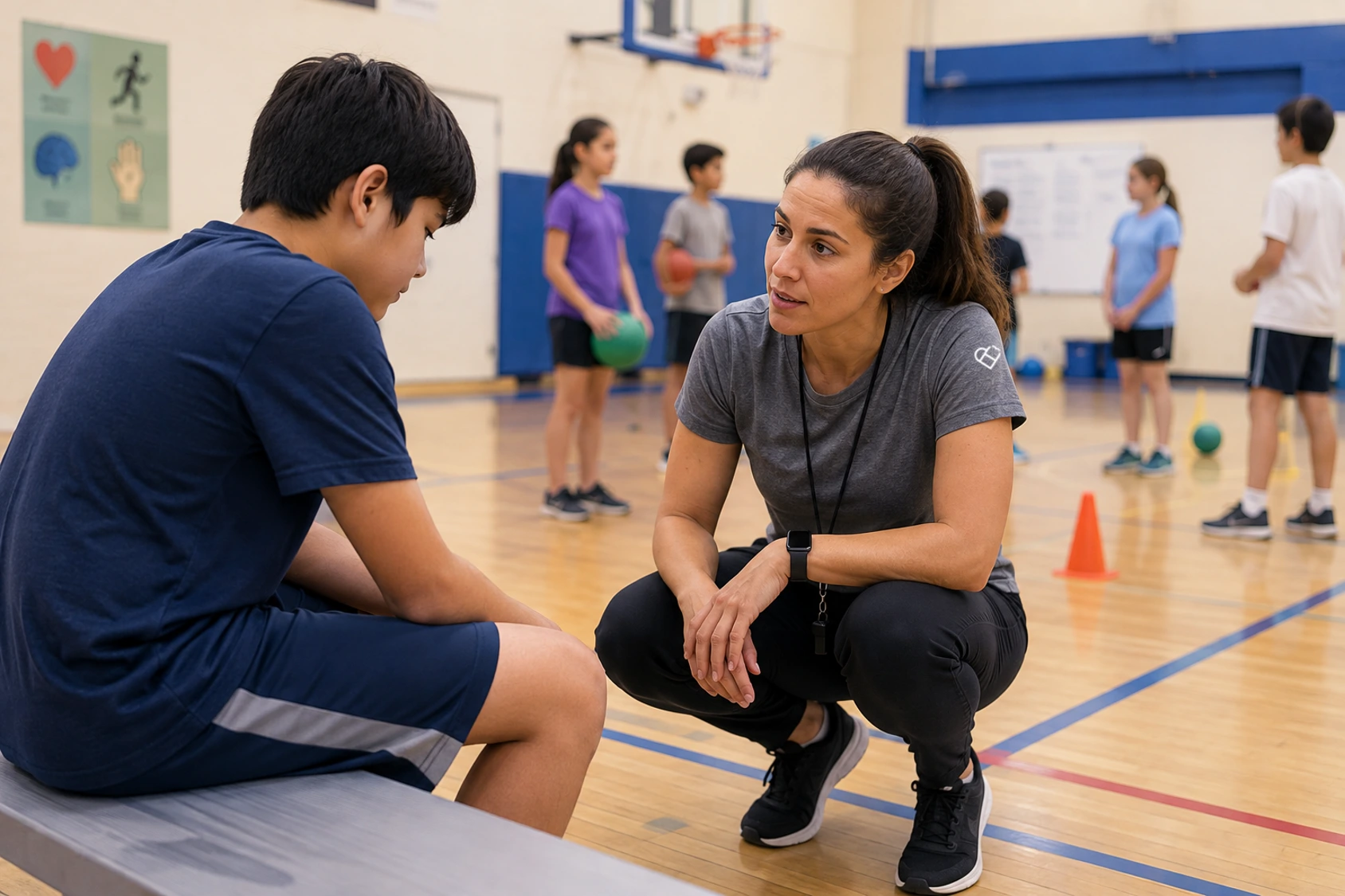
Some students walk into physical education ready to move. Others hang back, avoid eye contact, ask to sit out, joke around, or quietly do the minimum. That early resistance is rarely just “laziness” or defiance.
Student resistance in PE often reflects a perceived threat: the possibility of being embarrassed, exposed as less skilled, judged by peers, or forced to repeat a negative experience from a previous class. PE is unusually public. Students may be asked to perform, sweat, change clothes, compete, and make mistakes in front of classmates—all while navigating a new teacher, new routines, and changing social dynamics.
The first few weeks matter because students quickly form beliefs about whether PE is safe, fair, relevant, and a place where they can succeed. When teachers identify the root causes of resistance early, they can prevent avoidance patterns from becoming entrenched.
Student Resistance Is Often Self-Protection
Resistance can look like refusal, off-task behavior, disengagement, frequent requests for breaks, criticism of activities, or reluctance to try. But behavior is only the visible layer. Underneath it may be anxiety, low perceived competence, uncertainty, social pressure, or memories of prior embarrassment.
Research on students’ experiences in PE finds that stressors can come from the teaching environment, social environment, physical setting, lesson content, and students’ own interpretations shaped by prior experiences. In other words, the same activity may feel energizing to one student and threatening to another.pmc.ncbi.nlm.nih
Rather than asking, “Why won’t this student participate?” a more productive early-year question is:
“What might make participation feel risky for this student right now?”
That shift helps teachers respond with structure, empathy, and instructional design—not assumptions or escalating consequences.
Five Root Causes of Resistance
1. Embarrassment and fear of public failure
PE puts student performance in view. A missed catch, slow run, incorrect dance step, or difficulty with a movement pattern can feel highly visible—even when classmates are not paying as much attention as the student believes.
Body-related concerns, physical discomfort, and body insecurity are documented barriers to PE participation, particularly for many adolescent girls. Research also links body perception and health concerns with lower PE participation, with autonomous motivation playing an important role in the relationship.frontiersin
Students may resist participation because they fear:
- Being picked last or letting down a team
- Making visible mistakes
- Being laughed at or judged
- Wearing PE clothing or sweating in front of peers
- Having their fitness, size, coordination, or athletic identity evaluated publicly
What teachers can do: Normalize learning and mistakes from day one. Use language such as, “We are here to practice, not to perform perfectly,” and avoid structures that publicly rank students by speed, fitness, or skill. Teach students how to give specific, respectful feedback and intervene immediately when teasing or exclusion occurs.
2. Uncertainty about routines and expectations
The start of the year introduces many unknowns: Where do students go? How are teams formed? What happens if they do not understand a skill? What does participation mean? Will they be graded on athletic ability? Who can they ask for help?
For a student who already feels unsure about PE, unclear routines can raise the perceived risk of participation. Predictable rules, routines, and expectations help establish emotional and physical safety, especially for students whose previous school experiences have made group activity feel stressful.usq.pressbooks
What teachers can do: Explicitly teach routines rather than assuming students know them. Model entry procedures, equipment expectations, attention signals, safety practices, partner selection, and help-seeking. Post visual directions and use short practice rounds before expecting full participation.
A useful early-year message is: “You will always know what we are doing, why we are doing it, and how to get help.”
3. Low perceived competence
Students do not need to be highly skilled to participate willingly. They do, however, need to believe improvement is possible.
When a student thinks, “I am bad at sports,” “Everyone else already knows how to do this,” or “I will never be good at PE,” avoidance can become a logical self-protection strategy. Competitive, sport-dominant lessons can be particularly discouraging for students who see themselves as less athletic than classmates.
Research suggests students’ beliefs about control and value matter: stronger perceptions of control and intrinsic value are associated with more positive PE-related outcomes, while boredom and shame can negatively affect self-esteem and intentions to be physically active.memphis
What teachers can do: Design early lessons for quick, authentic success. Break complex skills into manageable progressions, offer varying levels of challenge, and give feedback that focuses on effort, strategy, and improvement.
Instead of saying, “You’re a natural,” try:
- “Your ready position helped you react faster.”
- “You adjusted after the first attempt—that is how skill develops.”
- “Choose the version that gives you an achievable challenge.”
This communicates that competence is developed through practice, not something students either have or lack.
4. Social comparison and peer judgment
Students naturally compare themselves with others, but PE can intensify that comparison. Teams, races, fitness tests, demonstrations, and elimination games can signal who is “good” and who is not.
Students may also worry that classmates are judging them, especially during adolescence. In studies of student perspectives, negative PE experiences have been associated with embarrassment, exposure, judgment, and intimidation, particularly when activities emphasize competition or reveal differences in athletic ability.scholars.fhsu
What teachers can do: Reduce unnecessary public comparison. Avoid captains choosing teams, elimination-based games, public fitness rankings, and activities where less-skilled students wait while more-skilled students dominate play.
Instead, use:
- Teacher-created or randomized groups
- Small-sided activities with more touches and less audience pressure
- Cooperative challenges
- Personal goal setting
- Private or criterion-referenced assessment
- Multiple roles that contribute to group success
The goal is not to remove challenge. It is to make challenge instructional rather than socially punitive.
5. Prior negative experiences in PE
Students arrive with histories. A student may have been excluded from games, embarrassed during a fitness test, criticized by an adult, bullied by peers, or repeatedly told—directly or indirectly—that PE is for athletes.
Research on PE stressors emphasizes that students’ past experiences influence how they appraise current situations. A student who had a negative experience in last year’s basketball unit may interpret a new basketball activity as proof that the same outcome will happen again.pmc.ncbi.nlm.nih
Teachers may never know every student’s history. Still, they can build a classroom environment that does not require students to disclose it before receiving support.
What teachers can do: Avoid beginning the year with high-exposure activities, public performance tests, or heavily competitive games. Build trust through inclusive, low-stakes learning experiences. Give students appropriate choices, invite anonymous feedback, and make it clear that participation can look like learning, trying, adjusting, and improving—not simply winning or excelling.
What to Do in the First Weeks
Early intervention is most effective when it changes the learning climate—not just the individual student’s behavior.
Build belonging before demanding performance
Start with activities that help students learn names, cooperate, solve movement problems, and experience shared success. Keep teams small and rotate partners frequently so social groups do not harden immediately.
Students are more likely to engage when they believe they belong in the space and can contribute meaningfully.
Teach a mastery-focused definition of success
Define success as progress, persistence, decision-making, safety, and respectful behavior. Reinforce that PE develops physical literacy—not just sport performance.
SHAPE America’s national standards emphasize motor competence, movement knowledge, health-enhancing activity, responsible personal and social behavior, and valuing physical activity for health, enjoyment, challenge, self-expression, and social interaction.t2t
This broader view gives more students legitimate pathways to success.
Offer meaningful choices
Choice can reduce resistance because it gives students an appropriate sense of control. That does not mean letting students opt out of learning. It means offering structured options that lead toward the same learning goal.
For example, during a striking-and-fielding lesson, students might choose between:
- A larger or smaller ball
- A tee, self-toss, or partner-toss progression
- A shorter or longer target distance
- A practice task or modified game format
The learning target stays consistent, but the path becomes more accessible.
Assess privately and describe growth clearly
Students may disengage when assessment feels like a public judgment of athletic identity. Whenever possible, assess skill development, knowledge, effort, reflection, and progress privately.
Share clear success criteria before the activity. Students should understand what they are learning and what evidence will show improvement.
Listen for the message behind behavior
A student who says, “This is stupid,” may mean, “I do not know how to do this.” A student who refuses a game may mean, “I am afraid of being embarrassed.” A student who talks constantly may be trying to avoid being seen struggling.
Brief, private check-ins can reveal useful information:
- “What would help you feel more ready to join today?”
- “Would you like a different starting version of this task?”
- “What part feels confusing or uncomfortable?”
- “What is one goal you could work on during this activity?”
These questions preserve dignity while keeping the expectation for learning intact.
An Early-Year PE Climate Check
Use this simple checklist during the first month of school:
- Students know routines, expectations, and how to ask for help.
- Activities provide multiple entry points for different skill levels.
- Teams are formed without public status hierarchies.
- Students experience early success without being falsely praised.
- Feedback emphasizes strategy, persistence, and progress.
- Competition is purposeful and modified so all students stay involved.
- Assessment is transparent and not dependent on athletic identity.
- Students have safe ways to share concerns or preferences.
- Teasing, exclusion, and negative peer behavior are addressed quickly.
- Lessons communicate that every student can develop competence and find value in movement.
The Long-Term Opportunity
Early resistance does not mean a student is destined to dislike physical activity. It is feedback about the learning conditions the student is experiencing.
Student perspectives research suggests that teacher style and the experiences teachers create strongly influence how young people view PE, specific activities, and physical activity more broadly. Students in one University of Kansas study especially valued positive, fun experiences, activity variety, meaningful guidance, and less overemphasis on competition.news.ku
When teachers treat resistance as information rather than insubordination, they can create a more inclusive beginning to the year. The payoff is not simply better compliance. It is a PE environment where more students feel safe enough to try, supported enough to improve, and capable of seeing movement as something that belongs to them.