
Why PE Teachers Burn Out Even When They Love Their Job
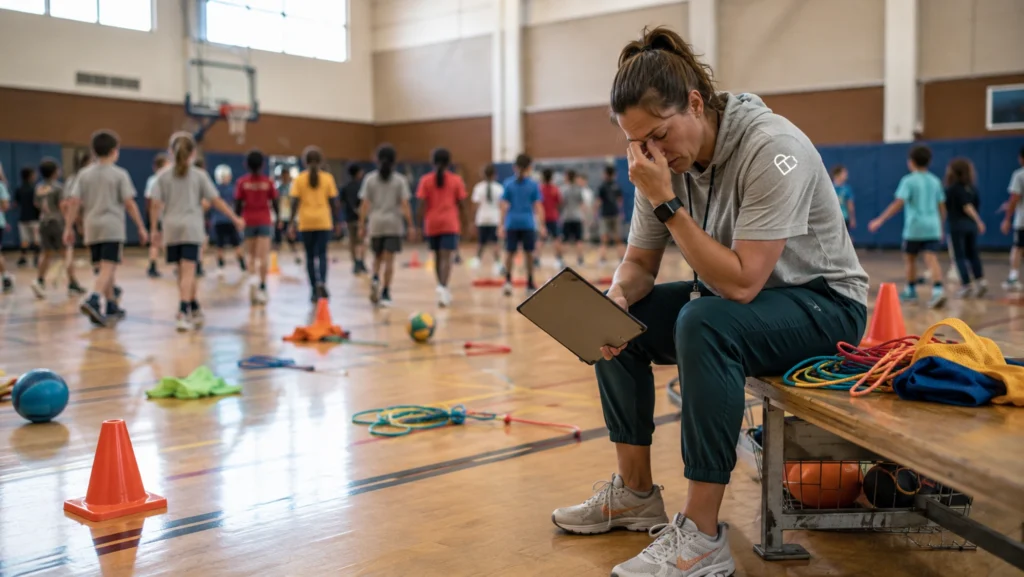
PE teacher burnout is a growing issue in K–12 education, even among educators who genuinely love what they do. While physical education is often associated with energy, movement, and student engagement, the professional demands placed on PE teachers are uniquely intense—and frequently overlooked. The Hidden Complexity of PE Teaching Unlike many classroom roles, PE teachers operate in highly dynamic, high-visibility environments. Research on occupational burnout (Maslach & Leiter, 2016) identifies workload, lack of control, and insufficient recognition as key drivers—and PE teachers often experience all three simultaneously. A typical PE teacher may manage: This creates sustained cognitive and physical load without the natural pauses that classroom transitions or seated instruction can provide. Always “On”: The Visibility Factor PE teachers are rarely out of sight. Unlike classroom teachers who may have moments of independent student work, PE requires continuous engagement and supervision. This constant visibility contributes to: From a cognitive science perspective, this aligns with “attention residue” and fatigue accumulation, where sustained attention without breaks reduces effectiveness over time. The Equipment and Logistics Burden Equipment management is a major, often underestimated contributor to PE teacher burnout. Responsibilities include: These logistical demands add a layer of operational workload not typically required in other subjects, increasing both time pressure and decision fatigue. Grading and Assessment Challenges Assessment in PE has evolved significantly, with a growing emphasis on standards-based grading, skill tracking, and fitness data. However, PE teachers often: Research shows that unclear or inefficient assessment systems are strongly linked to teacher stress and reduced job satisfaction. The Advocacy Pressure PE teachers frequently feel the need to justify their subject’s value within the broader academic landscape. This advocacy burden includes: Over time, this creates emotional labor—especially when PE is undervalued or misunderstood. Why Passion Isn’t Enough Many PE teachers enter the profession driven by a passion for movement, health, and student well-being. However, passion alone does not protect against burnout. According to the Job Demands–Resources model, burnout occurs when demands consistently exceed available resources. For PE teachers, high demands are often paired with: This imbalance leads to emotional exhaustion, even among highly committed educators. Building More Sustainable Systems Addressing PE teacher burnout requires systemic, not individual, solutions. Schools and districts can make meaningful improvements by focusing on structure and support. Key strategies include: For example, schools that adopt digital assessment platforms for PE often reduce grading time significantly, allowing teachers to focus more on instruction and student engagement. Making PE Teachers Feel Seen One of the most powerful interventions is simple acknowledgment. When administrators and stakeholders understand the full scope of PE teaching, it shifts the conversation from “just gym” to a complex, essential educational role. PE teachers are not just facilitating games—they are managing large-scale, high-energy learning environments while promoting lifelong health behaviors. Recognizing that reality is the first step toward reducing burnout and building sustainable programs.
Summer Self-Care for PE Teachers: Science-Backed Strategies to Recharge and Prevent Burnout
Summer break is not just a pause in the school calendar—it is a critical recovery window for Physical Education teachers. After a year of high physical output, constant supervision, and emotional labor, the body and brain need intentional recovery. Research on educator burnout and occupational fatigue consistently shows that structured rest improves cognitive performance, emotional regulation, and long-term job satisfaction. Why Summer Recovery Matters PE teachers experience a unique blend of physical and mental fatigue. Studies in occupational health indicate that prolonged physical exertion combined with decision fatigue can elevate cortisol levels and reduce overall well-being. Without proper recovery, this can carry into the next school year, increasing burnout risk. A 2022 study in the Journal of Occupational Health Psychology found that employees who psychologically detached from work during extended breaks reported significantly higher energy levels and job engagement upon return. For PE teachers, this means stepping away from lesson planning, assessments, and even fitness tracking tied to work. 1. Prioritize True Psychological Detachment It is not enough to simply stop going to school—you need to mentally disconnect. This aligns with recovery theory, which emphasizes that mental disengagement is essential for restoring cognitive resources. 2. Shift from Performance to Enjoyment-Based Movement PE teachers often associate movement with instruction, assessment, or performance metrics. Summer is an opportunity to reconnect with intrinsic motivation. Example: Instead of running structured drills, join a casual pickup game or go paddleboarding with friends. 3. Rebuild Physical Recovery Habits Ironically, PE teachers may neglect structured recovery during the school year. Sleep research shows that even small improvements in sleep quality can significantly enhance mood, immune function, and energy levels. 4. Invest in Non-Teaching Identity Burnout is strongly linked to identity overextension—when your sense of self is too tied to your profession. This diversification of identity has been shown to improve resilience and reduce stress-related fatigue. 5. Reflect Lightly, Not Strategically Reflection can be helpful, but summer is not the time for intensive curriculum redesign. Cognitive science suggests that insight often emerges during low-pressure, diffuse thinking states—not structured planning sessions. 6. Gradual Re-Entry in Late Summer Recovery does not mean ignoring the upcoming school year entirely—it means timing your re-engagement. This phased approach prevents the abrupt stress spike that often occurs when teachers return too quickly to full workload. The Bigger Picture Self-care for PE teachers is not indulgent—it is preventative. Sustained physical and emotional demands require intentional recovery cycles. By using summer break strategically, teachers can return not just rested, but more effective, present, and engaged. In the long run, prioritizing summer self-care supports not only teacher well-being but also student outcomes, as energized educators create more positive and impactful learning environments.
Why PE Teachers Should Collaborate More, Create Less, and Invest Smarter
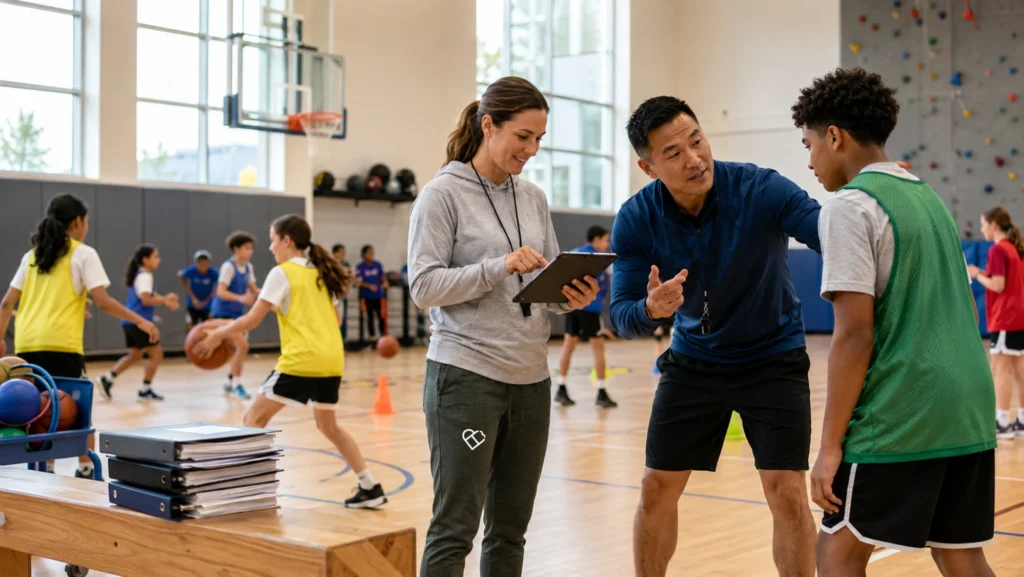
Physical education teachers face increasing demands on their time, yet many still spend hours creating lessons, assessments, and tracking tools that already exist. Research suggests this approach is inefficient and contributes to burnout. As the 2026–2027 school year approaches, PE teachers can improve outcomes and reduce workload by shifting toward collaboration, strategic resource use, and smarter investment. The Problem with Recreating PE Content Teacher workload studies from the RAND Corporation and Learning Policy Institute show educators work over 50 hours per week, with planning consuming a large portion. In physical education, this often includes: Cognitive load theory indicates that unnecessary creation tasks reduce mental capacity for high-impact teaching practices. In short, the more time spent recreating materials, the less energy remains for instruction, feedback, and student engagement. Why Collaboration Improves PE Outcomes Research from John Hattie highlights collective teacher efficacy as one of the strongest factors in student success, with an effect size of 1.57. For PE teachers, collaboration can significantly reduce workload while improving instructional quality. Effective collaboration strategies include: Example: A PE teacher using a SHAPE America-aligned assessment platform can immediately access validated fitness tracking and reporting instead of building a system independently. Create Less, Curate Better PE Resources Instructional design research shows that curating high-quality resources is more effective than creating new ones. PE teachers who rely on vetted tools can focus on delivering engaging instruction rather than administrative setup. Best practices for PE resource curation: This approach improves both efficiency and instructional consistency across schools and districts. Rethinking PE Teacher Spending: Supplies vs. Professional Tools Many PE teachers spend personal money on equipment, according to national education surveys. While this supports students in the short term, it creates long-term challenges: Instead, investing in professional tools—such as PE assessment software or curriculum platforms—offers long-term benefits: Schools and districts should provide equipment. Teachers should prioritize tools that improve their effectiveness and sustainability. Strategies for the 2026–2027 School Year To improve efficiency and impact, PE teachers should focus on: By implementing these strategies, teachers can reduce burnout while improving student engagement and performance. The Future of Physical Education The most effective PE teachers are not the ones who create the most—they are the ones who use the best available resources. Collaboration, not duplication, is the key to sustainable success in modern physical education. As the new school year begins, PE teachers should ask: What can I stop creating so I can start teaching more effectively?
End-of-Year PE Teacher Self-Reflection Survey
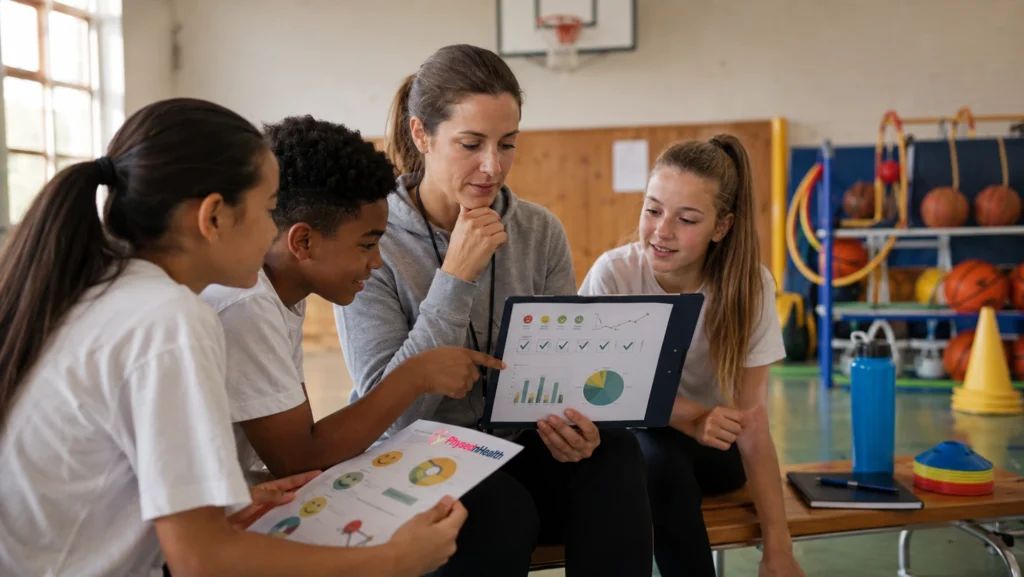
Turn Feedback Into Better Results Self-reflection is one of the most powerful tools a Physical Education teacher can use to improve instruction, student engagement, and long-term program outcomes. Research in educational psychology consistently shows that reflective practice—especially when paired with student feedback—leads to measurable improvements in teaching effectiveness and student motivation. As the 2025–2026 school year closes, this is the ideal moment for PE teachers to step back, analyze what worked, and build a data-informed strategy for the year ahead. Why Self-Reflection Matters in PE Reflective teaching is grounded in evidence from cognitive science and pedagogy. Studies show that teachers who engage in structured reflection are more likely to: In Physical Education specifically, reflection helps teachers evaluate not just skill development, but also student attitudes toward movement, confidence, and lifelong fitness behaviors. The Role of Student Feedback Student voice is a critical component of effective reflection. Research indicates that students can reliably report on: When combined with teacher self-assessment, this creates a more complete picture of program effectiveness. Example: A PE teacher may feel a unit on fitness circuits was successful, but student feedback might reveal confusion about expectations or lack of perceived relevance. This gap is where improvement happens. Building an Effective PE Self-Reflection Survey A strong PE teacher self-reflection survey should include both teacher prompts and student feedback questions. It should be short, structured, and aligned with measurable outcomes. Teacher Self-Reflection Prompts Student Feedback Questions Use a mix of Likert-scale questions (e.g., 1–5 ratings) and open-ended responses to balance quantitative and qualitative insights. Turning Data Into Strategy Collecting data is only valuable if it informs action. After reviewing survey results: This process mirrors continuous improvement models used in education and aligns with evidence-based teaching practices. Practical Example A middle school PE teacher finds that: Strategy for next year: This targeted approach ensures that reflection leads to meaningful change, not just observation. Final Thought End-of-year reflection is not just a professional exercise—it is a strategic tool. By combining teacher insight with student feedback, PE educators can create more engaging, inclusive, and effective programs that promote lifelong physical activity. A well-designed PE teacher self-reflection survey turns experience into evidence—and evidence into action.
Why Student Behavior Often Changes at the End of the School Year (and What PE Teachers Can Do About It)
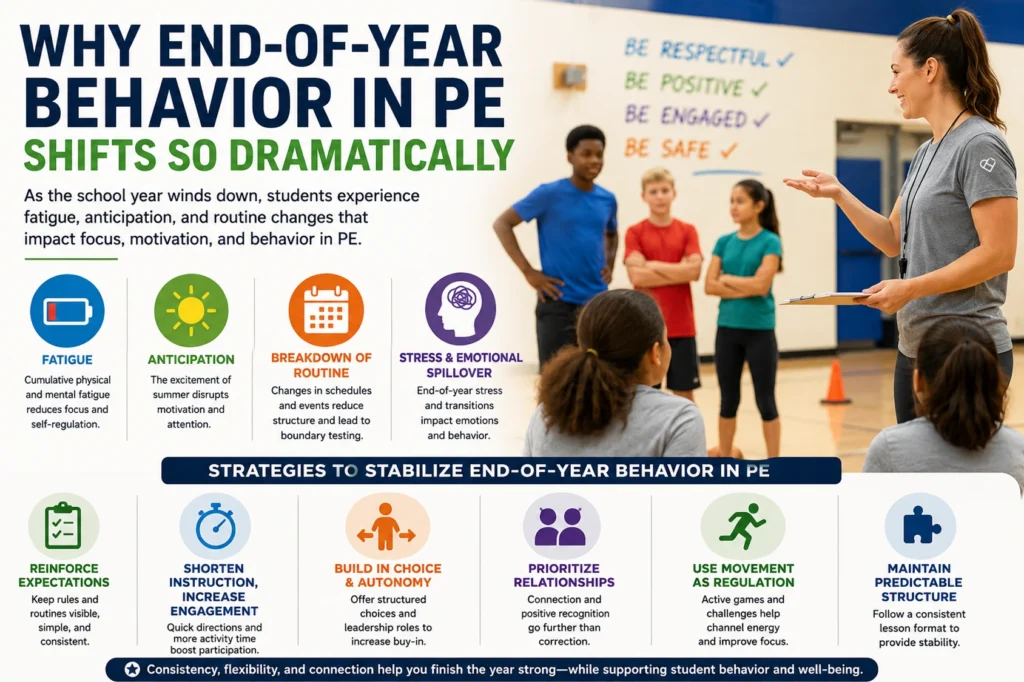
As the school year winds down, many physical education teachers notice a clear shift in student behavior. Focus declines, energy becomes inconsistent, and routines that once worked seamlessly begin to break down. This isn’t just anecdotal—it’s supported by research in cognitive science, behavioral psychology, and education. Understanding the “why” behind end of year behavior in PE is the first step toward maintaining a positive, structured, and engaging environment. 1. Cognitive and Physical Fatigue Build Over Time By late spring, students are experiencing cumulative fatigue. Months of academic demands, testing, and structured schedules take a toll on both cognitive function and self-regulation. Research in educational psychology shows that sustained mental effort reduces executive functioning—skills like attention control, impulse regulation, and task persistence. In a PE setting, this can look like: Even though PE is active, it still requires focus, cooperation, and adherence to rules—skills that are harder to maintain when students are mentally drained. 2. Anticipation of Summer Disrupts Motivation The closer students get to summer break, the more their attention shifts toward what’s next. Anticipation activates reward centers in the brain, making future-oriented thinking more appealing than present tasks. This creates a motivational imbalance: In PE, this often shows up as students rushing through activities, negotiating rules, or disengaging from skill-building tasks. 3. Breakdown of Routine Reduces Behavioral Stability Consistency is one of the strongest predictors of positive student behavior. Toward the end of the year, routines often loosen due to: Behavioral science suggests that when predictable structures disappear, students test boundaries to understand what expectations still apply. In PE, where space, movement, and group dynamics already add complexity, even small disruptions can lead to noticeable behavior changes. 4. End-of-Year Stress and Emotional Spillover While excitement is high, so is stress. Students may be dealing with: This emotional load can manifest physically and behaviorally, especially in PE where students are more expressive and less constrained by traditional classroom norms. Practical Strategies to Stabilize End-of-Year Behavior in PE Maintaining consistency doesn’t mean resisting the energy of the season—it means channeling it productively. 1. Reinforce (Don’t Relax) ExpectationsKeep rules and routines visible, simple, and consistent. Briefly revisit expectations at the start of each class. Consistency provides psychological safety when everything else feels uncertain. 2. Shorten Instruction, Increase EngagementGiven reduced attention spans, shift toward: This aligns with cognitive load theory—less verbal input, more meaningful movement. 3. Build in Choice and AutonomyResearch in motivation (Self-Determination Theory) shows that autonomy boosts engagement. Offer structured choices: This helps redirect anticipation energy into productive participation. 4. Prioritize Relationship-Based ManagementAt this time of year, connection is often more effective than correction. Strong teacher-student relationships improve behavior regulation, especially when routines weaken. 5. Use Movement as a Regulation ToolInstead of viewing high energy as a problem, design activities that absorb it: Physical activity itself helps regulate mood and attention through neurochemical responses (e.g., dopamine and endorphin release). 6. Maintain Predictable Lesson StructuresEven if content changes, keep the format consistent: This structure anchors students even when schedules feel chaotic. A Quick Example in Practice Instead of a long skill lecture during the final weeks, a PE teacher might: This approach maintains structure while adapting to students’ shifting motivation and energy levels. Final Thought End of year behavior in PE is not a loss of control—it’s a predictable response to fatigue, anticipation, disrupted routines, and emotional transitions. When teachers respond with consistency, flexibility, and connection, they can finish the year strong while supporting both student behavior and well-being.
Integrating Emotional Intelligence in Every PE Session
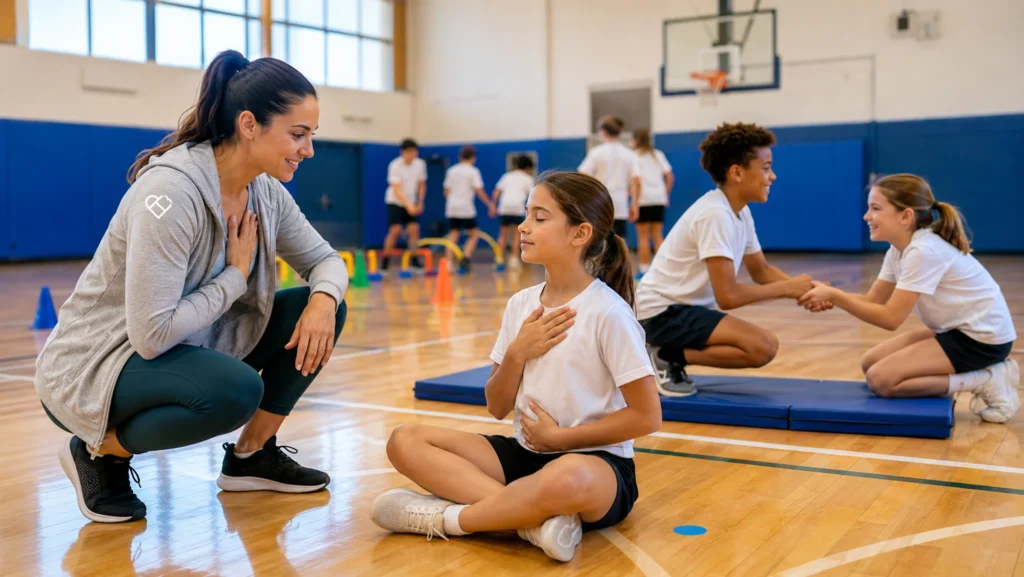
Physical education has evolved far beyond simply developing motor skills and physical fitness. Today’s PE curriculum demands a more holistic approach that nurtures students’ emotional, social, and psychological well-being alongside their physical development. Integrating emotional intelligence (EI) into every PE session represents a transformative shift that can significantly enhance student outcomes across multiple domains. Why Emotional Intelligence Matters in Physical Education The Scientific Foundation Recent research reveals compelling evidence for the critical role of emotional intelligence in physical education. A comprehensive 2025 study involving over 498 university students demonstrated that mindfulness practices and emotional self-regulation significantly reduce cognitive load stress while enhancing physical performance. The study found that students with higher emotional intelligence showed improved stress management, better focus during physical tasks, and enhanced overall performance outcomes. Multiple research studies confirm that physical education creates an emotionally-charged environment where students continuously face performance pressures, social interactions, and personal challenges. In this context, emotional intelligence serves as a protective factor that helps students navigate these challenges while maximizing their learning potential. The Mind-Body Connection Physical education uniquely positions educators to strengthen the mind-body connection. Our emotions are literally “feelings” that manifest in physical sensations throughout our bodies. When students learn to recognize these emotional cues during physical activity, they develop crucial self-awareness skills that extend far beyond the gymnasium. A 2025 study on primary school children found that physical exercise directly enhances social-emotional competence, with effects mediated through improved peer attachment and emotional regulation. Academic and Life Benefits The integration of emotional intelligence in PE yields benefits that extend throughout students’ academic and personal lives: Evidence-Based Benefits of Emotional Intelligence Integration Cognitive Domain Benefits Research demonstrates that emotional intelligence integration in PE enhances cognitive functioning through several mechanisms: Stress Reduction: Mindfulness practices and emotional regulation techniques reduce cognitive load, freeing up mental resources for learning and performance. Students learn to manage performance anxiety and maintain focus during challenging activities. Enhanced Decision-Making: Emotionally intelligent students make better strategic decisions during games and sports, as they can regulate their emotional responses and think more clearly under pressure. Improved Attention and Focus: EI training helps students maintain concentration during instruction and practice, leading to more efficient skill acquisition. Emotional and Social Benefits Self-Awareness Development: Students learn to recognize their emotional states, triggers, and responses during physical activities. This awareness becomes a foundation for emotional regulation throughout their lives. Empathy and Social Skills: Cooperative learning activities in PE naturally develop empathy as students work together, support teammates, and navigate interpersonal challenges. Research shows moderately strong associations between cooperative learning and all dimensions of emotional intelligence. Conflict Resolution: PE provides authentic opportunities to practice conflict resolution skills in real-time situations, from disagreeing with referee calls to managing competitive tensions. Stress Management: Physical activity combined with emotional intelligence training provides students with healthy coping mechanisms for managing stress and difficult emotions. Physical Performance Benefits Improved Athletic Performance: Athletes with higher emotional intelligence demonstrate better sports performance through enhanced stress management, emotional regulation, and team dynamics. Body Awareness: Students develop stronger proprioceptive awareness and learn to listen to their bodies’ signals for fatigue, stress, or optimal performance states. Motivation and Persistence: Emotionally intelligent students show greater intrinsic motivation for physical activity and higher persistence when facing challenges. Science-Backed Strategies for Implementation 1. Cooperative Learning Approaches Research consistently demonstrates that cooperative learning is one of the most effective methods for developing emotional intelligence in PE. A landmark 2020 study involving 1,332 students found positive and significant associations between cooperative learning and all dimensions of emotional intelligence. Implementation Strategies: Specific Activities: 2. Mindfulness and Body Awareness Integration Recent neuroscientific research reveals that mindfulness practices enhance emotional regulation by strengthening neural pathways associated with self-control and stress management. Pre-Activity Mindfulness: During-Activity Awareness: Post-Activity Reflection: 3. Emotion Vocabulary and Recognition Training Building emotional literacy is fundamental to emotional intelligence development. Research shows that students who can accurately identify and articulate emotions demonstrate better emotional regulation and social relationships. Emotion Check-ins: Emotion-Action Connections: 4. Social-Emotional Learning Through Game Modification Traditional PE activities can be modified to emphasize emotional intelligence development while maintaining physical benefits. Modified Rules for EI Development: Conflict Resolution Protocols: 5. Self-Regulation Skill Development Research demonstrates that self-regulation amplifies the benefits of mindfulness and emotional awareness, making it a crucial component of EI integration. Goal-Setting and Self-Monitoring: Stress Management Techniques: Practical Implementation Framework Daily Structure Integration Opening Routine (5 minutes): During Activities (Throughout class): Closing Routine (5 minutes): Assessment and Progress Monitoring Effective integration requires systematic assessment of both emotional intelligence development and traditional PE outcomes. Formative Assessment Strategies: Summative Assessment Options: Professional Development Considerations Teachers implementing EI integration need specific preparation and ongoing support: Essential Teacher Competencies: Implementation Support: Addressing Common Challenges Time Constraints Many PE teachers worry about losing instructional time for physical skills. Research demonstrates that EI integration actually enhances physical learning by improving focus, reducing behavioral disruptions, and increasing engagement. Solutions: Student Resistance Some students, particularly older ones, may initially resist emotional discussions in PE. Solutions: Administrative Support Successful implementation requires understanding and support from administrators and parents. Solutions: Measuring Success and Impact Student Outcome Indicators Short-term Indicators: Long-term Indicators: Program Evaluation Methods Quantitative Measures: Qualitative Measures: Conclusion: The Future of Physical Education Integrating emotional intelligence into every PE session represents more than an educational trend—it’s a research-backed approach to developing well-rounded, resilient, and emotionally healthy individuals. The scientific evidence clearly demonstrates that this integration enhances not only students’ physical development but also their academic performance, social relationships, and mental health. As educators, we have the opportunity and responsibility to use the unique environment of physical education to foster emotional intelligence alongside physical literacy. The strategies presented here provide a practical, science-based framework for creating PE programs that truly serve the whole child. The future of physical education lies in recognizing that the mind and body are inseparable in learning and development. By integrating emotional intelligence into our daily practice, we prepare students not just for physical activity, but for success in all areas of their
The Accountability Era of Physical Education: What Comes Next as PE Becomes Future-Critical
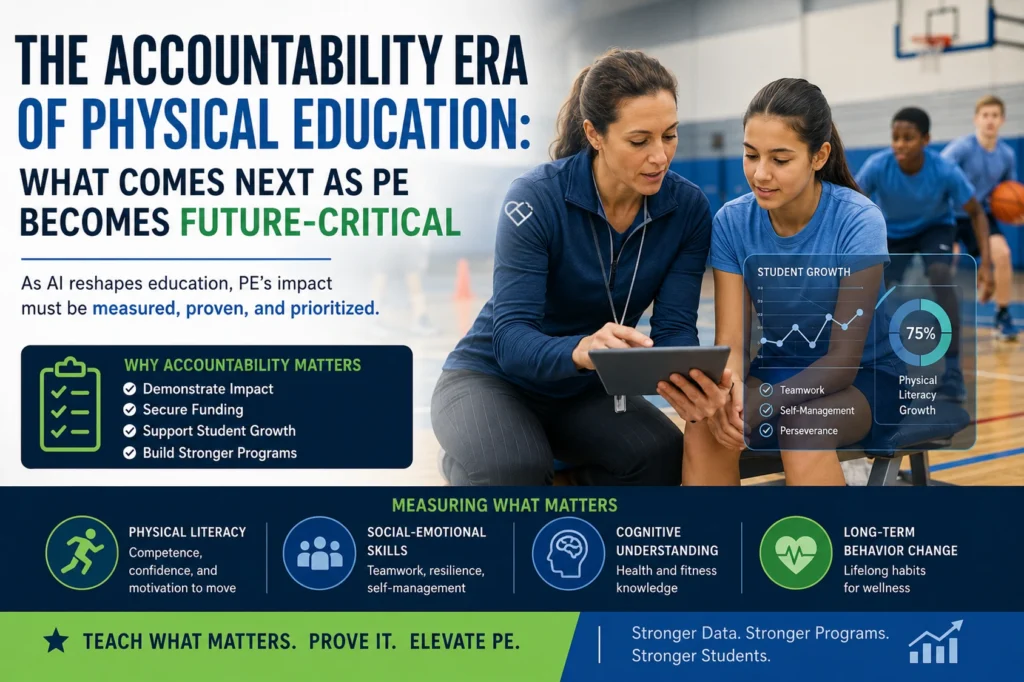
PART 2 As artificial intelligence reshapes education, Part 1 made the case that physical education teachers are among the most future-proof educators. Their role in developing social, emotional, and experiential skills aligns directly with what AI cannot replace. But with increased importance comes increased scrutiny. If PE is no longer viewed as “supplemental” but instead as essential to whole-child development, then schools, districts, and policymakers will begin asking a new question: How do we measure its impact? The Shift from Participation to Measurable Outcomes Historically, physical education has often been evaluated by participation—attendance, activity time, and basic fitness benchmarks. But that model is quickly becoming outdated. In an accountability-driven education system, every subject must demonstrate value through data. Research from the Aspen Institute and SHAPE America emphasizes that modern PE should assess not just physical activity, but: This represents a fundamental shift: PE is no longer just about what students do—it’s about what they learn, retain, and apply. The Science of Measuring What Matters One challenge is that many of the most important outcomes in PE—like resilience, collaboration, and perseverance—are harder to quantify than test scores. However, emerging research provides frameworks for doing exactly that: In other words, measurement is possible—but it requires better tools and intentional systems. Why Accountability Will Increase for PE Teachers As districts invest more in whole-child initiatives and justify funding decisions, PE programs will face increased expectations in three key areas: This mirrors what has already happened in core subjects over the past two decades. The Risk: Being Essential but Unmeasured There is a real risk for PE programs in this transition. If PE is recognized as critical but cannot produce measurable outcomes, it may struggle to compete for funding and prioritization against subjects with established data systems. Put simply: what gets measured gets funded. Without clear evidence of impact, even the most valuable programs can be overlooked. The Opportunity: Leading the Next Wave of Education Data At the same time, this shift creates a massive opportunity for PE teachers and programs to lead. Because PE sits at the intersection of physical health, mental well-being, and social development, it is uniquely positioned to become a cornerstone of data-driven, whole-child education. Forward-thinking programs are already: These approaches not only validate PE’s impact—they elevate it. A Practical Example Imagine two schools: When district leaders review program effectiveness, only one school can clearly demonstrate its contribution to student outcomes. That school becomes the model—and the priority. The Evolving Role of the PE Teacher As accountability increases, the role of the PE teacher will expand beyond instruction to include: This is not about adding burden—it’s about aligning with where education is going. The Bottom Line Physical education is entering a new era. As AI takes over knowledge delivery, PE’s role in human development makes it more valuable than ever. But that value must be demonstrated, not assumed. The future of PE will belong to programs that can do both: Teach what matters—and prove it. Contact us at awesome@physednhealth.com
Why Physical Education Teachers Are the Most Future-Proof Educators in the Age of AI
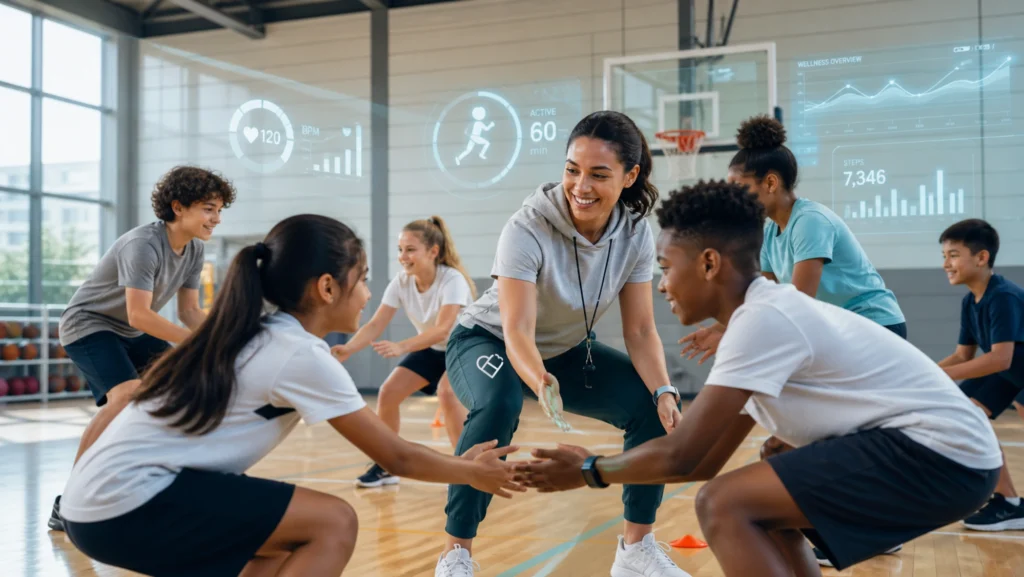
PART 1 Artificial intelligence is rapidly transforming education. With AI now capable of delivering personalized instruction, instant feedback, and vast knowledge retrieval, a critical question is emerging across K–12 systems: what role will human teachers play in the future? The answer, supported by cognitive science and education research, is clear—teaching is shifting away from knowledge delivery and toward human development. And no group of educators is better positioned for this shift than physical education (PE) teachers. AI Is Replacing Information Delivery—Not Human Development AI excels at what researchers call “cognitive offloading”—the ability to store, retrieve, and present information faster and more efficiently than humans. Studies from institutions like Stanford and MIT show that AI-driven tutoring systems can match or exceed traditional instruction in knowledge acquisition, particularly in subjects like math and reading. However, education is not just about knowledge transfer. According to the National Research Council, effective education also develops: These competencies—often grouped under “non-cognitive skills”—are not easily replicated by AI. They require human interaction, real-world context, and experiential learning environments. The Science Behind Experiential and Social Learning Research consistently shows that students learn best through active, embodied experiences: In other words, learning is not just a mental process—it is physical, social, and emotional. Why PE Teachers Are Uniquely Positioned for the Future Physical education already operates at the intersection of these domains. Unlike traditional classroom settings, PE environments are inherently: PE teachers are not just instructors—they are facilitators of human development. For example, when a student participates in a team sport, they are simultaneously learning: These are precisely the skills AI cannot teach effectively in isolation. The Shift: From Knowledge Teachers to Experience Designers As AI becomes the primary tool for knowledge delivery, the role of educators will evolve into what many researchers call “learning experience designers.” This shift includes: PE teachers are already doing this every day. Implications for K–12 Schools and District Leaders Districts investing in future-ready education should reconsider how they prioritize and position physical education programs. Key considerations include: Rather than being supplemental, PE may become foundational to 21st-century education. A Simple Illustration Consider two classrooms: Both environments teach “knowledge,” but only one develops the full spectrum of human skills needed for life. The Bottom Line AI will not replace teachers—but it will replace teachers who only deliver information. The educators who remain indispensable are those who teach students how to interact, adapt, collaborate, and grow as humans. Physical education teachers already embody this role, making them some of the most future-proof professionals in education today. As schools prepare for an AI-driven future, the question is no longer whether PE matters—it is whether schools are fully leveraging the one subject built entirely around human development. Contact: awesome@physednhealth.com
You’re Right – PE Assessment Is Harder Than Classroom Assessment. That’s Exactly Why You Need The Zone Approach
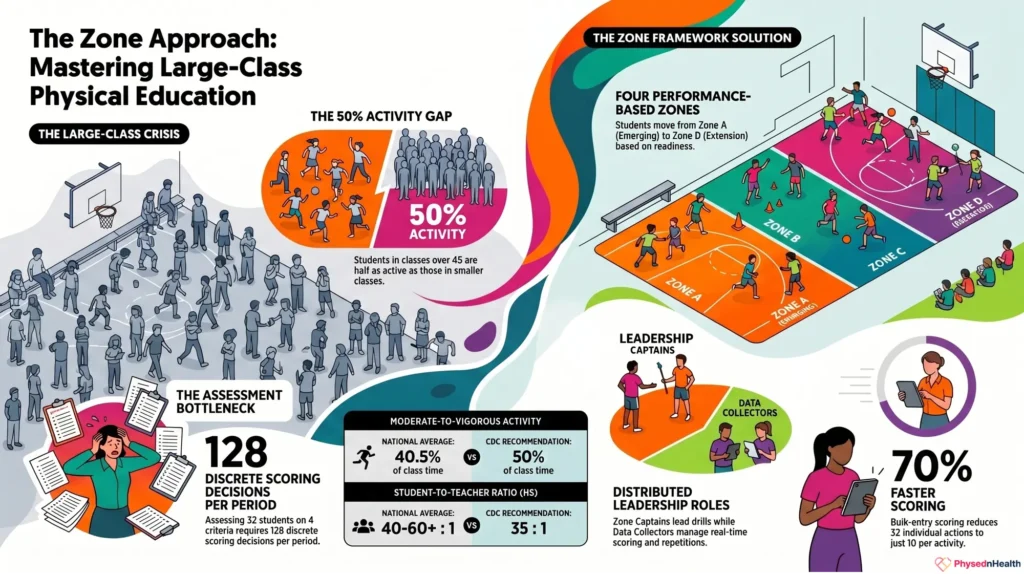
A PE teacher recently posted something on Reddit that stopped us in our tracks: “I think it is easier to write a report of the class than grade because in order for grading to be meaningful and accurate, it will take time. Classroom teachers have a much easier time with assessments because they can be done without the teacher observing in real time. PE we have to observe in real time to actually assess.” This teacher is not wrong. They’re describing a real structural problem, and it’s one that every PE professional with 30+ students has felt in their bones. But the conclusion they’ve reached—that individual grading is too hard, so class-level reports are the only realistic option—is a surrender to the logistics, not a solution to them. Let’s talk about why, and what the alternative looks like. The Real-Time Observation Problem Is Real Here’s the fundamental asymmetry that makes PE assessment different from every other subject in the building: A math teacher distributes a test. Students work independently. The teacher collects papers. That evening or the next day, the teacher grades them one at a time, with coffee, at their own pace. The assessment and the scoring are separated by hours or days. The teacher has time to think, compare, reconsider. A PE teacher needs to watch a student dribble a basketball, evaluate hand position, eye focus, ball control, and athletic posture, assign a score on a 1–4 scale across four criteria, and record it—all while 31 other students are also dribbling, some are chasing loose balls, two are arguing about teams, and one just sat down claiming a stomachache. The assessment is the observation. And the observation window is measured in seconds. So when this teacher says grading in PE requires the teacher to observe in real time, they’re identifying the exact constraint that makes PE assessment orders of magnitude harder than classroom assessment. We agree with every word of the diagnosis. We disagree with the treatment. Why Class-Level Reports Aren’t Enough The instinct to write a class report rather than individual grades is understandable. It’s also dangerous for the long-term health of your PE program. A class-level report tells an administrator something like: “The 6th grade demonstrated developing proficiency in locomotor skills, with most students performing at or near grade-level expectations.” That’s useful context. But consider what it cannot do: This isn’t a criticism of the teacher who wrote that Reddit post. It’s a description of the institutional reality: programs without individual student data are vulnerable programs. PE already fights an uphill battle for time, funding, and respect. Giving up on individual assessment, however understandable the reasons, makes that battle harder. The Cognitive Bottleneck: Why 32 Feels Impossible To understand why the zone approach works, you first need to understand why observing 32 students individually doesn’t. When you scan a gymnasium of 32 students performing the same skill, your brain is attempting to do 32 independent evaluations in parallel. Cognitive science tells us this is essentially impossible. Human working memory holds roughly 4–7 discrete items at once. You can observe 4–6 students with reasonable accuracy before the earlier observations start degrading in memory. So what actually happens in practice? One of three things: None of these approaches is the teacher’s fault. They’re the predictable result of asking one human to simultaneously observe and evaluate 32 moving bodies with no structural support. The zone approach provides that structural support. How the Zone Approach Changes the Math The zone approach organizes students into 4 groups of roughly 8, based on approximate performance readiness. The groups are called zones, and they persist across a unit of instruction. Here’s how that changes the assessment equation: Instead of 32 Independent Evaluations, You Make 4 Group Judgments + Exceptions When you look at a zone of 8 students who are all at a similar developmental level, you don’t need to evaluate each one from scratch. You make one baseline judgment for the group: “Zone B is generally performing at a 2 on this rubric.” That’s 8 students scored in one cognitive action. Then you spend 30 seconds scanning for exceptions. Maybe one student is clearly performing at a 3. Another is struggling and looks more like a 1. You override those two. That’s 3 total scoring decisions for 8 students. Do that four times—once per zone—and you’ve assessed the entire class of 32 with roughly 12–16 decisions instead of 128 (32 students times 4 rubric criteria). The observation time drops from “impossible” to about 4–5 minutes of focused attention. Pattern Detection Replaces Parallel Evaluation Here’s the cognitive science behind why this works: when students are grouped by ability, you’re no longer asking your brain to evaluate 32 individuals in parallel. You’re asking it to detect deviations from a pattern. “Does anyone in this group of 8 look different from the rest?” Your brain is exceptionally good at this. Spotting the one kid in a group of 8 who’s performing differently is a perceptual task, not a memory task. It’s fast, automatic, and reliable. It’s the same cognitive process that lets you spot a typo in a paragraph or notice one student sitting while the rest are moving. Without zones, you’re asking your brain to do 32 recall-based evaluations. With zones, you’re doing 4 pattern-detection scans. The underlying cognitive task changes from impossible to intuitive. The Grid Is the Override Surface Teachers who hear about zone-based scoring sometimes worry it means every student in a zone gets the same grade. It doesn’t. The zone baseline is a starting point, not a final score. Every individual cell in the scoring grid remains editable. The teacher confirms or overrides each score based on direct observation. Think of it like a spreadsheet autofill: you fill a column with a default value, then go back and change the cells that need changing. The autofill saves time. The manual overrides preserve accuracy. Both happen on the same surface. For the Skeptics: Five Honest Objections and Straight Answers 1.
What PE Teachers Need to Know About Proving Student Growth
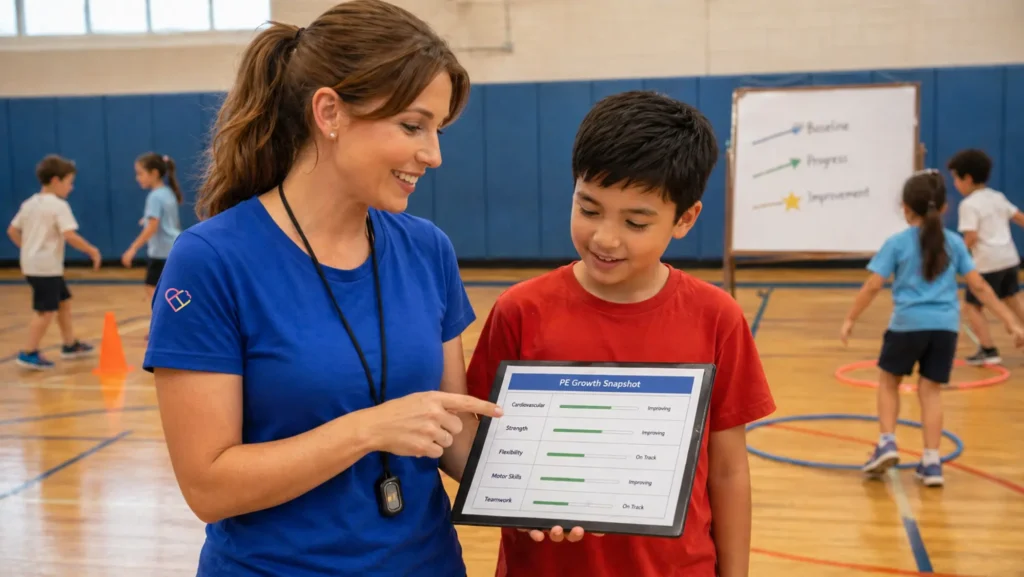
In PE, “student growth” often gets talked about as if it should be obvious. But for many teachers, that is the problem. They know students are improving. They see better movement patterns, stronger effort, more confidence, smarter decisions, and more consistent participation in learning. What is harder is proving that growth in a way families and administrators can understand quickly and trust. SHAPE America’s guidance makes that expectation clear: physical education assessment should be aligned to standards and grade-level outcomes, measure achievement across instruction, and be communicated to students and parents through school and district reporting protocols (SHAPE). That is why proving student growth in PE is not just an assessment issue. It is also an advocacy issue. The stronger your evidence, the easier it is to show that PE is not random activity. It is real teaching, real learning, and real student development. SHAPE America’s 2024 National Physical Education Standards framework explicitly positions the standards as a tool used by teachers, administrators, and policymakers to shape curriculum, instruction, and the assessment of student achievement and progress (SHAPE). First, what actually counts as evidence of growth in PE? A lot more than one final test score. SHAPE America says PE assessment should be standards-aligned and should measure student achievement in all areas of instruction, including physical fitness. It also describes PE assessment as a sequence that can include preassessment, formative assessment, and summative assessment. That means evidence of growth in PE should show how a student moves from a starting point to a later point in learning, not just where they finished on one day (SHAPE). In practical terms, strong evidence of progress in PE can include: The key idea is simple: evidence of growth should match what you say you teach. If your program values fitness knowledge, skill development, self-management, and personal progress, then your evidence should reflect those things too. Why one score is usually not enough One score can be part of the picture, but it is rarely the whole picture. A student may still be below class average in a fitness task and yet show strong growth from baseline. Another student may still not be “advanced” in a skill but may have made clear progress in form, control, or confidence. If teachers only report the final score, they hide much of the actual learning. SHAPE America’s standards-based student progress report was created specifically to help teachers report assessment results to students and families in a way that aligns with standards and grade-level outcomes, which is a signal that PE progress should be reported more comprehensively than a single number. That matters for advocacy because administrators and families often understand PE best when teachers show growth over time, not isolated moments. A helpful way to think about proof in PE When you need to prove student growth, try organizing evidence into three simple buckets: 1. Growth in fitness This is often the easiest category for schools to understand. Examples include improvement in endurance, muscular endurance, recovery, movement efficiency, or consistency across a unit. SHAPE explicitly includes physical fitness within PE assessment, which makes fitness progress valid evidence when it is aligned to curricular outcomes. 2. Growth in skill This includes progress in movement competence, technique, tactical decision-making, and application of cues. Because SHAPE’s standards framework centers what students should know and be able to do within a learning progression, skill growth is one of the clearest forms of evidence a PE teacher can present. 3. Growth in learning behaviors tied to standards This is where many PE teachers under-report what students are actually learning. If students improve in self-management, safe behavior, cooperation, communication, or giving and using feedback, that can count as evidence when those outcomes are part of the standards and your curriculum. The 2024 SHAPE standards include learning indicators related to communication, feedback, respect, teamwork, safety, and problem-solving in physical activity settings. That does not mean grading kids for “being good.” It means documenting growth in standards-based behaviors and competencies that are explicitly part of PE learning. How to make growth easier to communicate to administrators Administrators usually do not need more raw data. They need a clearer story. The best story is usually: Here is where students started.Here is the evidence of what improved.Here is how that improvement connects to standards and instruction. That framing works because SHAPE’s standards are designed to support curriculum, instruction, and assessment together, and SHAPE’s own “How to Demonstrate My Effectiveness” guidance tells teachers to assess students according to curricular objectives and standards, then share results with principals and parents. A strong administrator-facing growth update might include: For example: “Students in Grade 5 began the striking unit with an average rubric score of 1.8 on contact and follow-through. By the end of the unit, the average rose to 3.1, with most students independently applying cues in game-like practice. This aligns to our grade-span PE learning indicators for skill application and feedback.” That kind of language helps PE sound like what it is: instruction with measurable outcomes. How to make growth easier for families to understand Families usually care about different questions than administrators. They want to know: SHAPE’s student progress report template was created specifically to help teachers report PE assessment results to students and families in a user-friendly, standards-based format. SHAPE’s instructional practice guidance also says parents and guardians should receive regular reports of student progress using continuous, formative evidence, not just a report-card letter. That means family communication in PE works best when it is: A family-friendly progress note might sound like: “Your child has improved in pacing and endurance during our cardiovascular fitness unit. They also show stronger understanding of how to manage effort during continuous activity. Next, we are working on helping them recognize when to adjust pace earlier.” That is much more meaningful than “B in PE.” What stronger PE tracking actually looks like Better tracking does not mean collecting everything. It means collecting the right evidence consistently. Usually, that means teachers have