
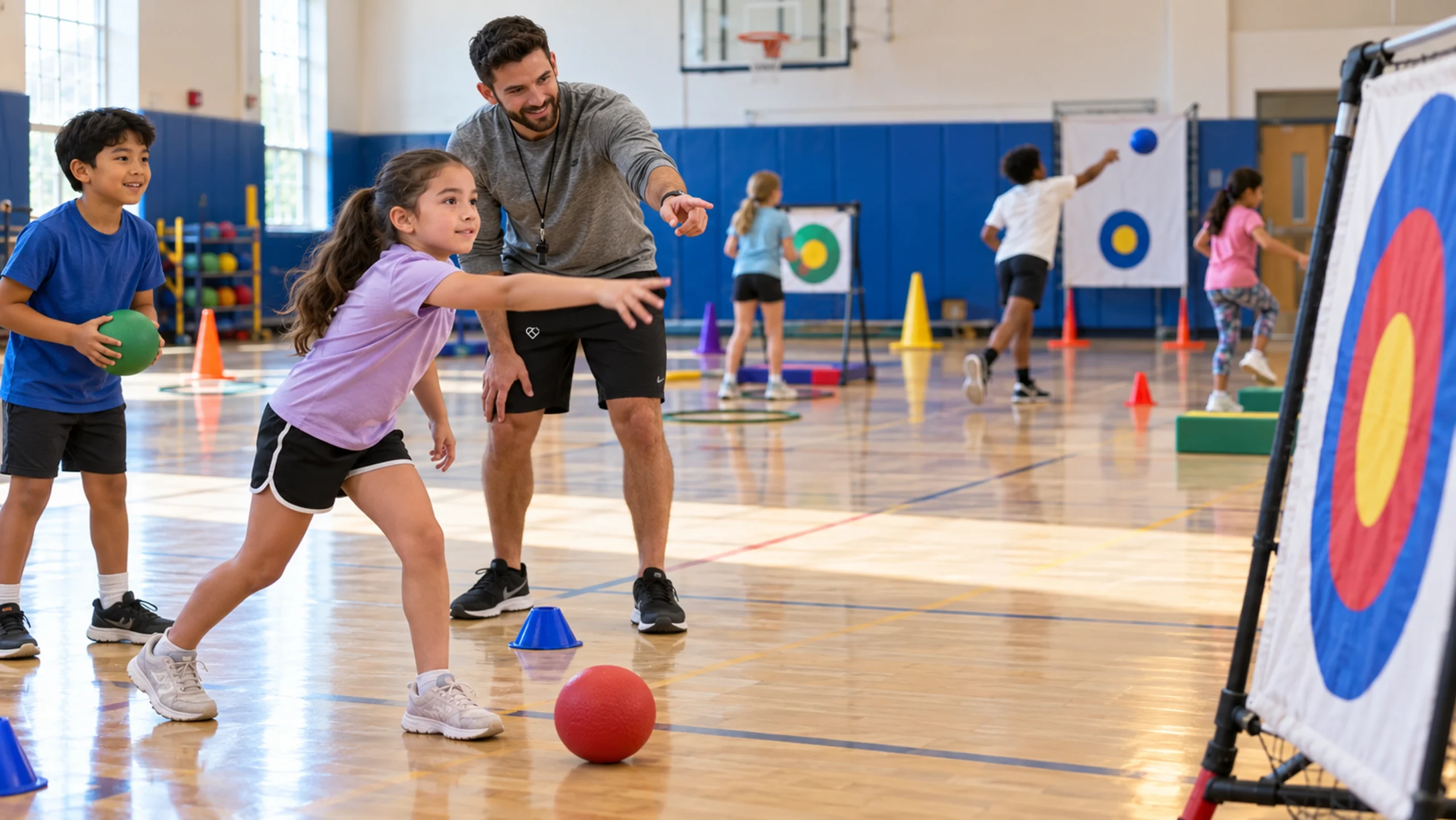
A student misses the catch, retrieves the ball, and tries again. Another misses the catch, looks around to see who noticed, and stops participating.
Both students experienced difficulty. Only one is still in a position to learn from it.
That difference matters. Productive struggle in PE is not about making activities harder or asking students to tolerate repeated failure. It means giving students a meaningful challenge, a realistic way forward, and enough support to make progress. Motor-learning research and research on student motivation support that combination—not difficulty for its own sake.pubmed.ncbi.nlm.nih+1
The goal is progress, not struggle.
What Is Productive Struggle in PE?
Productive struggle in PE is a manageable learning challenge in which students can attempt a movement skill, notice what happened, adjust their approach, and try again with appropriate support.
For example, a student learning to throw accurately might miss a target, receive a useful cue, move closer, and begin making more controlled throws. The skill still requires effort, but the student has something specific to work on.
This approach fits the challenge point framework developed by motor-learning researchers Mark Guadagnoli and Timothy Lee. Their central idea is that the same task presents different challenges to learners with different abilities. A task’s learning value depends on the interaction between its difficulty, the learner’s skill, and the information available during practice.pubmed.ncbi.nlm.nih
A basketball pass across the gym might be routine for one student and overwhelming for another. Giving everyone the same task does not give everyone the same learning opportunity.
Why Supported Challenge Helps Students Learn
1. Challenge gives students something useful to solve
When students already perform a task comfortably, repeating it may serve a purpose—but it may offer little new information. When the task is far beyond their current ability, they may struggle to understand what to change.
The challenge point framework proposes that useful practice sits between those extremes: students encounter enough difficulty to learn, without receiving more information than they can interpret and use. It is a framework for designing practice, not a formula that identifies one perfect difficulty level for every student.
In PE, that means adjusting the task rather than simply demanding more effort:
- Move a throwing target closer or farther away.
- Change the size or type of ball.
- Let students practice a movement before adding defensive pressure.
- Simplify a movement sequence before combining its parts.
- Add complexity when students demonstrate readiness.
These are practical applications of the framework. The question is not, “How hard can I make this?” It is, “What challenge can this student learn from?”
2. Confidence grows from evidence of improvement
Encouragement matters, but students also need evidence that their actions can produce success.
Psychologist Albert Bandura’s self-efficacy theory describes how people develop beliefs about their ability to complete particular tasks. Successful experiences—often called mastery experiences—are an especially influential source of those beliefs. Repeated failure, particularly before confidence is established, can have the opposite effect.
That helps explain why supported struggle can build confidence while unsupported struggle can undermine it.
Consider a student learning to jump rope. Asking for 20 consecutive jumps immediately may produce repeated failure. Beginning with a single controlled jump, then linking two or three, gives the student a way to experience improvement while still working toward a challenging skill.
The useful message is not, “You succeeded because you are naturally athletic.” It is:
“You changed your timing, and that helped you clear the rope.”
The student now has a reason to believe that a strategy—not luck—can improve the next attempt.
3. Motivation depends on how students experience the challenge
Students are not more motivated simply because an activity is difficult.
A systematic review and meta-analysis of 265 studies in school physical education found that satisfaction of students’ needs for autonomy, competence, and relatedness was strongly associated with autonomous motivation: participating because an activity feels interesting or personally valuable.findresearcher.sdu
For PE teachers, those needs translate into three useful questions:
- Competence: Can the student recognize a realistic path to improvement?
- Autonomy: Does the student have a meaningful choice or voice?
- Relatedness: Does the student feel supported by the teacher and classmates?
A challenging activity can support these needs when students can select an appropriate starting level, understand the goal, and receive respectful help. Difficulty without those conditions is not the same instructional experience. The evidence supports need-supportive teaching, not the claim that harder tasks automatically increase motivation.findresearcher.sdu
4. Challenge creates opportunities to practice resilience-related skills
A missed shot or an unsuccessful balance attempt can become an opportunity to practice responding to a setback:
- Notice the frustration.
- Pause rather than react impulsively.
- Identify something to change.
- Ask for help when needed.
- Return to the task.
These are useful teaching opportunities, but teachers should avoid overstating the research. A difficult PE lesson does not automatically create lasting resilience or transfer coping skills into every area of a student’s life.
Research on the Teaching Personal and Social Responsibility model treats effort, self-direction, supportive relationships, and transfer beyond PE as explicit instructional goals. The implication is important: teachers need to teach and discuss these skills, not assume that physical activity or struggle will develop them on its own.zaguan.unizar
Productive Struggle vs. Discouraging Overload
A missed attempt does not automatically mean the activity is too difficult. A completed task does not necessarily mean the student felt safe or learned something.
The distinction is whether the student still has an accessible route forward.
The following table is a practical observation guide informed by motor-learning and motivation research—not a validated diagnostic checklist.
| What to observe | Productive struggle | Possible discouraging overload |
|---|---|---|
| Understanding | The student knows the goal and can identify a next step. | The student remains confused about what to do or change. |
| Attempts | The student tries again and experiments with an adjustment. | Attempts become random, rushed, or stop altogether. |
| Feedback | The student can use a cue or demonstration. | Additional instructions do not help the student act. |
| Progress | There are signs of better control, understanding, or consistency. | Repeated attempts show no usable progress despite support. |
| Emotional response | Frustration occurs, but the student can recover with support. | Distress, embarrassment, or withdrawal persists. |
| Student voice | The student can explain what feels difficult. | The student reports that the task feels impossible, unsafe, or humiliating. |
Do not treat these observations as labels. A student who withdraws may need clearer directions, an equipment adjustment, less public attention, or a different way to access the activity—not a lecture about persistence.
Ask a specific question:
“Is the hardest part controlling the ball, understanding the task, or doing it while others watch?”
The answer helps identify what needs to change.
How to Support Productive Struggle in PE
Start with a clear learning target
“Practice throwing” leaves students with a broad assignment. “Step toward the target and see how that changes your accuracy” gives them something to investigate.
Before practice, establish:
- What students are learning.
- What they should notice.
- What they can change after an unsuccessful attempt.
Clear targets help make the information from practice more usable, consistent with the challenge point framework.pubmed.ncbi.nlm.nih
Adjust one source of difficulty at a time
If a student is struggling with a moving target, a small ball, a long distance, and defensive pressure, it is difficult to determine what is causing the problem.
A practical approach is to change one variable first. Shorten the distance, remove the defender, or use a more manageable ball. Then observe the next attempts.
This preserves the learning goal while adjusting the task’s demands to the learner’s current skill—the relationship at the center of the challenge point framework.pubmed.ncbi.nlm.nih
Support does not have to mean removing the challenge. It can mean removing an unnecessary barrier.
Give students choices within the same goal
For a catching lesson, offer options such as:
- A self-toss and catch.
- A partner toss from a short distance.
- A partner toss with an added movement requirement.
Students can work toward the same learning goal through different starting points. Allow movement between options rather than assigning permanent “low,” “middle,” and “high” groups.
This is a practical way to support autonomy while retaining instructional structure. PE research links autonomy and competence satisfaction with more autonomous motivation, although it does not establish that these particular task options will work equally well in every class.findresearcher.sdu
Pair encouragement with an actionable next step
“Keep trying” offers encouragement, but it does not explain what to try differently.
Use language such as:
“That catch got away from you. Watch the ball into your hands on the next toss.”
Or:
“You controlled the landing that time. Try the same landing after a slightly longer jump.”
The instructional aim is to connect an adjustment with observable progress. That gives students both usable information for practice and evidence of developing capability.
Avoid making persistence the only response you reward. Asking for a demonstration, selecting a more appropriate challenge, and taking a needed break can also be responsible decisions.
Make the coping skill explicit
If self-management is part of the lesson, teach it as deliberately as the movement skill.
A simple routine is:
Pause. Name the problem. Choose one adjustment. Try again.
After practice, ask:
- “What did you change after an unsuccessful attempt?”
- “What helped you return to the task?”
- “When did asking for help make a difference?”
These prompts reflect the intentional teaching of effort, self-direction, and responsibility described in responsibility-based PE approaches. They create an opportunity to discuss transfer without assuming it has already occurred.zaguan.unizar
Build support into the setup for large classes
Productive struggle cannot depend entirely on the teacher delivering individual feedback after every attempt.
Practical options include:
- Challenge stations with clear task cards.
- Equipment choices at the same station.
- A single observation cue for partners.
- A visible “make it simpler” and “add a challenge” option.
- Brief teacher check-ins focused on students who lack a next step.
These are implementation suggestions, not a separately tested intervention package. Their purpose is to make appropriate challenge, student choice, and usable information easier to access across the class.
A PE Example: Challenge Without Repeated Failure
Imagine a target-throwing lesson.
The learning goal is controlled accuracy—not throwing from the greatest distance.
One student begins close to a large target. Another works farther away. A third adds a step before throwing. All students observe where the ball lands and choose one adjustment.
A student who misses repeatedly receives a brief demonstration or moves closer. A student who demonstrates consistent control adds distance or a movement requirement.
The teacher asks:
“What changed when your throws became more accurate?”
The lesson still includes challenge, unsuccessful attempts, and persistence. But students also have choices, useful feedback, and a visible route to improvement. That combination reflects the motor-learning and motivation principles behind productive struggle.
Frequently Asked Questions About Productive Struggle in PE
Does productive struggle mean letting students fail?
It means allowing manageable errors within a supported learning process—not leaving students to fail repeatedly without guidance. Motor-learning theory emphasizes the relationship between difficulty and learner ability, while self-efficacy research shows why repeated failure can undermine confidence.
How do teachers know when to step in?
Step in when the student lacks a usable next step, cannot apply the available feedback, or continues to disengage despite support. Ask what feels difficult, then adjust the task, information, or social conditions. This is a practical judgment informed by challenge-point and motivation research, not a universal numerical threshold.
Can productive struggle build resilience?
It can provide opportunities to practice responding to setbacks, seeking help, and returning to a challenge. However, lasting resilience and transfer beyond PE should not be assumed. Responsibility-based PE approaches explicitly teach self-direction and discuss applying skills outside the lesson.zaguan.unizar
Should every student receive the same challenge?
No. The same activity can be easy for one student and overwhelming for another. Appropriate challenge depends on the learner’s skill and the task’s demands, so equipment, distance, rules, and support may need to differ.pubmed.ncbi.nlm.nih
What Teachers Should Aim For
Students do not need PE lessons designed to prove how much difficulty they can tolerate. They need opportunities to discover that an unfamiliar skill can become more manageable through practice, useful feedback, and appropriate support. That is the connection between challenge, learning, and confidence supported by motor-learning and self-efficacy research.
When a student struggles, the most useful teaching question is:
“Does this student have a realistic next step—and the support to take it?”