
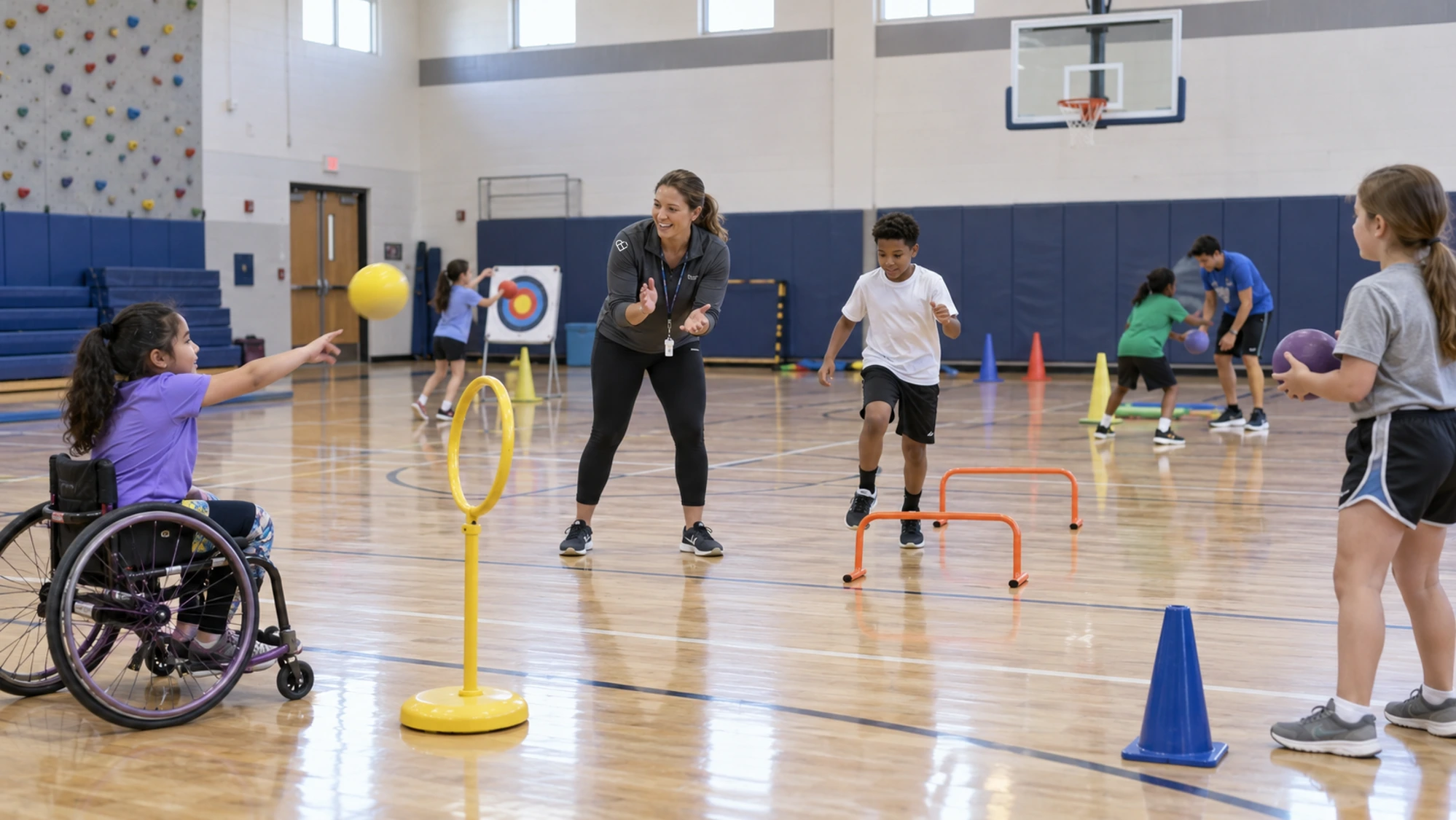
A single physical education class may include a competitive club athlete, a student who is still developing foundational motor skills, a learner with a disability or social-emotional vulnerability, and a student who avoids movement because PE feels embarrassing. The solution is not to create separate lessons for every student. It is to build one shared learning experience with multiple valid entry points, challenge levels, and ways to demonstrate growth.
Inclusive physical education means every student has meaningful access to learning, participation, social connection, and progress—not merely a place in the gym. Federal disability protections require equal opportunity in PE and physical activity, while CDC and SHAPE America guidance emphasizes adapting instruction, equipment, environments, rules, and assessment so students can participate alongside peers.
The Core Challenge of Mixed-Ability PE
Extreme variation in PE is structural, not a sign that a teacher has failed to plan. Students enter class with different:
- Motor-skill histories and movement confidence
- Fitness levels and physical development
- Disability-related needs, 504 accommodations, or IEP services
- Sport experiences outside school
- Sensory, communication, and executive-function needs
- Cultural experiences with sport and competition
- Feelings about their bodies, competence, and public performance
A traditional “one task, one standard, one pace” lesson tends to create predictable problems:
| Student group | What often happens in a uniform lesson | What they need instead |
|---|---|---|
| High-performing athletes | They finish early, dominate play, or disengage from repetitive basics | Complexity, decision-making, leadership, constraints, and meaningful challenge |
| Students with motor delays or disabilities | They wait, fail publicly, receive less practice, or are relegated to peripheral roles | Adapted access, sufficient repetitions, appropriate equipment, peer connection, and authentic contribution |
| Social-emotionally vulnerable students | They fear mistakes, comparison, elimination, or unwanted attention | Psychological safety, predictable routines, choice, private feedback, and self-referenced goals |
| Chronically inactive or disengaged students | They opt out, fake participation, avoid games, or experience PE as punishment | Early success, relevant options, autonomy, supportive relationships, and nonjudgmental re-entry points |
The goal is not identical performance. The goal is equitable access to rigorous learning. Every student should work toward the same broad learning intention—for example, “use space to maintain possession” or “send an object accurately to a target”—while using an appropriately challenging version of the task.
Use One Objective, Many Entry Points
The most effective planning move is to separate the learning target from the task format.
For example, instead of planning, “Students will play a 5v5 soccer game,” identify the actual learning goal:
“Students will use passing, movement, and space awareness to help their team maintain possession.”
Once the objective is clear, create pathways that preserve the learning goal while varying equipment, space, speed, rules, support, or complexity.
Build a task progression, not a fixed activity
Use a three-level or four-level task design. Avoid labeling groups “advanced,” “average,” or “low.” Use neutral names such as Explore, Build, Apply, and Extend, or let students choose a starting point.
| Task pathway | Example: Passing and receiving lesson | Who benefits |
|---|---|---|
| Explore | Pass a larger, softer ball with a partner from a short distance; stop the ball before returning it | Students needing more control, reduced speed, or confidence |
| Build | Pass and receive while moving through open space; use a defender-free or low-pressure condition | Most students developing the skill |
| Apply | Play small-sided possession games with constraints such as a three-pass sequence before scoring | Students ready to make tactical decisions under pressure |
| Extend | Add one-touch options, numerical disadvantage, scanning requirements, weaker-side constraints, or peer-coaching responsibilities | Skilled athletes needing cognitive and tactical challenge |
This approach prevents two common errors:
- Making skilled students repeat low-level tasks without meaningful learning.
- Placing students who need support into tasks that are too fast, public, or complex to produce success.
A shared objective with differentiated challenge also aligns with research on mastery-oriented motivational climates. In a mastery climate, success is defined through learning, effort, improvement, collaboration, and self-referenced progress—not outperforming classmates. PE studies associate mastery-oriented teaching approaches with more autonomous motivation and less amotivation.
Differentiate the Task, Not the Student’s Worth
Differentiation should change the conditions of learning, not communicate that some students are more valued than others. The teacher’s language matters.
Avoid:
- “You use the easy ball.”
- “You can just keep score.”
- “Let the good players show everyone.”
- “Try harder.”
- “You are on the modified version.”
Use:
- “Choose the tool that helps you work on today’s target.”
- “Select a challenge that gives you about a 70–80% success rate.”
- “When you are consistently successful, add one constraint.”
- “Everyone is working on control, decision-making, and movement—your version may look different.”
- “Tell me what adjustment would make this task challenging and doable.”
Six high-impact ways to adjust a PE task
Teachers do not need a new curriculum for every learner. Start by changing one or two variables:
| Variable | Ways to adapt it | Example |
|---|---|---|
| Equipment | Size, weight, texture, bounce, color contrast, grip, sound | Use a foam ball, beach ball, yarn ball, bell ball, larger target, or short-handled implement |
| Space | Distance, boundaries, traffic, visual cues, surface | Shorten the pass, widen a lane, use floor spots, create a quieter practice zone |
| Time | Pace, wait time, work-to-rest ratio, transition speed | Allow more processing time or increase the tempo for students who need a greater challenge |
| Rules | Contacts, scoring, movement restrictions, defensive pressure | Permit a bounce, require everyone to touch the ball, use walking defense, or add a decision-making constraint |
| Support | Peer partner, visual model, teacher prompt, communication system | Provide picture cues, a demonstration, a peer model, or a consistent partner |
| Outcome | Distance, accuracy, tactical complexity, movement quality | Measure personal accuracy growth rather than a single class-wide performance threshold |
CDC guidance specifically identifies adaptations to teaching strategies, equipment, environments, and assessments as central to inclusive PE.
Design for Participation Before Problems Arise
Universal Design for Learning, or UDL, is useful because it shifts planning from retrofitting an activity after a student struggles to proactively offering multiple ways to engage, understand, move, and show learning.
In PE, that means providing options in three areas:
Multiple ways to engage
Students are more likely to participate when they have a meaningful degree of choice and perceive the task as relevant and achievable.
Offer bounded choices, not unlimited free choice:
- Choose between two locomotor pathways, such as a dance sequence or fitness circuit.
- Choose an individual, partner, or small-group practice format.
- Choose a target distance or task level.
- Choose a role within a team that still involves movement and learning.
- Choose music, equipment, or a culturally relevant activity variation when feasible.
Autonomy support in PE is associated with stronger satisfaction of students’ psychological needs, intrinsic motivation, positive emotions, and intentions to remain physically active. An umbrella review of school-based physical-activity interventions similarly found that approaches grounded in self-determination theory—especially those using autonomy-supportive instruction—were effective for strengthening intrinsic motivation, autonomy, and competence.
Multiple ways to receive information
PE teachers often rely almost entirely on verbal explanation followed by a whole-class demonstration. That format can disadvantage students who need more processing time, visual supports, repeated cues, or a quieter learning environment.
Use a combination of:
- Brief teacher demonstrations
- Visual task cards with icons or photos
- One or two critical cues, rather than five corrections at once
- Color-coded pathways, targets, or stations
- Video clips or QR-linked demonstrations when appropriate
- Peer modeling
- Check-for-understanding prompts such as, “Show me where your eyes go before you receive the pass.”
Keep instruction short, then get students moving. Revisit cues during activity rather than turning every correction into another stoppage.
Multiple ways to act and show learning
A student can understand a tactical concept without demonstrating it through the same motor output as every peer. For example, a student might show an understanding of space by moving to an open passing lane, directing a teammate, selecting a target, using a visual communication board, or explaining a decision after a modified game.
This does not mean lowering expectations. It means measuring the intended learning, rather than treating one narrow movement pattern as the only valid evidence of learning.
UDL-oriented approaches in PE emphasize flexible engagement, representation, and action/expression. At the same time, the evidence base is still developing, so teachers should use UDL as a practical planning framework while monitoring whether individual adaptations actually improve participation and learning.
Make Challenge Visible and Safe
Students who are highly skilled need more than extra repetitions. They need problems worth solving. But extension work should not turn them into unpaid assistant teachers or isolate them from classmates.
Challenge club athletes with constraints
Instead of asking skilled athletes to “help others” for an entire lesson, increase the tactical, technical, or cognitive demand:
- Use a weaker hand, weaker foot, or non-dominant side.
- Reduce time and space.
- Add scanning or communication requirements before receiving an object.
- Create a numerical disadvantage, such as 2v3.
- Require a specific tactical decision before scoring.
- Add a leadership role for a brief rotation, then return the student to learning.
- Ask the student to design a constraint that improves the team’s learning goal.
- Use performance analysis: “What option did you see? What cue told you to choose it?”
A high-performing student remains a student. They should have the same right to feedback, challenge, mistakes, and growth as everyone else.
Protect students from public failure
For students with low confidence, the most harmful structures are often not the activity itself but the social conditions around it:
- Captains selecting teams publicly
- Elimination games
- Whole-class comparison charts
- Fitness scores announced aloud
- “Last person standing” activities
- Competition before students have had time to practice
- Being singled out for a modification
- Being assigned a sedentary helper role rather than a movement role
Replace those structures with:
- Teacher-created, random, or intentionally balanced groups
- Continuous re-entry instead of elimination
- Small-sided games and small practice groups
- Private or self-tracked progress data
- Cooperative goals alongside individual goals
- Multiple ways to contribute physically and socially
- Error-normalizing language: “We are collecting information, not proving who is good.”
Students are more likely to engage when they feel competent, connected, and able to make meaningful choices. These are the core needs described by self-determination theory: autonomy, competence, and relatedness.
Use Small-Sided, High-Activity Structures
When skill differences are large, whole-class games magnify inequity. More confident students tend to control the object, less confident students touch it less often, and teachers struggle to give feedback while managing congestion and safety.
Small-sided formats are often a better default because they increase opportunities to practice, decide, communicate, and re-enter after errors.
Try:
- 1v1, 2v2, 3v3, or 4v4 rather than large-team games.
- Station rotations with different task demands.
- Partner tasks before competitive play.
- Cooperative challenges with shared team targets.
- Modified invasion games with protected zones or designated passing lanes.
- Short rounds followed by reflection and a chance to adjust the challenge.
- Multiple activity lanes, each built around the same learning target.
Example: Inclusive striking and fielding lesson
Learning target: “I can strike an object into open space and make a safe movement decision after striking.”
Rather than one full-class kickball game:
- Station 1: Strike a balloon or beach ball from a tee toward a wide target.
- Station 2: Strike a foam ball from a tee and choose between two running pathways.
- Station 3: Partner striking with a fielder who uses a catch-or-stop option.
- Station 4: Small-sided 3v3 striking game with a “three successful passes or fielding actions” team target.
- Extension: Skilled students strike with a weaker side, use directional placement, or make tactical choices based on defenders’ positions.
Every student works on striking, space, safety, and decision-making. The motor demand, speed, equipment, and social pressure vary without changing the value of the learning.
Plan Inclusion With the Student Team
Some needs can be anticipated through universal design. Others require individualized planning. For students with disabilities, collaboration is essential.
Before a unit or when needs change, consult as appropriate with:
- The student
- Families or caregivers
- Special educators
- Adapted physical education specialists
- Occupational, physical, or speech-language therapists
- School nurses
- Paraprofessionals
- Counselors or behavior-support staff
- The student’s IEP or 504 team
Start with strengths and preferences:
- What activities does the student enjoy?
- What conditions help them feel safe and willing to participate?
- What movements are accessible, emerging, or fatiguing?
- What communication supports are effective?
- What sensory, social, or environmental barriers should be anticipated?
- What does meaningful progress look like for this student?
Do not assume that an adult aide should automatically become the student’s partner or that the student should always complete a separate activity. The least restrictive and most socially inclusive option is often participation with peers using purposeful adaptations.
CDC notes that schools commonly address PE accommodations through IEPs or 504 plans and identifies collaboration with adapted PE specialists, disability organizations, and allied health professionals as important parts of inclusive practice.
Assess Growth Without Ranking Students
Assessment can either reinforce inequity or make individual progress visible. In classes with extreme skill variation, use criterion-referenced and self-referenced assessment more often than norm-referenced comparison.
Instead of asking, “Who ran the fastest?” ask:
- Can the student identify and apply the learning cue?
- Did the student select an appropriate challenge level?
- Did they increase successful attempts over time?
- Can they make a safer or more effective movement decision?
- Can they explain what adaptation helps them learn?
- Did they contribute to a respectful, inclusive activity environment?
- Did they show persistence, adjustment, and reflection?
Use a “challenge–evidence–next step” routine
At the end of class, have students complete a quick reflection:
- Challenge: Which version of the task did you choose?
- Evidence: What shows that you improved, learned, or contributed?
- Next step: What will you adjust next class?
This routine gives the club athlete a reason to move beyond easy success, gives a beginner a way to recognize real growth, and gives disengaged students a manageable re-entry point.
SHAPE America’s National Physical Education Standards describe what students should know and be able to do in a highly effective PE program, and its instructional-practice guidance addresses learning environment, instructional strategies, curriculum, assessment, and professionalism.
A Practical Lesson-Planning Template
Use this checklist when planning a mixed-ability PE lesson.
1. Write one shared learning target
Example: “Students will use controlled force to send an object toward a target.”
2. Identify the nonnegotiable learning
Ask: What must every student understand or practice today?
For the target above, the nonnegotiable may be controlling force and observing the result—not throwing the same distance or using the same object.
3. Pre-plan at least three task variations
Adjust equipment, distance, speed, target size, partner support, or rules before students arrive.
4. Add an extension, not just a harder version
For advanced learners, include strategy, decision-making, constraints, or self-analysis—not simply more volume.
5. Remove predictable exclusion points
Eliminate public team selection, elimination, long waiting lines, and scoring systems that reward only the most skilled students.
6. Build in student choice
Offer two or three meaningful options connected to the same learning goal.
7. Decide how you will assess progress
Use observation criteria, individual goals, brief conferences, self-reflection, or skill evidence rather than one class-wide performance ranking.
8. Debrief inclusion
Ask students:
- “What helped you participate today?”
- “What made the task more challenging?”
- “How did your group help everyone stay involved?”
- “What would improve access next time?”
What Inclusive PE Is Not
Inclusive PE is not:
- Giving a student a clipboard, scorekeeping job, or sideline role as a substitute for movement.
- Expecting high-skilled students to teach all lesson long.
- Reducing rigor for students who need adaptations.
- Treating accommodations as unfair advantages.
- Assuming disability, low skill, low fitness, or disengagement means low potential.
- Making every student perform an identical task to prove fairness.
- Using competition as the only source of motivation.
Inclusion is a teaching practice, not merely a placement decision. It requires designing lessons so students can access the curriculum physically, socially, and emotionally.
The Bottom Line
The strongest PE lessons do not ask, “How can I make everyone do the same thing?” They ask, “How can every student pursue the same meaningful learning goal at an appropriate level of challenge?”
When PE teachers combine tiered tasks, adaptive equipment, small-sided learning structures, mastery-based assessment, autonomy-supportive choices, and purposeful collaboration, they can serve both ends of the skill spectrum without sacrificing rigor. The club athlete gets complexity. The student with motor or social-emotional needs gets authentic access and belonging. The disengaged learner gets a safer path back into movement.
That is not a watered-down version of physical education. It is high-quality physical education: active, challenging, evidence-informed, and designed so every student has a real chance to learn.
