
Inclusive Physical Education: How to Teach Extreme Skill Differences
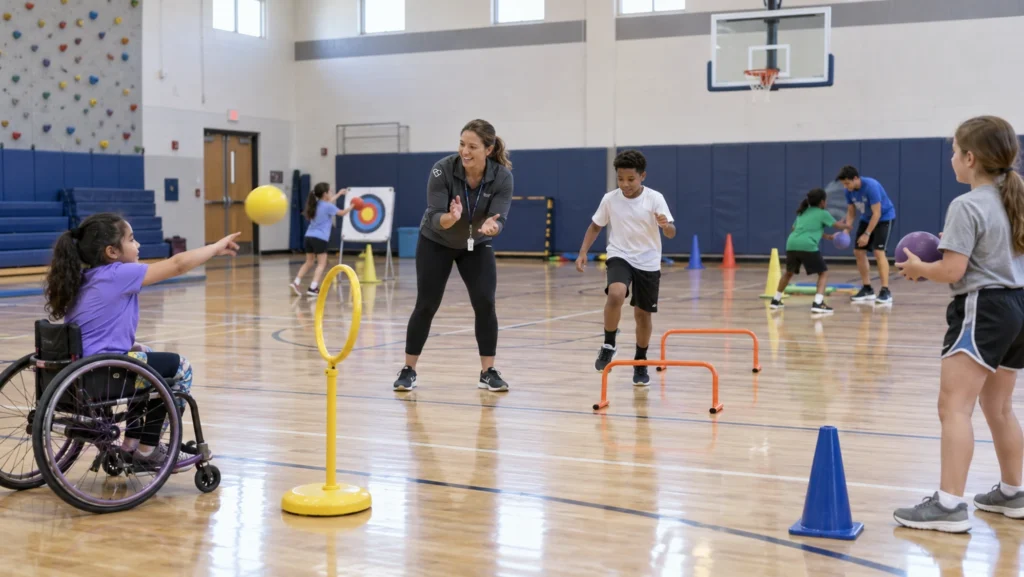
A single physical education class may include a competitive club athlete, a student who is still developing foundational motor skills, a learner with a disability or social-emotional vulnerability, and a student who avoids movement because PE feels embarrassing. The solution is not to create separate lessons for every student. It is to build one shared learning experience with multiple valid entry points, challenge levels, and ways to demonstrate growth. Inclusive physical education means every student has meaningful access to learning, participation, social connection, and progress—not merely a place in the gym. Federal disability protections require equal opportunity in PE and physical activity, while CDC and SHAPE America guidance emphasizes adapting instruction, equipment, environments, rules, and assessment so students can participate alongside peers. The Core Challenge of Mixed-Ability PE Extreme variation in PE is structural, not a sign that a teacher has failed to plan. Students enter class with different: A traditional “one task, one standard, one pace” lesson tends to create predictable problems: Student group What often happens in a uniform lesson What they need instead High-performing athletes They finish early, dominate play, or disengage from repetitive basics Complexity, decision-making, leadership, constraints, and meaningful challenge Students with motor delays or disabilities They wait, fail publicly, receive less practice, or are relegated to peripheral roles Adapted access, sufficient repetitions, appropriate equipment, peer connection, and authentic contribution Social-emotionally vulnerable students They fear mistakes, comparison, elimination, or unwanted attention Psychological safety, predictable routines, choice, private feedback, and self-referenced goals Chronically inactive or disengaged students They opt out, fake participation, avoid games, or experience PE as punishment Early success, relevant options, autonomy, supportive relationships, and nonjudgmental re-entry points The goal is not identical performance. The goal is equitable access to rigorous learning. Every student should work toward the same broad learning intention—for example, “use space to maintain possession” or “send an object accurately to a target”—while using an appropriately challenging version of the task. Use One Objective, Many Entry Points The most effective planning move is to separate the learning target from the task format. For example, instead of planning, “Students will play a 5v5 soccer game,” identify the actual learning goal: “Students will use passing, movement, and space awareness to help their team maintain possession.” Once the objective is clear, create pathways that preserve the learning goal while varying equipment, space, speed, rules, support, or complexity. Build a task progression, not a fixed activity Use a three-level or four-level task design. Avoid labeling groups “advanced,” “average,” or “low.” Use neutral names such as Explore, Build, Apply, and Extend, or let students choose a starting point. Task pathway Example: Passing and receiving lesson Who benefits Explore Pass a larger, softer ball with a partner from a short distance; stop the ball before returning it Students needing more control, reduced speed, or confidence Build Pass and receive while moving through open space; use a defender-free or low-pressure condition Most students developing the skill Apply Play small-sided possession games with constraints such as a three-pass sequence before scoring Students ready to make tactical decisions under pressure Extend Add one-touch options, numerical disadvantage, scanning requirements, weaker-side constraints, or peer-coaching responsibilities Skilled athletes needing cognitive and tactical challenge This approach prevents two common errors: A shared objective with differentiated challenge also aligns with research on mastery-oriented motivational climates. In a mastery climate, success is defined through learning, effort, improvement, collaboration, and self-referenced progress—not outperforming classmates. PE studies associate mastery-oriented teaching approaches with more autonomous motivation and less amotivation. Differentiate the Task, Not the Student’s Worth Differentiation should change the conditions of learning, not communicate that some students are more valued than others. The teacher’s language matters. Avoid: Use: Six high-impact ways to adjust a PE task Teachers do not need a new curriculum for every learner. Start by changing one or two variables: Variable Ways to adapt it Example Equipment Size, weight, texture, bounce, color contrast, grip, sound Use a foam ball, beach ball, yarn ball, bell ball, larger target, or short-handled implement Space Distance, boundaries, traffic, visual cues, surface Shorten the pass, widen a lane, use floor spots, create a quieter practice zone Time Pace, wait time, work-to-rest ratio, transition speed Allow more processing time or increase the tempo for students who need a greater challenge Rules Contacts, scoring, movement restrictions, defensive pressure Permit a bounce, require everyone to touch the ball, use walking defense, or add a decision-making constraint Support Peer partner, visual model, teacher prompt, communication system Provide picture cues, a demonstration, a peer model, or a consistent partner Outcome Distance, accuracy, tactical complexity, movement quality Measure personal accuracy growth rather than a single class-wide performance threshold CDC guidance specifically identifies adaptations to teaching strategies, equipment, environments, and assessments as central to inclusive PE. Design for Participation Before Problems Arise Universal Design for Learning, or UDL, is useful because it shifts planning from retrofitting an activity after a student struggles to proactively offering multiple ways to engage, understand, move, and show learning. In PE, that means providing options in three areas: Multiple ways to engage Students are more likely to participate when they have a meaningful degree of choice and perceive the task as relevant and achievable. Offer bounded choices, not unlimited free choice: Autonomy support in PE is associated with stronger satisfaction of students’ psychological needs, intrinsic motivation, positive emotions, and intentions to remain physically active. An umbrella review of school-based physical-activity interventions similarly found that approaches grounded in self-determination theory—especially those using autonomy-supportive instruction—were effective for strengthening intrinsic motivation, autonomy, and competence. Multiple ways to receive information PE teachers often rely almost entirely on verbal explanation followed by a whole-class demonstration. That format can disadvantage students who need more processing time, visual supports, repeated cues, or a quieter learning environment. Use a combination of: Keep instruction short, then get students moving. Revisit cues during activity rather than turning every correction into another stoppage. Multiple ways to act and show learning A student can understand a tactical concept without demonstrating it through the same motor output as every