
Why Progress Changes Motivation
A student may hear “Good job!” several times during a PE class and still wonder, Am I actually improving? Encouragement can reinforce effort, but visible evidence helps students connect that effort to a meaningful result.
Visible progress in PE gives students a concrete answer to questions such as:
- What can I do now that I could not do before?
- Which part of this skill is improving?
- What should I practice next?
- How can I tell whether my strategy is working?
This matters because motivation is stronger when students experience competence, autonomy, and ownership. Research on physical education goal setting indicates that appropriately designed goals can improve task motivation and support the development of physical and developmental skills. Formative assessment can also help students recognize what they already understand and identify what they need to work on next. eric.ed
The goal is not to turn PE into a competition or make every lesson about scores. The goal is to help students notice growth.
Encouragement Is Not Enough
Praise is most useful when it is specific and connected to a behavior. “Nice work” is positive, but “You kept your eyes on the target and followed through” gives students information they can use.
Even specific encouragement, however, may not show the full learning process. A student who struggles with an overhand throw may hear positive feedback but fail to recognize gradual improvement in:
- Stance and balance.
- Arm position.
- Step-and-throw coordination.
- Direction and accuracy.
- Follow-through.
- Willingness to try again.
A simple progress record makes these changes easier to see. It shifts feedback from a general judgment to a learning conversation:
“Your accuracy improved from 3 successful throws to 6. What did you change?”
That question invites reflection, rather than asking students to rely entirely on the teacher’s opinion.
The Evidence Behind Tracking Growth
Visible progress connects several evidence-informed practices:
Formative assessment
Formative assessment provides information during learning, not only after a unit ends. In PE, this may include teacher observation, peer feedback, student reflection, skill checklists, or brief performance demonstrations.
Recent research on student involvement in formative assessment found that students benefited from visible examples of quality, clear criteria, targeted teacher questions, and opportunities to discuss performance expectations. These practices helped shift responsibility toward student learning ownership.tandfonline
Goal setting
Goals give students a specific direction for practice. Effective PE goals should be:
- Personal rather than based only on comparison with classmates.
- Focused on improvement or learning.
- Challenging but realistic.
- Observable or measurable.
- Flexible when students need a different level of support.
For example, “Get better at basketball” is too broad. “Complete five controlled dribbles with my eyes forward” is more useful because the student can practice it and recognize progress.
Self-monitoring
Self-monitoring asks students to collect or notice information about their own learning. This can strengthen reflection and help students make decisions about practice.
A student might record:
- Number of successful passes.
- Time maintaining a plank with safe form.
- Consecutive jump-rope repetitions.
- Completion of a movement sequence.
- Use of a personal or interpersonal strategy.
- Confidence before and after practice.
Self-monitoring should support learning—not label students permanently or rank them publicly.
Simple Ways to Make Progress Visible
Teachers do not need expensive technology or complicated data systems. A clipboard, index card, whiteboard, or student notebook can be enough.
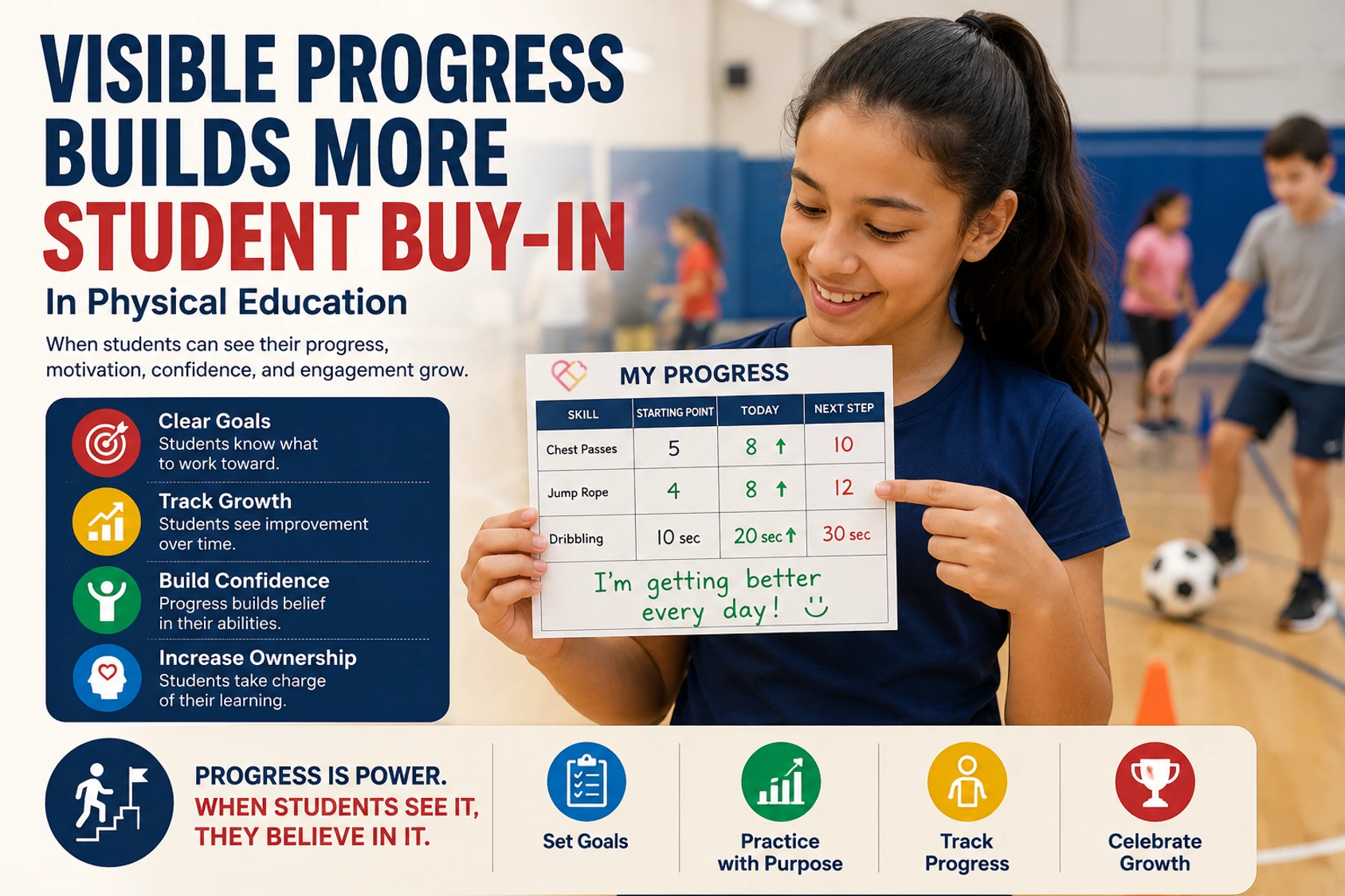
1. Use a “starting point and next step” card
At the beginning of a unit, students record a baseline. The baseline might be a performance count, a skill level, or a short reflection.
Example:
| Skill | Starting point | Next step |
|---|---|---|
| Chest passes to a partner | 5 accurate passes | 8 accurate passes |
| Jump-rope rhythm | 4 consecutive jumps | 8 consecutive jumps |
| Soccer dribbling | Controlled for 10 seconds | Controlled for 20 seconds |
At the end of the lesson or week, students update the card. The emphasis remains on movement from one point to another.
2. Create personal progress ladders
A progress ladder breaks a complex skill into manageable stages. Students highlight or circle the level they are currently working toward.
For an underhand serve, a ladder might include:
- I can face the target and use a ready position.
- I can contact the ball with a controlled swing.
- I can send the ball over a short-distance net.
- I can serve over the regulation net.
- I can serve with improved placement.
Students do not have to move through every level at the same speed. The ladder simply makes the learning pathway visible.
This aligns well with standards-based instruction because learning progressions show how students can develop toward broader physical education outcomes. SHAPE America’s National Physical Education Standards include motor skills, movement concepts, social skills, and personal skills related to lifelong physical activity.shapeamerica
3. Track quality, not only quantity
Counting repetitions can be useful, but more is not always better. A student who completes 20 poorly controlled repetitions may need a different goal from a student who completes 8 repetitions with strong technique.
Use short quality criteria such as:
- Balanced starting position.
- Controlled movement.
- Appropriate force.
- Safe landing.
- Eyes focused on the task.
- Cooperation with a partner.
- Recovery after an error.
Students can use a three-point scale:
- Not yet: I am still learning this part.
- Developing: I can do it sometimes.
- Consistent: I can do it independently and safely.
This gives students a more accurate picture of growth than a single performance score.
4. Use “before and after” demonstrations
Invite students to demonstrate a skill at the beginning and end of a lesson or unit. The demonstrations can be brief and private, partner-based, or recorded only when school policies and family permissions allow it.
Students can compare the two attempts using one prompt:
- What changed?
- What stayed the same?
- What helped you improve?
- What will you practice next?
The comparison should focus on learning evidence, not appearance or athletic ability.
5. Add progress checkpoints
Build short checkpoints into instruction rather than waiting for a final assessment.
A checkpoint might ask students to:
- Demonstrate one target skill.
- Identify one strength.
- Choose one next step.
- Explain which cue helped them.
- Give a partner feedback using one agreed-upon criterion.
A two-minute checkpoint at the end of class can provide more useful information than a lengthy end-of-unit test.
Make Tracking Motivating
Progress tracking can increase ownership, but only when students experience it as supportive. Poorly designed tracking can create anxiety, embarrassment, or unhealthy comparison.
Use these principles:
Compare students with their own previous performance
A personal-best model helps students focus on growth. It also recognizes that students begin with different experiences, abilities, confidence levels, and access to physical activity.
Instead of displaying a class leaderboard, display examples of learning behaviors:
- Practiced a new strategy.
- Gave useful peer feedback.
- Adjusted technique.
- Persisted after an error.
- Set a realistic next goal.
Let students help choose goals
Offer a small menu of appropriate goals or allow students to select a target within a defined range. Choice supports autonomy, one of the psychological needs associated with self-determined motivation in PE. Research has linked more self-determined forms of motivation with desirable engagement-related responses in physical education.pmc.ncbi.nlm.nih
For example, during a fitness circuit, students might choose to improve:
- Number of controlled repetitions.
- Recovery between stations.
- Movement quality.
- Consistency across rounds.
- Use of breathing strategies.
Keep records private and purposeful
Progress charts should belong to the student, teacher, or learning team—not function as public rankings.
Avoid requiring students to publicly disclose:
- Body weight.
- Body composition.
- Personal medical information.
- Fitness results that may be sensitive.
- Comparisons with classmates.
Use secure, age-appropriate systems when collecting digital data. For many PE goals, a paper tracker or teacher observation note may be sufficient.
Celebrate strategies, not just outcomes
A student may not reach a target every time. However, the student may still demonstrate meaningful growth by changing a strategy, asking for feedback, or persisting through difficulty.
Teacher language can reinforce this:
- “Your first strategy did not work, so you tried a different one.”
- “You noticed your balance changed and adjusted your landing.”
- “You identified a specific next step without waiting for me to tell you.”
- “Your result stayed similar, but your technique became safer and more controlled.”
A Practical Progress Tracker
The following format can work across elementary, middle, and high school PE with age-appropriate language.
My PE progress check
Skill or goal:
At the start, I could:
Today, I can: _
Evidence of progress:
- Number, time, distance, or successful attempts:
- Quality feature I demonstrated:
- Strategy that helped: _
My next step:
Confidence rating:
- 1 — I need significant support.
- 2 — I am developing.
- 3 — I can do this with occasional support.
- 4 — I can do this independently.
- 5 — I can help explain or demonstrate it to someone else.
The confidence rating should not replace performance evidence. It adds information about how students perceive their learning and can reveal when a student needs encouragement, clarification, or a more appropriate challenge.
Example: Applying It to a Throwing Unit
Imagine a fourth-grade class learning to throw to a target. The teacher begins with a baseline: each student gets ten attempts from an appropriate distance.
A student records:
- Baseline: 3 accurate throws out of 10.
- Focus cue: Step toward the target.
- Midpoint: 5 accurate throws out of 10.
- Next step: Keep the non-throwing shoulder pointed toward the target.
- Final result: 7 accurate throws out of 10.
The most important evidence is not simply the increase from 3 to 7. Students also see the relationship between a technical adjustment and improved performance. That connection can build confidence and encourage purposeful practice.
The teacher might ask:
“What did you change between your first and final attempts, and how did that affect your accuracy?”
Students are then using assessment as a tool for learning rather than experiencing it as a judgment delivered at the end.
Avoid Common Tracking Problems
Visible progress works best when the system is simple and inclusive. Watch for these problems:
- Tracking too much: Choose one or two meaningful indicators instead of recording every detail.
- Rewarding athletic ability: Measure learning behaviors, technique, decision-making, and personal improvement.
- Using fixed targets: Offer adaptations in distance, equipment, time, rules, or complexity.
- Public comparison: Protect student privacy and emphasize individual growth.
- Treating numbers as the whole story: Combine quantitative evidence with student reflection and teacher observation.
- Making the tracker the lesson: Keep most class time active, instructional, and socially engaging.
- Ignoring emotional responses: Let students revise goals when a target feels unrealistic or no longer meaningful.
A strong tracking system answers the question, “What did I learn, and what can I do next?” It should never reduce a student’s identity to a score.
Frequently Asked Questions
What is visible progress in PE?
Visible progress in PE is evidence that helps students recognize changes in their skills, knowledge, effort, decision-making, fitness behaviors, or confidence over time. Examples include a skill checklist, personal goal chart, before-and-after demonstration, or reflection showing how a strategy improved performance.
Does progress tracking make PE too competitive?
It can if students are ranked or compared publicly. Personal progress tracking reduces unnecessary competition by focusing students on their own starting point, next step, and learning strategies.
What should PE teachers track?
Track information connected to the lesson objective. This might include skill accuracy, movement quality, decision-making, cooperation, safe technique, persistence, or the ability to explain a movement concept.
How often should students record progress?
Short, regular check-ins are usually more practical than lengthy assessments. Teachers might use a one-minute reflection each lesson, a progress checkpoint once a week, and a more complete review at the end of a unit.
Can young students track their own progress?
Yes. Younger students can use pictures, symbols, color-coded ladders, thumbs-up scales, or simple “I can” statements. The teacher should model how to interpret evidence and help students choose realistic next steps.
The Takeaway for PE Teachers
Students are more likely to buy into PE when they can see that practice leads somewhere. Encouragement tells students that their effort matters; visible progress helps them understand how that effort is producing change.
Start with one target, one baseline, and one next step. When students can identify their growth, explain what helped them improve, and choose what to work on next, assessment becomes more than a grade—it becomes a pathway to motivation, confidence, and ownership.
