How Visible Progress Builds More Student Buy-In in PE
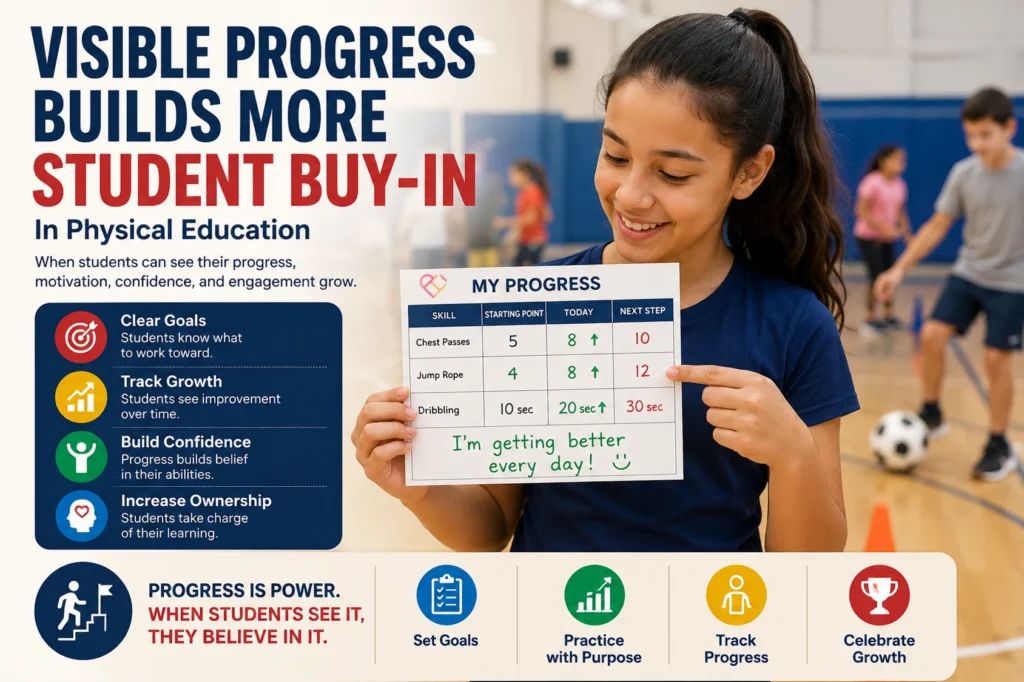
Why Progress Changes Motivation A student may hear “Good job!” several times during a PE class and still wonder, Am I actually improving? Encouragement can reinforce effort, but visible evidence helps students connect that effort to a meaningful result. Visible progress in PE gives students a concrete answer to questions such as: This matters because motivation is stronger when students experience competence, autonomy, and ownership. Research on physical education goal setting indicates that appropriately designed goals can improve task motivation and support the development of physical and developmental skills. Formative assessment can also help students recognize what they already understand and identify what they need to work on next. eric.ed The goal is not to turn PE into a competition or make every lesson about scores. The goal is to help students notice growth. Encouragement Is Not Enough Praise is most useful when it is specific and connected to a behavior. “Nice work” is positive, but “You kept your eyes on the target and followed through” gives students information they can use. Even specific encouragement, however, may not show the full learning process. A student who struggles with an overhand throw may hear positive feedback but fail to recognize gradual improvement in: A simple progress record makes these changes easier to see. It shifts feedback from a general judgment to a learning conversation: “Your accuracy improved from 3 successful throws to 6. What did you change?” That question invites reflection, rather than asking students to rely entirely on the teacher’s opinion. The Evidence Behind Tracking Growth Visible progress connects several evidence-informed practices: Formative assessment Formative assessment provides information during learning, not only after a unit ends. In PE, this may include teacher observation, peer feedback, student reflection, skill checklists, or brief performance demonstrations. Recent research on student involvement in formative assessment found that students benefited from visible examples of quality, clear criteria, targeted teacher questions, and opportunities to discuss performance expectations. These practices helped shift responsibility toward student learning ownership.tandfonline Goal setting Goals give students a specific direction for practice. Effective PE goals should be: For example, “Get better at basketball” is too broad. “Complete five controlled dribbles with my eyes forward” is more useful because the student can practice it and recognize progress. Self-monitoring Self-monitoring asks students to collect or notice information about their own learning. This can strengthen reflection and help students make decisions about practice. A student might record: Self-monitoring should support learning—not label students permanently or rank them publicly. Simple Ways to Make Progress Visible Teachers do not need expensive technology or complicated data systems. A clipboard, index card, whiteboard, or student notebook can be enough. 1. Use a “starting point and next step” card At the beginning of a unit, students record a baseline. The baseline might be a performance count, a skill level, or a short reflection. Example: Skill Starting point Next step Chest passes to a partner 5 accurate passes 8 accurate passes Jump-rope rhythm 4 consecutive jumps 8 consecutive jumps Soccer dribbling Controlled for 10 seconds Controlled for 20 seconds At the end of the lesson or week, students update the card. The emphasis remains on movement from one point to another. 2. Create personal progress ladders A progress ladder breaks a complex skill into manageable stages. Students highlight or circle the level they are currently working toward. For an underhand serve, a ladder might include: Students do not have to move through every level at the same speed. The ladder simply makes the learning pathway visible. This aligns well with standards-based instruction because learning progressions show how students can develop toward broader physical education outcomes. SHAPE America’s National Physical Education Standards include motor skills, movement concepts, social skills, and personal skills related to lifelong physical activity.shapeamerica 3. Track quality, not only quantity Counting repetitions can be useful, but more is not always better. A student who completes 20 poorly controlled repetitions may need a different goal from a student who completes 8 repetitions with strong technique. Use short quality criteria such as: Students can use a three-point scale: This gives students a more accurate picture of growth than a single performance score. 4. Use “before and after” demonstrations Invite students to demonstrate a skill at the beginning and end of a lesson or unit. The demonstrations can be brief and private, partner-based, or recorded only when school policies and family permissions allow it. Students can compare the two attempts using one prompt: The comparison should focus on learning evidence, not appearance or athletic ability. 5. Add progress checkpoints Build short checkpoints into instruction rather than waiting for a final assessment. A checkpoint might ask students to: A two-minute checkpoint at the end of class can provide more useful information than a lengthy end-of-unit test. Make Tracking Motivating Progress tracking can increase ownership, but only when students experience it as supportive. Poorly designed tracking can create anxiety, embarrassment, or unhealthy comparison. Use these principles: Compare students with their own previous performance A personal-best model helps students focus on growth. It also recognizes that students begin with different experiences, abilities, confidence levels, and access to physical activity. Instead of displaying a class leaderboard, display examples of learning behaviors: Let students help choose goals Offer a small menu of appropriate goals or allow students to select a target within a defined range. Choice supports autonomy, one of the psychological needs associated with self-determined motivation in PE. Research has linked more self-determined forms of motivation with desirable engagement-related responses in physical education.pmc.ncbi.nlm.nih For example, during a fitness circuit, students might choose to improve: Keep records private and purposeful Progress charts should belong to the student, teacher, or learning team—not function as public rankings. Avoid requiring students to publicly disclose: Use secure, age-appropriate systems when collecting digital data. For many PE goals, a paper tracker or teacher observation note may be sufficient. Celebrate strategies, not just outcomes A student may not reach a target every time. However, the student may still demonstrate meaningful growth by