
Turn Bias-Balancing into Daily Wins: Brain-Smart Moves You Can Use Today
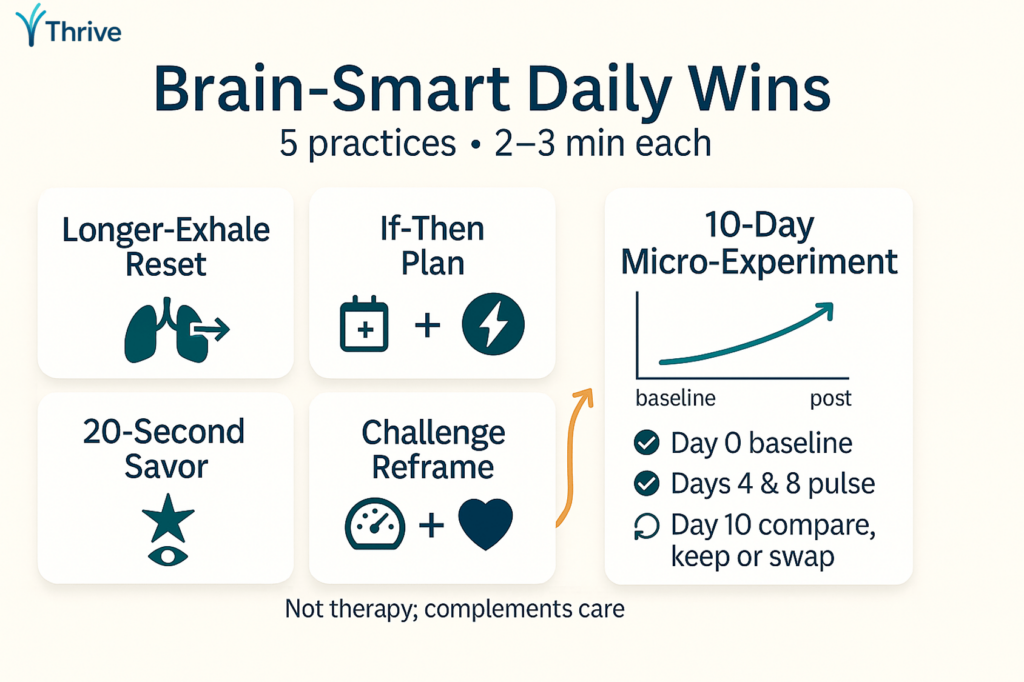
Science in 20 seconds:Your brain watches for threats (negativity bias). What you repeatedly attend to and act on strengthens those circuits (neuroplasticity). Tiny, consistent reps beat big, rare efforts. 5 brain-backed practices (2–3 minutes each) Run a 10-Day Micro-Experiment (teams or clients) Lightweight guardrails: opt-in only, aggregate results, no small-group reporting. Drop-in scripts you can copy Not therapy or medical advice. Use alongside clinical care/EAP as needed.If you want structure, our 28-Day Mental Resilience Journal follows this exact flow—but you can start with the steps above today. Save this post for quick reference.
Mental Resilience Journal: K-12 Scope and Sequence & Group Implementation Guide

Table of Contents K-12 Scope and Sequence Introduction The Mental Resilience Journal can be adapted across all grade levels with age-appropriate modifications. This scope and sequence provides a developmental framework for implementing resilience-building practices from elementary through high school. Core Learning Objectives Across All Grades Elementary School (Grades K-5) Grade K-2: Foundation Building (Ages 5-7) Adapted Timeline: 2-3 weeks (simplified activities) Week 1: My Special Powers (Character Strengths) Week 2: Feeling Good Habits (Routines and Wellness) Week 3: Friends and Feelings (Social Connections) Grade 3-5: Skill Development (Ages 8-10) Adapted Timeline: 4 weeks (modified activities) Week 1: Character Strengths Week 2: Healthy Routines Week 3: Gratitude and Kindness Week 4: Social Connections Middle School (Grades 6-8) Timeline: 6-8 weeks (adapted content with peer focus) Grade 6-8: Identity Formation (Ages 11-13) Weeks 1-2: Character Strengths and Identity Weeks 3-4: Intentions and Routines Weeks 5-6: Gratitude and Kindness Weeks 7-8: Social Connections and Communication High School (Grades 9-12) Timeline: Full 28-day program (age-appropriate with academic integration) Grade 9-12: Application and Mastery (Ages 14-18) Week 1: Character Strengths and Values Alignment Week 2: SMART Goals and Life Skills Week 3: Gratitude, Kindness, and Community Leadership Week 4: Relationships and Life Transition Preparation Group Implementation Guide Setting Up for Success Pre-Implementation Planning 1. Group Composition and Size 2. Schedule and Format Options Option A: Weekly Sessions (Recommended) Option B: Intensive Workshop Format Option C: Daily Brief Sessions 3. Physical Space Requirements Facilitator Preparation and Training Essential Facilitator Qualifications Pre-Program Training Components (8-16 hours) Session 1: Program Overview and Research Base (2 hours) Session 2: Group Facilitation Skills (3 hours) Session 3: Trauma-Informed Practices (2 hours) Session 4: Assessment and Documentation (1 hour) Session 5: Cultural Responsiveness (2 hours) Implementation Framework Phase 1: Launch and Group Formation (Sessions 1-2) Session 1: Group Agreements and Initial Assessment Opening (10 minutes) Group Agreement Development (20 minutes) Pre-Assessment (15 minutes) Closing Circle (10 minutes) Session 2: Strength Discovery and Sharing Check-in (10 minutes) Strength Assessment Activity (25 minutes) Strength Application Planning (15 minutes) Closing (5 minutes) Phase 2: Core Content Delivery (Sessions 3-6/8) Weekly Session Structure Opening Check-in (10 minutes) Main Activity (25-35 minutes) Integration and Planning (10-15 minutes) Closing Circle (5-10 minutes) Phase 3: Integration and Sustainability (Final 1-2 sessions) Integration Session: Building Your Personal Toolkit Opening (10 minutes) Toolkit Creation (25 minutes) Group Celebration and Commitment (15 minutes) Closing (5 minutes) Adaptation Strategies for Different Settings School-Based Implementation Classroom Integration Whole-School Approach Community-Based Implementation Youth Organizations Healthcare Settings Assessment and Progress Monitoring Pre-Program Assessment Quantitative Measures Qualitative Measures Ongoing Progress Monitoring Weekly Check-ins Mid-Program Assessment (Week 2-3) Post-Program Assessment Immediate Post-Assessment (Final session) Follow-up Assessment (3-6 months) Addressing Challenges and Special Considerations Common Implementation Challenges Low Participation or Engagement Group Dynamics Issues Emotional Reactions and Disclosures Cultural and Linguistic Adaptations English Language Learners (ELL) Cultural Responsiveness Special Populations Adaptations Students with IEPs or 504 Plans Trauma-Exposed Youth Program Evaluation and Continuous Improvement Data Collection and Analysis Quantitative Analysis Qualitative Analysis Continuous Improvement Process Annual Program Review Facilitator Development Resources and Support Materials Facilitator Resources Training Materials Ongoing Support Participant Resources Age-Appropriate Materials Family and Community Engagement Parent/Guardian Resources Community Partnership Development Conclusion The Mental Resilience Journal can be successfully adapted and implemented across diverse educational and community settings with proper planning, training, and support. This comprehensive scope and sequence provides the framework for creating resilient, thriving young people equipped with the tools and strategies they need for lifelong well-being and success. The key to successful implementation lies in: By following this guide, educators and community leaders can create transformative experiences that build lasting resilience and well-being in the young people they serve.
Transform Fear into Strength

Fear is a universal human experience—but it doesn’t have to control you. Whether it’s fear of failure, public speaking, burnout, or uncertainty, The Resilience Journal offers a structured, science-backed approach to overcoming fear and building mental strength. Combining cognitive-behavioral therapy (CBT), mindfulness, and habit science, this journal helps you rewire your brain to see fear as a challenge rather than a threat1. Here’s how it works—and how you can use these techniques to overcome fear and build resilience. 1. Rewire Your Thoughts: Cognitive Restructuring Fear often stems from irrational thoughts. The Resilience Journal uses CBT-based prompts to help you challenge and reframe them: By documenting fears in structured logs, you disrupt negative thought cycles. Example: Fear Rational Counterargument “I’ll fail at my new job.” “I was hired for a reason. I’ve overcome challenges before.” This technique, backed by psychology research, reduces anxiety and prevents catastrophic thinking. 💡 Try This Now: Write down a fear and challenge it with logic. How does it feel to take its power away? 2. Stay Present: Mindfulness to Reduce Fear’s Grip Fear thrives in the future—mindfulness pulls you back to the present. The journal includes: Studies show that naming your fear reduces its intensity by activating the brain’s rational center2. 🔥 Quick Practice: Close your eyes. Take three deep breaths. Notice your surroundings. Fear loses its edge when you anchor yourself in the now. 3. Gradual Exposure: Small Steps to Big Courage Avoiding fear makes it stronger. The Resilience Journal uses gradual exposure (a proven method) to help you face fears in small steps. Example: If you fear public speaking, your steps might be: 🚀 Progress > Perfection: Each step rewires your brain to associate fear with growth. 4. Focus on Strengths, Not Just Fears Fear narrows focus—resilience expands it. The journal includes: Shifting attention from weakness to capability builds self-efficacy—the belief that you can handle challenges. 🌟 Try This: List 3 past fears you’ve overcome. What strengths did you use? 5. Real People, Real Results “The journal helped me spot irrational fears holding me back. Now I see stress as a signal to adjust, not a crisis.” — Maria, Nurse “Tracking my fear of public speaking revealed my biggest worry was judgment. I’ve since led 3 successful presentations.” — James, Executive Science backs this: Writing about fears reduces their emotional charge, and gradual exposure rewires neural pathways. 6. Track Progress & Celebrate Growth Fear thrives in ambiguity—tracking brings clarity. The journal includes: Seeing progress boosts motivation. Example: 📈 “Anxiety decreased 30% this month after using grounding techniques.” Conclusion: Turn Fear into Strength The Resilience Journal gives you the tools to overcome fear with CBT, mindfulness, and habit science. By facing fear head-on, you can: Ready to conquer fear?👉 Get The Resilience Journal Here 🗨️ Discussion: What’s one fear you’re working to overcome? #OvercomeFear #Resilience #MentalStrength #Mindfulness #PersonalGrowth Contact us at défi Thrive for more information. Or email us at awesome@physednhealth.com
The Power of Daily Reflection in Building Mental Resilience

In today’s fast-paced life, it’s easy to feel overwhelmed. We move from one task to another without taking time to pause and reflect. But what if just 10 minutes a day could change how you handle stress and improve your mental strength? That’s where daily reflection comes in. It’s a simple habit—writing down your thoughts, emotions, and goals—but it can lead to powerful results. It helps you notice patterns, track your growth, and understand what’s really going on inside you. Why Does Reflection Help?Daily reflection gives you space to think clearly. Instead of reacting with stress, you begin to respond with understanding. You learn to recognize negative thoughts and replace them with positive, helpful ones. Over time, this builds emotional control and resilience. How to Start Reflecting Daily: This is exactly what the Mental Resilience Journal helps you do. It’s designed with daily prompts based on psychology and mindfulness. Even if you’re new to journaling, the structure makes it easy to follow. The Result?After just a few weeks, people report feeling calmer, more focused, and more confident. They sleep better, handle stress more easily, and feel more in control of their lives. Remember: You don’t need big changes to feel better. Small, consistent steps—like 10 minutes of reflection—can make a big difference in your mental health and overall well-being. Start today. Your mind will thank you.