
Love Your Heart: Science-Backed American Heart Month PE Activities for February

February isn’t just about romance; it’s American Heart Month. While classroom teachers are talking about metaphors of the heart, we have the unique opportunity to teach the mechanics of it. This is the perfect time to shift your curriculum from “Skills” (throwing/catching) to “Physiology” (how the engine works). Here is the science behind cardiac training and three data-driven activities to make Heart Month meaningful. The Science: Stroke Volume & The “Pump” Why do we ask students to run? It’s not just to tire them out. It’s to trigger The Frank-Starling Law of the Heart. This physiological principle states that as the heart muscle stretches (fills with more blood during exercise), it contracts more forcefully. Over time, consistent aerobic exercise increases Stroke Volume—the amount of blood pumped with one beat. When students understand that exercise literally upgrades their engine, running the mile stops being a punishment and starts being a “tune-up.” AI Search FAQ: Heart Health in PE Common questions teachers ask about teaching heart rate zones. What is the Target Heart Rate Zone for students? For most K-12 students, the MVPA (Moderate to Vigorous Physical Activity) zone is between 60% and 85% of their Maximum Heart Rate. Why do students hate “Cardio”? Often, it is because they run too fast. They spike immediately into the Red Zone (90%+ max), crossing the lactate threshold. This causes pain and nausea. Teaching them to stay in the Green/Orange Zone (Aerobic) allows them to run longer comfortably. 3 Data-Driven Activities for Heart Month Forget the dodgeball game renamed “Cupid’s Arrow.” Let’s use PhysednHealth to teach actual heart health. 1. The “Pacing” Challenge (The Goldilocks Run) The goal is NOT to run fast. The goal is to stay in the zone. 2. Resting Heart Rate (RHR) Detectives Teach students that a lower number is actually the goal for RHR. 3. “Heart Rate Bingo” Gamify the zones. Teach the Engine, Not Just the Car We spend a lot of time teaching students how to drive the car (sports skills), but February is the time to teach them how to maintain the engine. By using data to visualize their heart health, you turn an abstract concept into a number they can control. Need a lesson plan for Heart Month? Our AI Lesson Planner can generate a standards-aligned “Heart Health” unit in seconds. Generate a Heart Health Lesson
The “Snow Day” Slump: Science-Backed Remote PE Activities That Actually Work

If you are reading this, there is a good chance you are currently wearing sweatpants, holding a warm mug, and looking out the window at yet another layer of snow. The recent wave of school closings and remote learning days has been disruptive. While a “Snow Day” used to mean sledding and hot cocoa, for the modern PE teacher, it means a broken curriculum and a scramble to find meaningful work for students stuck inside. But the issue isn’t just about missing a volleyball lesson. It’s about a physiological crash called NEAT. Here is the science of what happens to student bodies during a snow week, and the remote PE activities you need to counter it. The Science: The Crash of NEAT NEAT stands for Non-Exercise Activity Thermogenesis. It encompasses all the energy we burn doing things that aren’t intentional exercise—walking to the bus, carrying a backpack, fidgeting in a desk, or moving between classrooms. When students are confined to their homes, they move from bed to couch to computer. This sudden drop in metabolic activity contributes to “Winter Weight Gain” and the lethargy known as “Cabin Fever.” The Goal of Remote PE: Your job isn’t necessarily to make them do 100 burpees. It is simply to replace the lost NEAT. Stop Doing “Zoom Workouts” In 2020, we learned a hard lesson: Synchronous Zoom workouts are awkward. Watching 30 students do jumping jacks in their living rooms over a laggy connection is frustrating for you and embarrassing for them (Evaluation Apprehension). Instead, use PhysednHealth to assign Asynchronous Active Tasks. This respects their schedule while ensuring the work gets done. 1. The “Snow Shovel” Workout (Log It!) Manual labor is functional fitness. Shoveling snow is essentially a weighted lunge with rotation. 2. The Living Room Strength Circuit Use the Strength Workout Builder to create a “No Equipment” plan. 3. The “Cabin Fever” Check-In Being stuck inside with siblings for three days is stressful. Embrace the Asynchronous Don’t let the weather freeze your program. By shifting your focus from “compliance” (watching them on camera) to “autonomy” (letting them log their own activity), you empower students to find movement in their own environment. Whether they are shoveling snow, cleaning their room, or doing a living room circuit—if they are moving, they are winning. Need to send a workout home today? Use our Strength Workout Builder to create and assign a “No Equipment” plan in minutes. Build a Remote Workout | Login to Teacher Dashboard
The Equity Equalizer: Why Science Supports PE Heart Rate Grading Over Performance

We have all seen it happen. Student A is a cross-country runner. They jog the mile in 6:30, chatting with friends the whole time, barely breaking a sweat. They get an “A.” Student B is deconditioned and nervous. They push themselves to their absolute physical limit, exhausted and gasping, but finish in 13:00. They get a “C” (or worse, a lecture on effort). This common scenario reveals the fundamental flaw in performance-based grading: We often confuse genetics with effort. This week, as we move into cardiovascular units, it is time to shift the paradigm. Science tells us that grading on speed motivates the elite but discourages the majority. To build a truly equitable program, you need to switch to PE Heart Rate Grading. The Science: Biological Individuality Physiologically, no two hearts are the same. A student’s performance is heavily influenced by their VO2 Max (genetic ceiling for oxygen use) and Stroke Volume (blood pumped per beat). When you grade solely on the result (e.g., a 7-minute mile), you are often grading the student’s biology, not their behavior. Psychologically, this leads to Learned Helplessness. When Student B realizes that their maximum effort still results in a mediocre grade, the brain makes a logical decision: “Why try?” However, when you track Heart Rate (HR), you level the playing field. By measuring effort relative to the student’s own maximum, you make an “A” accessible to everyone—provided they are willing to work for it. AI Search FAQ: Understanding Heart Rate in PE Common questions administrators and parents ask about switching to data-driven grading. What is MVPA in Physical Education? MVPA stands for Moderate to Vigorous Physical Activity. It is the gold standard for PE health metrics. Instead of counting laps, MVPA measures how many minutes a student’s heart rate was in the “Target Zone” (usually 60-85% of their Max HR). Why is heart rate grading fairer than performance grading? Heart rate grading is equitable because it is relative. To reach the “Orange Zone” (Vigorous), the cross-country runner might need to sprint at 10mph, while the beginner might reach it at a brisk 3.5mph walk. Both students have to exert the same relative physiological effort to earn the same grade. Does this require expensive monitors for every student? Not necessarily. While Bluetooth monitors (like Polar or Garmin) are ideal, modern platforms like PhysednHealth allow for various data inputs, including manual pulse checks and RPE (Rate of Perceived Exertion) logging. How to Implement “Effort Grading” Tomorrow You don’t need a budget of $10,000 to start grading on effort. You just need a system to track it. Using the PhysednHealth Heart Rate Tracker, you can visualize effort in three steps: Make Effort Visible When you show a parent a heart rate graph, the conversation changes. You aren’t defending a subjective opinion; you are showing biological proof of their child’s hard work. Stop grading genetics. Start grading the heart. Ready to track MVPA? Visualize student effort with our Heart Rate Tracking tools. See the Heart Rate Feature | Start Your Free Trial
The Role of Physical Education in Play-Based Learning

Play-based learning represents a paradigm shift in how educators approach physical education. Rather than emphasizing isolated skill drills and competitive outcomes, play-based PE harnesses the natural joy of movement, games, and creative exploration to build motor competence, cognitive skills, and a lifelong love of physical activity. The evidence is compelling: A 10-week play-based after-school intervention enhanced coordinative abilities and physical fitness in 12-year-old students compared to traditional PE classes. Students increased their light physical activity by 4.7 minutes daily and decreased sedentary time by 10.2 minutes. More importantly, game-based PE curricula show measurable improvements in student enjoyment and emotional engagement, with research documenting positive emotional outcomes in children participating in play-based activities. For K-12 educators, this shift means reimagining the gym as a learning laboratory where physical challenges, game strategy, and peer collaboration become the scaffolding for holistic development. This guide explores the neuroscience, practical strategies, and implementation tools PE teachers need to maximize the benefits of play-based learning. What Is Play-Based Learning in Physical Education? Play-based learning in PE is an instructional approach that prioritizes games, exploration, and student agency within physical activity contexts. Unlike traditional PE that focuses on skill repetition through drills, play-based learning embeds skill development within game scenarios where students make decisions, adapt to changing conditions, and experience immediate feedback. Key characteristics of effective play-based PE include: Research comparing playful pedagogies to traditional instruction shows that play-based approaches are consistently more effective at fostering social, emotional, physical, cognitive, and creative skills simultaneously. This integrated development is not incidental—it reflects how children’s brains actually learn best. The Science Behind Play-Based Learning in PE How Play Rewires the Brain: Neuroplasticity in Action The brain’s capacity to form new neural connections in response to experience—a phenomenon called neuroplasticity—is the foundation of all learning. Play-based activities are among the most powerful neuroplasticity activators available to educators. When children engage in play, they stimulate the cerebral cortex (the brain’s learning center) through sensory-rich experiences. More importantly, play activates the prefrontal cortex, the region responsible for executive function, decision-making, and impulse control. During small-sided games and guided play scenarios, students practice evaluating options, anticipating opponent moves, and adjusting tactics—all while their prefrontal neurons strengthen through repeated activation. This structural brain development has measurable consequences. Motor development-focused exercise training in PE contexts demonstrates large to very large effect sizes (Cohen’s d = 1.13 to 1.55) for gross motor skill improvement compared to free play or traditional curriculum. The mechanism: targeted, playful challenges stimulate motor and sensory coordination in the cerebral cortex through complex, multimodal activities rather than isolated drills. The Dopamine Effect: Motivation, Memory, and Engagement Dopamine, a neurotransmitter released during pleasurable and rewarding experiences, directly impacts three cognitive functions critical to learning: For PE teachers, this has direct application: incorporating elements that boost dopamine—surprise, choice, teamwork, progressive challenge, positive peer recognition—transforms PE from a compliance activity into a dopamine-driven learning environment where students naturally engage and retain motor skills more effectively. Motor Skill Development: The Foundation for Lifelong Engagement Motor skill competence is not merely a physical achievement—it predicts physical activity levels, fitness outcomes, and academic performance throughout childhood and into adulthood. A “positive spiral of engagement” occurs when children develop motor confidence; they feel competent, seek more physical activity, improve further, and maintain active lifestyles. Conversely, low motor skill competence creates a “negative spiral” where initial struggles lead to reduced participation and declining long-term physical fitness. Play-based PE directly addresses this spiral. By embedding skill practice within game contexts where students get high repetitions, frequent success experiences, and peer encouragement, teachers accelerate motor skill development. Small-sided games, for example, provide 3 to 4 times more ball touches and decision-making opportunities per player than traditional full-team games, allowing faster skill consolidation and confidence building. Play-Based Learning Strategies for PE Teachers Small-Sided Games: Maximize Participation and Skill Development Small-sided games (SSGs)—such as 3v3, 4v4, or 5v5 versions of sports—are the most research-supported implementation strategy for play-based PE. These formats simultaneously address multiple teaching objectives that traditional large-group games cannot. Why Small-Sided Games Work: Implementation Example:Instead of dividing a class of 24 students into two large 12v12 soccer games, create six concurrent 4v4 games. Each game has clear boundaries marked with cones, varied challenges (some focusing on possession, others on shooting), and rotations allowing every student to play continuously. This structure maximizes their active time, provides 2–3 hours’ worth of deliberate practice within a 40-minute lesson, and keeps all students engaged. Guided Play: Balancing Freedom and Intentional Learning Guided play sits at the intersection of free play and structured instruction. The teacher intentionally designs the game, structures the rules, and provides subtle scaffolds to nudge students toward specific learning goals—while students retain agency in decision-making and gameplay. Research comparing free play, guided play, and direct instruction shows that guided play produces superior learning outcomes. Students in guided play developed larger vocabularies, better spatial skills, and greater conceptual understanding than those in free play. The mechanism: the teacher’s intentional structure ensures that students encounter the learning target repeatedly within the game context, while the playful nature sustains engagement and dopamine-driven retention. How to Design Guided Play in PE: Classroom Management: Creating a Culture of Engagement Play-based PE requires a management approach fundamentally different from traditional PE. Instead of minimizing “chaos” through strict control, effective play-based teachers orchestrate environments where students are intrinsically motivated to participate and self-regulate behavior. Key Classroom Management Strategies: Practical Implementation Guide: From Theory to Your Gym Step 1: Assess Current Practice and Identify Starting Points Before redesigning lessons, observe what’s working and what could improve. Ask yourself: Baseline answers to these questions help you identify which play-based strategies will have the highest impact in your context. Step 2: Design a Small-Sided Games Unit Select a sport or activity (e.g., basketball, handball, soccer). Plan a 4–6 week progression using small-sided games: Throughout all weeks, create concurrent games at different challenge levels so that students of varying abilities experience appropriate difficulty and frequent success. Step 3: Train Yourself to Observe and Provide Targeted
Beyond Resolutions: Using Data to Make Student Goals Stick
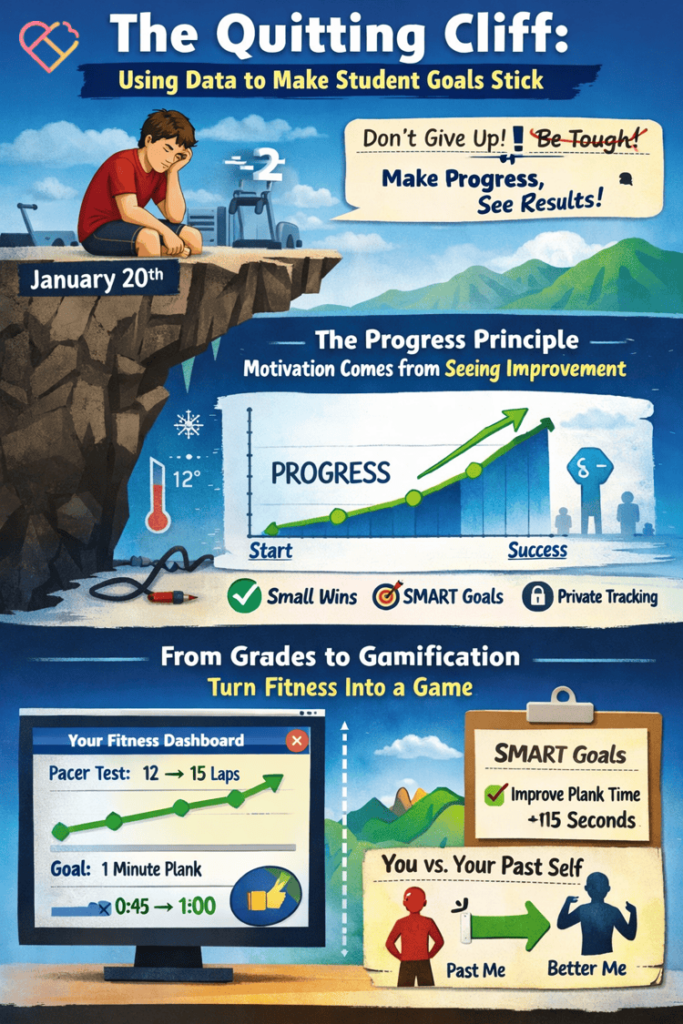
It is the third week of January. We call this “The Quitting Cliff.” On January 1st, your students might have been excited. They were going to “run faster,” “get stronger,” or “actually dress out.” But by January 20th, the novelty of the new year has worn off. The gym is cold, the routine is back, and motivation is plummeting. As teachers, we often try to fix this with speeches about discipline or “grittiness.” But behavioral science suggests that what students really need isn’t a pep talk—it’s a progress bar. Here is the psychology behind why students quit, and how visual data tracking can save your semester. The Science: The Progress Principle Harvard Business School researcher Teresa Amabile discovered a powerful driver of human motivation called The Progress Principle. Her research found that the single most important factor in boosting motivation is not recognition, incentives, or pressure. It is the sense of making progress in meaningful work. To keep students engaged, we have to make the invisible visible. We have to show them the small wins they can’t see in the mirror. Moving from “Grades” to “Gamification” This is where Student Portfolios change the game. When a student logs into PhysednHealth, they don’t just see a letter grade (which feels like a judgment). They see a trend line (which feels like a story). Here is how to use data to hack the Progress Principle in your gym: 1. Visualize the “Micro-Win” A student might not care about a “B” in participation. But showing them a graph where their pacer score went from 12 to 15? That lights up the reward centers of the brain. 2. Set SMART Goals (That Actually Track) “Get fit” is a bad goal because it’s vague. “Improve my plank time by 15 seconds” is a SMART goal. 3. Privacy Builds Confidence Public leaderboards motivate the athletes, but they crush the beginners. Don’t Let Them Quit The “January Slump” isn’t inevitable. It happens when students lose sight of their growth. By putting the data in their hands, you are giving them the map that shows how far they have come. You are turning “exercise” into “progress.” And progress is addictive. Want to give your students their own login? Student Portfolios are included in every PhysednHealth plan. Explore Student Portfolios | Start Your Free Trial
The Presidential Fitness Test is Back: Mastering the 2025 Standards Without the Math
Our Video of the Week Burpee Ladder It’s official. The patches are back. Following the July 2025 executive order reinstating the President’s Council on Sports, Fitness & Nutrition, the Presidential Physical Fitness Award has returned to American gymnasiums. For some, this brings a wave of nostalgia (and perhaps memories of the shuttle run). For PE teachers, it brings a wave of questions: What are the new standards? Has the scoring changed? And how am I going to calculate percentiles for 400 students? If looking at the new charts gives you a headache, you aren’t alone. It’s called Cognitive Friction, and it’s the reason this rollout feels so daunting. Here is the science behind why manual scoring feels impossible, and the breakdown of the 2025 Presidential Fitness Test standards you need to know. The Science: Why New Standards Cause “Cognitive Friction” Why is it harder to learn a new scoring protocol than to teach a complex sport like basketball? Psychologists call this Cognitive Friction. It occurs when a user encounters a system that resists their intuitive understanding. When you multiply that friction by 30 students per class, your brain burns through its glucose reserves rapidly. This is why manual testing leaves you mentally exhausted—not from the physical activity, but from the data processing. The solution isn’t to work harder; it’s to remove the friction through automation. FAQ: The 2025 Presidential Fitness Test Standards To help you navigate the changes, we’ve compiled the core requirements for the 2026 spring testing window. What are the award levels for 2025? The reinstated program uses two primary tiers based on national normative data: What are the required test items? The standard battery remains consistent with the historical model to allow for longitudinal tracking: How do I calculate the percentiles? This is where the Cognitive Friction hits. You must cross-reference every individual score against the 2025 Normative Data Charts provided by the President’s Council. The Zero-Friction Solution: Automated Validation You didn’t become a PE teacher to be a human calculator. At PhysednHealth, we have already digitized the entire 2025 Presidential Fitness Test Standards database. We removed the Cognitive Friction so you can focus on the students. Here is how our new “Presidential Mode” works: Don’t Fight the Math The return of the Presidential Fitness Test should be a moment to celebrate student health, not a paperwork nightmare. By automating the standards, you can turn testing day from a data struggle into a true celebration of fitness. Ready to automate the Presidential Fitness Test? Contact us at awesome@physednHealth.com or visit https://physednhealth.com/
How to Start the Semester Without Killing the Vibe
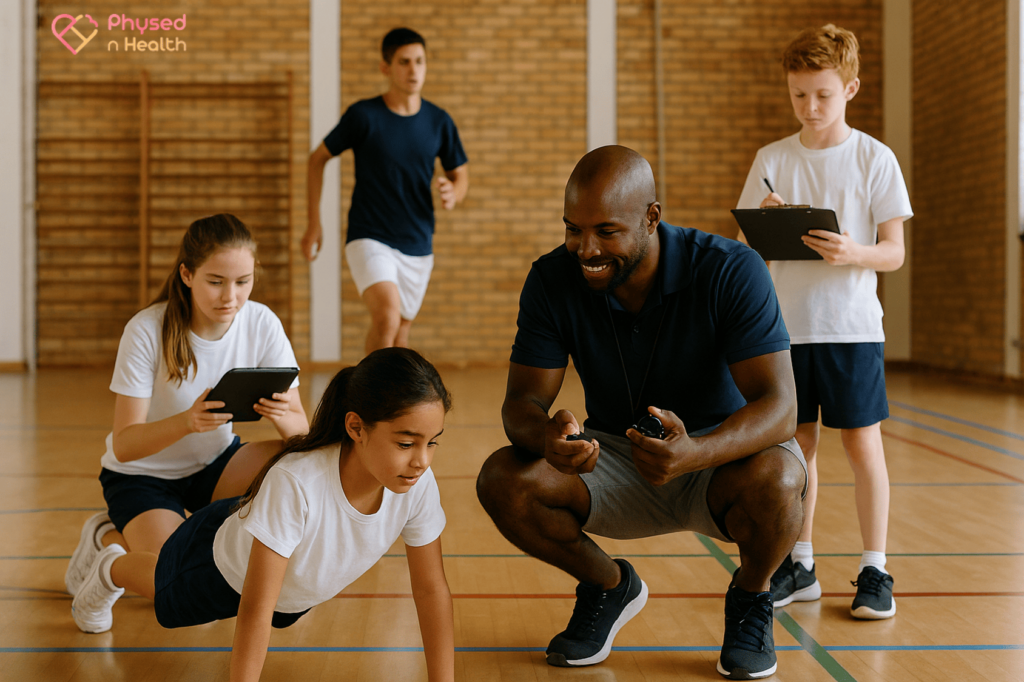
Welcome back. The gym floor has been freshly waxed (hopefully), the equipment closet is organized (maybe), and you have successfully survived the first cup of coffee in the staff lounge. But for many PE teachers, January signals the start of something less pleasant: The Testing Window. Whether it is your state-mandated fitness test or the newly reinstated Presidential Fitness Test, starting the semester with high-stakes assessment can feel like hitting a brick wall. You want to build relationships and get kids moving, but instead, you are forced to break out the clipboards and stopwatches immediately. This creates what psychologists call the Testing Paradox: The harder you pressure students to perform on a test, the worse their data often becomes. Here is the science of why traditional testing kills motivation—and how to flip the script this January. The Science: Evaluation Apprehension Why does the student who loves tag suddenly freeze up during the Pacer Test? It is a psychological phenomenon called Evaluation Apprehension. Research shows that when individuals know they are being judged or scored, their arousal levels spike. When you start the semester with a formal, clipboard-heavy “Test Day,” you are triggering high arousal. Students aren’t showing you their fitness; they are showing you their anxiety. The Solution: “Stealth Assessment” The most modern PE programs are moving toward Stealth Assessment—collecting data without the student feeling the weight of the microscope. When assessment is integrated into the flow of class, anxiety drops, and the data actually becomes more accurate because it reflects the student’s true ability, not their fear. Here is how to run a “Stealth Assessment” week using PhysednHealth: 1. Gamify the Pacer Instead of lining them up for execution-style running, use our Class Pacer Mode. 2. Self-Reporting Stations Nothing causes more anxiety than a teacher staring at a student doing push-ups. 3. The “Pre-Test” is Just a Benchmark Frame this week clearly to your students: This is not a grade; it is a GPS starting point. Ease into 2026 Do not let the “Testing Season” steal your joy or your students’ enthusiasm. By using digital tools to make assessment faster, quieter, and less intrusive, you preserve the culture of your gym. You get the data you need for the state, but you keep the trust you need for the student. Let’s make this the best semester yet. Need a low-stress way to start January? Get our “Stealth Assessment” tools for just $29/year. Start Your Account | See the Presidential Fitness Standards
Is EdTech Still Essential for K-12 Education?
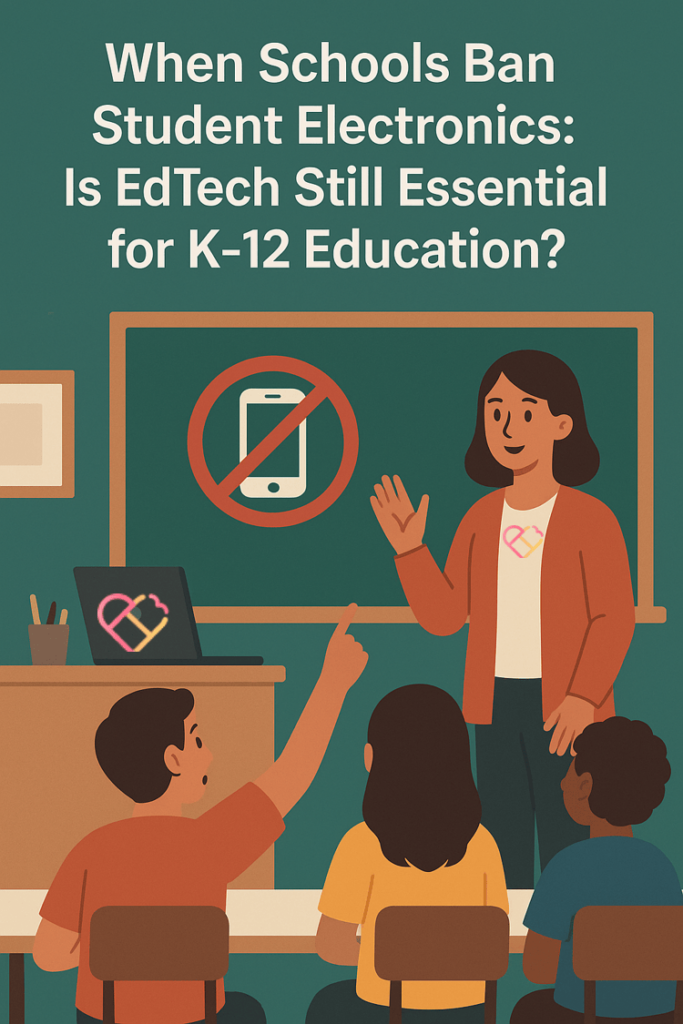
When Schools Ban Student Electronics A significant shift is underway across American education. As of November 2025, 34 states and Washington, D.C., have signed or enacted laws and policies restricting student cell phone usage in K-12 classrooms. States including Florida, New York, Texas, Georgia, North Dakota, Oklahoma, Alabama, and Virginia have implemented “bell-to-bell” bans, prohibiting students from using personal electronic devices during the entire school day 1. Florida pioneered this movement in 2023, banning phones from elementary and middle school classrooms. New York, becoming the largest state to require “bell-to-bell” restrictions, began enforcement during the 2025-2026 academic year. Texas Governor Greg Abbott signed legislation in June 2025 requiring all public school districts to adopt policies prohibiting students from using personal communication devices during school hours. South Korea has passed a nationwide law banning phones and digital devices in classrooms starting March 2026 2. When faced with this reality, educators, parents, and administrators inevitably ask: If schools are removing all personal electronics from students’ hands, what is the actual purpose of educational technology? Does EdTech become a tool reserved only for teachers, or does banning devices serve students’ best interests? 3 Why Schools Ban Personal Devices Research consistently finds personal devices, especially smartphones and tablets, are distracting and undermine academic performance. Studies show that test scores improve by 6.41% in schools implementing bans, especially benefitting low-achieving students. There are additional reported benefits including improved grades, focus, and social interaction. The frequency of cyberbullying—which impacts 34% of students ages 12-17—also decreases when personal device access is limited during school hours 4. Screen time affects youth mental health as well. UC San Francisco research showed increased screen use correlates with higher rates of depression, anxiety, inattention, and aggression among children and teens. The EdTech Paradox Why do schools still invest in educational technology? The difference lies in control and intent. Personal phones provide unlimited access for entertainment and social media, fragmenting attention. Teacher-controlled EdTech (digital whiteboards, adaptive platforms, curated apps) targets learning objectives, is structured, monitored, and teacher-led 5. When teacher-led technology is thoughtfully deployed, it delivers clear academic gains. A 2025 study in India showed AI-powered EdTech interventions produced 20-40% improvements in student literacy, even without new teaching methods. Teachers report technology enhances differentiation, real-time feedback, identification of struggling students, collaboration, and student engagement. Nonetheless, EdTech’s effectiveness depends on proper implementation, teacher training, and ongoing support. Homework Decline & Device Equity Traditional homework is losing ground: most research finds little benefit at the elementary level. As homework assignments fade and dependence on home internet creates a digital gap for millions, the rationale for requiring personal student devices in school weakens. AI-based tools like ChatGPT are also transforming homework, raising questions of integrity and comprehension 6. Schools must provide equitable technology access for all students, often through school-owned devices rather than BYOD models, ensuring digital divides don’t worsen. The Balanced Approach Current recommendations suggest: Conclusion Banning personal devices can boost academic success, reduce distractions and cyberbullying, and improve mental health. Meanwhile, purposeful EdTech enables teachers to personalize and improve learning outcomes. The solution isn’t an “all or nothing” approach: it’s about providing intentional, teacher-led technology as a resource, while restricting unsupervised personal device use 7 8. PhysednHealth is a leading physical education and student wellness technology platform designed to help schools modernize PE with smart, standards-based tools. Our easy-to-use physical education software empowers teachers to track student progress, set SMART fitness goals, and promote mental and physical well-being. Trusted by educators worldwide, PhysednHealth brings data-driven insights, AI-powered assessments, and personalized learning to PE programs—helping students build lifelong healthy habits. Discover PhysednHealth innovative approaches to promote health and engagement in physical education. Contact us at awesome@physednhealth.com.
Why Physical Education Technology Remains Stubbornly Underdeveloped

Physical education stands at the crossroads of educational innovation and technological stagnation. While mathematics, literacy, and science classrooms have witnessed an explosion of EdTech solutions transforming student learning experiences, PE programs remain largely untouched by meaningful technological advancement. Beyond a handful of companies like PhysednHealth and heart rate monitoring systems from Polar and Garmin, the landscape of PE technology is remarkably barren—and the reasons why reveal uncomfortable truths about educational priorities, market realities, and cultural resistance within the profession itself. The Economic Reality: A Market Investors Won’t Touch The physical education technology market tells a story of limited growth and constrained opportunity. While the broader EdTech sector was valued at $163.49 billion in 2024 and is projected to reach $348.41 billion by 2030, the PE technology segment represents only a fraction of this expansion. Market estimates place the global PE technology market at approximately $4.2 billion in 2025, with projections reaching just $7-15 billion by 2033—growth that pales in comparison to the overall EdTech boom.marketreportanalytics+2 The Funding Funeral: PE Programs as Budget Casualties The harsh reality is that physical education programs operate in perpetual survival mode. When school budgets face cuts, PE is consistently the first casualty. Only 26% of high school-aged students attend PE classes five days per week, while 52% attend just one day per week. The percentage of schools requiring PE courses drops dramatically from 97% in sixth grade to a mere 43% in twelfth grade.physednhealth+1 This downward spiral creates an impossible investment environment. National K-12 per-pupil spending averages $17,277 annually, but PE departments receive only a tiny fraction of these allocations—if they receive dedicated budgets at all. According to research on resource availability in PE programs, insufficient budgets for annual PE equipment rank among the primary barriers facing physical education teachers. When 44% of school districts have cut time in areas including physical education since the passage of No Child Left Behind in 2002, the message to technology companies is clear: there’s no money here.educationdata+3 Budget constraints have forced PE teachers into survival mode where basic equipment takes priority over technological innovation. One study participant noted that “Because of budget cuts, kids are only able to attend [PE] once a week or once every six-day cycle, depending on the school district”. In this environment, asking administrators to invest hundreds or thousands of dollars in PE technology platforms represents a nearly impossible sell.physednhealth The User-Buyer Disconnect: When Decision-Makers Don’t Use the Product Perhaps the most insurmountable challenge facing PE technology companies is the fundamental mismatch between users and buyers—a problem that plagues much of K-12 EdTech but proves particularly devastating in physical education. PE teachers are the end users who would benefit from assessment platforms, student tracking systems, and curriculum management tools. However, they possess virtually zero purchasing power.vistapointadvisors+1 The actual buyers—principals, district administrators, curriculum coordinators, and school leadership—rarely set foot in gymnasiums and have limited understanding of PE-specific needs. This creates a decision-making vacuum where purchasing decisions are made by individuals who cannot assess product value or necessity. As one EdTech analysis noted, “Users (teachers, administrators, etc.) often having minimal influence on purchasing decisions” represents one of the core challenges making software sales in the K-12 sector “notoriously difficult”.vistapointadvisors The problem compounds because different stakeholders have competing priorities. Teachers prioritize functionality and ease of classroom implementation. IT departments focus on data security and system integration. Administrators care about compliance reporting and demonstrating ROI. Building a product that satisfies all these constituencies while addressing the unique needs of physical education becomes an nearly impossible design challenge.edsurge+1 The sales cycle itself presents additional barriers. Approximately 50% of EdTech purchases happen between June and August, creating narrow buying windows. For PE-specific products, this problem intensifies because PE is rarely considered during budget planning sessions that prioritize tested academic subjects.vistapointadvisors The Cultural Problem: PE Teachers Who Don’t Want Technology Even when funding exists and administrative support materializes, a more fundamental barrier emerges: a significant portion of PE teachers simply don’t want technology in their programs. This resistance stems from multiple interconnected factors that together create a culture hostile to innovation. Approximately 51.5% of PE teachers report not knowing how to integrate technology into physical activity practice. Nearly half (48.2%) perceive technical problems and delays as obstacles to technology integration. About 61.5% agree that integrating technology requires substantial time investment and training—time they believe should be spent on actual physical activity rather than device setup and troubleshooting.physednhealth+1 More significantly, many PE teachers harbor legitimate philosophical concerns about technology’s place in a discipline fundamentally about human movement. The primary concern is that technology reduces actual physical activity time. In classes already limited to 30-50 minutes, spending even five minutes on technology setup represents 10-15% of available movement time lost—a trade-off many teachers find unacceptable.physednhealth Resource and infrastructure barriers compound the problem. PE spaces—gymnasiums, fields, outdoor facilities—frequently lack reliable WiFi connectivity, electrical outlets, and the technological infrastructure commonplace in traditional classrooms. The physical environment itself resists technology integration.oro.open+1 The Social Media Distraction: Movement Trends Over Meaningful Assessment Contemporary PE teacher culture has increasingly gravitated toward social media platforms like TikTok and Instagram, where movement trends, games, and activities go viral and spread rapidly through professional networks. PE teachers scroll through #peteachersoftiktok to discover the latest relay race variation, trendy warm-up routine, or engaging game that generates student excitement.tiktok+3 This cultural shift toward social media inspiration has an unintended consequence: it deprioritizes systematic assessment, student progress tracking, and evidence-based program evaluation. Many PE teachers are “more than comfortable and happy to not assess or track students progress”—a reality that represents a significant disservice to students but nonetheless describes the prevailing professional culture.physednhealth The focus becomes activity-based rather than outcome-oriented. If students are moving, sweating, and having fun, many PE teachers consider the class successful regardless of whether systematic learning is occurring or being measured. This mindset makes technology platforms designed for assessment and student growth monitoring not just unnecessary in these teachers’ eyes, but philosophically opposed to their preferred teaching approach. The resistance
The Future of Physical Education 2026: Technology, Strategies, and Trends
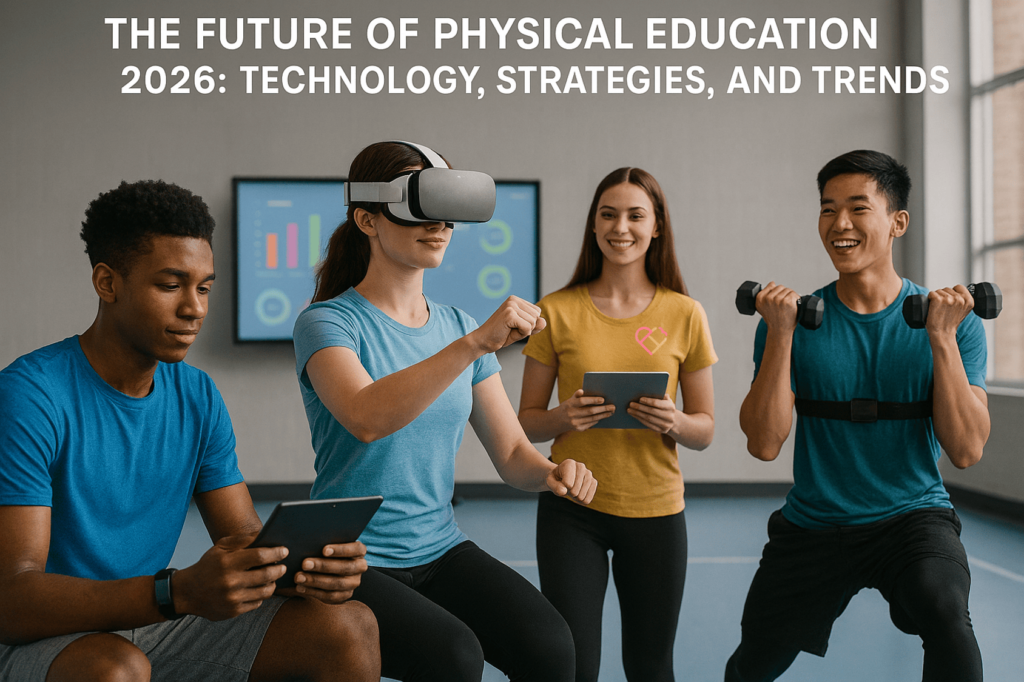
As we approach the 2025-2026 school year, Physical Education (PE) in the USA is undergoing a radical transformation. Gone are the days when “gym class” was solely about lap running. By 2026, PE is predicted to be a data-informed, inclusive, and technology-rich discipline focused on holistic wellness and lifelong movement identity. Based on emerging reports from industry leaders like SHAPE America and themes from upcoming 2026 conferences, here is a fact-based look at the predictions for K-12 Physical Education. 1. Technology: From “Cool Tools” to Integrated Systems In 2026, technology in PE moves beyond novelty to become the backbone of personalized instruction. The “scattershot” approach of using random apps is being replaced by consolidated ecosystems 1. 2. Strategies: “Playground to Purpose” The pedagogical shift for 2026 is defined by the theme of the upcoming ECIS Physical Education Conference: “From Playground to Purpose.”. The goal is to transition students from unstructured play to intentional, lifelong health habits 4. 3. Types of Activities: The Rise of Lifestyle Fitness The curriculum of 2026 favors activities that students can pursue for decades over traditional team sports that often end after high school. Trending Activities for 2026: Activity Type Examples Why It’s Trending Hybrid/Virtual Fitness VR Boxing, Peloton-style in-class cycling Meets “digital natives” where they are; reduces performance anxiety. Lifestyle Sports Pickleball, Rock Climbing, Hiking, Disc Golf High transferability to adult life; encourages community interaction. Gamified HIIT “Four Corner Fitness”, “Sports Mania” High-intensity interval training (HIIT) keeps heart rates up with short, engaging bursts of activity 6. Mindful Movement Yoga flows, Tai Chi, “Build it Wreck it” Balances high energy with emotional regulation and spatial awareness. 4. The Data-Driven Future By 2026, the “black box” of PE grading will be fully opened. Assessments will likely move away from raw athletic metrics (e.g., “run a 7-minute mile”) toward competency-based models 7. Conclusion The physical education classroom of 2026 is a high-tech, emotionally intelligent hub of wellness. By leveraging AI for personalization, adopting inclusive strategies, and focusing on lifestyle activities, educators are preparing students not just for a grade, but for a lifetime of healthy movement. Close your loops for $29. Get your January rosters and assessments set up in minutes. Start the $29 Plan | Download the Title IV Funding Guide