
AI in Education Paradox: Debating Advanced Technology While Students Lack Basic Internet Access

The American education system finds itself embroiled in an increasingly intense debate about whether to allow artificial intelligence tools in K-12 classrooms. State departments of education are crafting elaborate policies, teachers are attending professional development sessions on “responsible AI use”, and districts are investing in AI platforms like MagicSchool AI. Meanwhile, a fundamental irony persists: millions of students across the country still lack access to the most basic requirement for digital learning—reliable internet connectivity1 2 3. This disconnect between the sophisticated AI policy discussions happening in education boardrooms and the digital reality facing students highlights a profound misalignment of priorities. As policymakers debate the nuances of generative AI ethics and academic integrity, approximately 16.9 million children remain “logged out” from instruction because their families lack home internet access. The debate over AI in schools, while generating considerable attention and resources, becomes largely academic when applied to the millions of students who cannot reliably connect to the internet in the first place 4. The Scope of the AI Debate The artificial intelligence conversation in K-12 education has exploded since ChatGPT’s public release in late 2022. At least 26 states have now issued official AI guidance or policies for schools, with topics ranging from ethical considerations to implementation strategies. The debate initially centered around concerns about academic dishonesty and plagiarism, but has evolved into more nuanced discussions about how AI can enhance teaching and learning. Recent federal initiatives have elevated the conversation further. President Trump’s April 2025 Executive Order on “Advancing Artificial Intelligence Education for American Youth” mandated AI integration across all grade levels, with Education Secretary Linda McMahon prioritizing AI incorporation in discretionary grant programs. The order asserts that “AI in kindergarten through 12th grade is essential” for cultivating an “AI-ready workforce”5. Survey data reveals the complexity of educator attitudes toward AI. According to Pew Research, 25% of public K-12 teachers say AI tools do more harm than good in education, while only 6% believe they do more good than harm. Despite these mixed feelings, approximately 60% of teachers now acknowledge incorporating AI into lesson planning, parent communication, and grading processes. The urgency around AI education has led to significant policy development. States like North Carolina have created comprehensive frameworks emphasizing that “all schools and districts ensure all staff and students are AI literate”, while others like West Virginia require parental permission for students under 18 to use AI tools. This patchwork of policies reflects both the perceived importance of AI literacy and the uncertainty about how to implement it safely and effectively7. The Persistent Digital Divide While education leaders focus on advanced AI policies, the fundamental infrastructure for digital learning remains inadequate for millions of students. The statistics paint a stark picture of educational inequality that makes sophisticated AI discussions seem premature: Home Internet Access Challenges: The Homework Gap:The Federal Communications Commission reports that nearly 17 million children lack home internet access, creating what educators call the “homework gap.” This digital divide disproportionately affects marginalized communities, with one out of three Black, Latino, and American Indian/Alaska Native households lacking adequate connectivity. Research shows that 70% of teachers now assign homework requiring internet access, yet millions of students cannot complete these assignments at home. Many resort to using smartphones for schoolwork—approximately 4% of students can only access the internet through a smartphone—which creates additional challenges since educational software often functions poorly on smaller screens. Rural Connectivity Crisis:Rural students face particularly acute challenges. Nationally, 13.4% of rural households lack the minimum necessary broadband connection for streaming educational videos or virtual classrooms. In some rural Michigan schools, one-third of students still lack high-speed broadband internet at home, and these students demonstrate lower classroom grades, standardized test scores, and educational aspirations compared to their better-connected peers. Device Access Disparities Beyond internet connectivity, device access represents another layer of the digital divide: The Irony of Priorities The juxtaposition of these realities creates a striking irony. Education systems are investing substantial resources in AI guidance, training, and tools while basic digital infrastructure remains inadequate for millions of students. This misalignment becomes particularly apparent when examining specific examples: Resource Allocation Paradox:While districts spend money on AI platforms and teacher training for “responsible AI use”, only 45% of public schools are still offering home internet access to students as of 2022, down from 70% in 2021. The decline occurred as federal COVID relief funding expired, highlighting how temporary solutions failed to address systemic connectivity issues. Policy vs. Reality:States are crafting sophisticated AI policies that assume universal digital access. For instance, North Carolina’s guidance encourages “infusing AI literacy in all curriculum areas”, but this recommendation becomes meaningless for students who cannot reliably access digital content at home. Similarly, discussions about AI-generated homework assistance are irrelevant when students lack basic tools to submit assignments online. Training Disconnect:The emphasis on professional development for AI tools contrasts sharply with the more fundamental need for training teachers to serve students without basic technology access. While 68% of teachers surveyed didn’t receive training on AI tools, even fewer receive guidance on accommodating students in the homework gap. The Smartphone Dependency Problem Many students caught in the digital divide rely on smartphones as their primary internet access point, creating additional educational challenges that make AI debates even more disconnected from reality. Research indicates that students who depend solely on smartphones for homework face significant academic disadvantages: Academic Performance Impact:Studies show that students without home internet access or who rely solely on mobile plans spend more time on homework, have lower grade point averages, and weaker digital skills. The gap in digital skills between these students and those with reliable broadband “is equivalent to the gap in digital skills between 8th and 11th grade students”. Smartphone-Based Learning Limitations:When students complete assignments on phones, the results are often problematic. Educators report issues with “huge font, wide margins, bizarre formatting” in work obviously completed on mobile devices. More concerning, research from Rutgers University found that students who rely on smartphones to look up homework answers score significantly lower on exams—as much as half to a full letter grade lower—because they rapidly forget both questions and
Maximizing Summer Break: Strategic Prep for PE Teachers in the Digital Age
As the 2024-2025 school year concludes, physical education teachers have a valuable opportunity to reflect, recharge, and strategically prepare for the upcoming academic year. The summer break provides the perfect window to enhance teaching methodologies, refine curriculum planning, and explore emerging technologies that are transforming physical education. This comprehensive guide outlines how PE teachers can effectively utilize their time off to create innovative, engaging, and standards-aligned programs for the 2025-2026 school year, with special attention to incorporating cutting-edge technology trends. Professional Development Opportunities Summer Institutes and Specialized Workshops The summer months offer numerous professional development opportunities specifically designed for physical education professionals. The SHAPE America Summer Institute stands out as a premier event, offering brand new professional development based on the latest National Physical Education Standards and National Health Education Standards2. This institute features presentations from leading experts covering essential topics such as implementing new standards, creating teachable progressions, and developing student-centered approaches to physical education2. Attending these specialized workshops allows PE teachers to network with colleagues, gain fresh perspectives, and develop new strategies for their classrooms. Participants will “walk away with lessons, ideas, and student engagement strategies – all based on these new standards,” making it a worthwhile investment in professional growth2. The summer institute represents a unique opportunity to advance your career while staying current with evolving educational approaches. Curriculum Planning and Design The summer break provides an ideal time to develop a comprehensive curriculum plan for the upcoming year. Rather than rushing through this critical process, PE teachers can dedicate focused time to thoughtful planning. Some experts suggest that with proper strategies, you can effectively “Plan a Whole Year of PE in 15 minutes” by taking a big-picture approach to curriculum mapping1. A well-structured PE curriculum should include a clear framework covering key areas such as fundamental movement skills, sports and games, and health and fitness education4. The summer term planning process should emphasize building a progressive curriculum that develops coordination, body awareness, teamwork, and communication skills throughout the year4. This period is also ideal for designing curriculum elements that take advantage of seasonal opportunities, particularly outdoor activities that will be feasible during the fall semester. Assessment Strategies Development Comprehensive Evaluation Approaches Summer provides PE teachers with time to develop or refine assessment tools that comprehensively evaluate student learning across all domains. Appropriate assessment in physical education should cover “all three domains of learning (psychomotor, cognitive and affective)” using a variety of techniques3. By dedicating time during the break to creating robust assessment tools, teachers can better track student progress and provide targeted instruction in the coming year. Effective assessment tools should measure student learning, align with content standards, include clear scoring criteria, be authentic, age-appropriate, and manageable3. During the summer, PE teachers can develop a toolkit of assessment strategies including: Standards Alignment and Progression Planning With the recent updates to national physical education standards, the summer break provides a critical opportunity to realign curriculum and assessment practices. Teachers should dedicate time to unpacking the “new SHAPE America National Physical Education Standards” and understanding the associated learning indicators and progressions2. This process ensures that instruction and assessment are cohesively aligned with current best practices and national expectations. PE teachers can use the summer to map out learning progressions that build skills systematically throughout the school year. By carefully planning this sequence in advance, teachers can create a more coherent and effective learning experience for students that demonstrates clear growth and development across the academic year. Embracing Educational Technology Trends Virtual and Augmented Reality in Physical Education One of the most transformative technology trends for PE in 2025 is the increasing integration of immersive technologies. According to industry reports, “By 2025, spending on advanced technology in education is expected to hit $12.6 billion, up from $1.8 billion in 2018,” with augmented reality (AR), virtual reality (VR), and mixed reality (MR) playing significant roles in this expansion5. These technologies offer revolutionary possibilities for physical education: Case studies demonstrate the effectiveness of these approaches. A middle school in California implemented a VR program with “Beat Saber and a dance-based VR app” resulting in “80% of the students reported higher motivation to participate in PE” and significantly increased in-class engagement6. Similar implementations in Singapore and the UK showed improvements in upper-body strength, hand-eye coordination, and increased participation among students with special needs6. Summer break provides the perfect opportunity for PE teachers to research these technologies, identify potential applications for their specific student populations, and develop implementation plans for the upcoming school year. Teachers can explore available options, evaluate costs and technical requirements, and develop lesson plans that meaningfully integrate these technologies into their existing curriculum. Digital Fitness Tracking and Assessment Tools Beyond immersive technologies, PE teachers should explore digital tools that can enhance assessment, motivation, and engagement. Applications that allow students to track physical activity, set personalized goals, and monitor progress can transform how students interact with physical education content7. These tools can make fitness more accessible and engaging by incorporating elements of gamification and social interaction. During the summer, PE teachers can: Communication and Collaboration Platforms Technology can also enhance communication between PE teachers, students, and parents. Tools like Remind “allow teachers to send information via text, images, & voice to students and parents through any kind of device” which can be particularly valuable for sharing information about upcoming units, special events, or celebrating student achievements7. The summer break is an ideal time to set up these communication systems, create content calendars, and develop strategies for effectively engaging with the school community throughout the coming year. Establishing these channels before the school year begins ensures seamless communication from day one. Implementation Planning and Resource Development Technology Integration Framework Successful implementation of technology in PE requires thoughtful planning. During the summer, teachers should develop a comprehensive framework for technology integration that includes: Developing this framework during the summer allows teachers to approach the new school year with confidence and clarity about how technology will enhance, rather than distract from, core physical education goals. Budgeting and Resource Allocation Modern technology
AI and Fitness: Preparing K-12 Schools for Dual Education Mandates
Embracing the Next Era of K–12 Education As the U.S. educational system confronts two sweeping mandates—President Trump’s 2025 executive order on Advancing Artificial Intelligence Education and the revival of the Presidential Youth Fitness Program—K–12 schools are at a pivotal crossroads. Together, these initiatives demand not only technological literacy but also a renewed commitment to student health and wellness. This guide outlines the critical implications for physical education (PE) teachers and school administrators and provides a roadmap to align curriculum, technology, and health standards in meaningful and sustainable ways. 1. Understanding the AI Executive Order in K–12 Schools What the Executive Order Means President Trump’s 2025 order marks a definitive move toward AI literacy for all students, tasking the Department of Education and a newly formed White House Task Force with spearheading the effort. The vision is clear: American students must be prepared for a world shaped by artificial intelligence—both as users and as future innovators. Key Initiatives for Educators: 2. The Return of the Presidential Youth Fitness Program Historical Context and New Direction The Presidential Youth Fitness Program (PYFP) has evolved from measuring athletic prowess to promoting health-related fitness. The latest iteration, aligned with the Take Back Your Health initiative, is expected to: 3. AI Integration in Physical Education: Challenges and Opportunities Key Professional Development Areas for PE Teachers: Curriculum Ideas: 4. Implementing the Revived Youth Fitness Program What PE Teachers Should Prepare For: Engaging Students and Parents: 5. AI Meets Fitness: Powerful Synergies AI-Enhanced Assessment: Personalized Fitness Programs: 6. Leadership Guidance for School Administrators Strategic Steps: Infrastructure & Policy: 7. Actionable Tips for PE Teachers Shaping a New Vision for K–12 Physical Education The convergence of AI and Youth Fitness in K–12 Schools is not a passing trend—it’s a transformational shift in how we prepare students for the future. By embracing these dual mandates, educators can redefine physical education for the digital age—combining data-driven insights with the irreplaceable value of movement, health, and human connection. Whether you’re a teacher, administrator, or policymaker, now is the time to align your strategy with the future of education—where technology empowers health, and every student becomes an active participant in their own well-being. Looking to fundraise? Visit WellPledge to start your campaign today! Contact us at PhysednHealth for more information. Or email us at awesome@physednhealth.com PhysednHealth is a leading physical education and student wellness technology platform designed to help schools modernize PE with smart, standards-based tools. Our easy-to-use physical education software empowers teachers to track student progress, set SMART fitness goals, and promote mental and physical well-being. Trusted by educators worldwide, PhysednHealth brings data-driven insights, AI-powered assessments, and personalized learning to PE programs—helping students build lifelong healthy habits.
AI Prompts for Physical Education: A Comprehensive Guide Part 1

AI prompts for physical education are revolutionizing how PE teachers plan, adapt, and deliver their lessons. This comprehensive guide provides you with ready-to-use prompts aligned with SHAPE America standards, helping you create engaging activities, differentiated assessments, and inclusive programs. Whether you’re new to AI or looking to enhance your existing practice, these classroom-tested prompts can be easily customized for your specific teaching needs. Table of Contents Lesson Planning AI Prompts Unit Planning Create a [sport/activity] unit plan for [grade level] that:- Aligns with SHAPE America Standards [list specific standards]- Spans [number] weeks with [number] lessons per week- Includes progression from fundamental skills to game play- Incorporates assessment strategies- Uses available equipment: [list equipment]- Accommodates [number] students in [space description]- Integrates social-emotional learning objectives Individual Lesson Design Design a [duration] minute [activity] lesson for [grade] that:- Targets [specific skill/standard]- Includes warmup, skill development, and cooldown- Uses station-based learning with [number] stations- Incorporates peer feedback opportunities- Provides differentiation for varied skill levels- Maximizes participation with [equipment] for [number] students Warmup Activities Create age-appropriate warmup activities that:- Take [duration] minutes- Target muscle groups used in [main activity]- Include both dynamic stretching and cardiovascular elements- Can be done in [space constraints]- Are engaging for [grade level] students- Include modifications for different fitness levels Assessment and Rubrics Skill Assessment Design a standards-based assessment rubric for [skill] that:- Aligns with [specific standard]- Includes 4 performance levels- Lists observable behaviors for each level- Incorporates both technique and application- Provides specific feedback language- Includes student self-assessment component Fitness Testing Create a fitness testing protocol that:- Measures [specific components] of fitness- Aligns with FitnessGram standards- Includes data collection sheets- Provides benchmark scores by age/gender- Lists required equipment and setup- Includes testing stations rotation schedule Progress Monitoring Develop a progress monitoring system for [unit/skill] that:- Tracks individual student progress- Uses both quantitative and qualitative measures- Includes regular check-in points- Provides student feedback templates- Aligns with learning objectives- Documents modifications used Differentiation and Inclusion Adaptive Equipment Suggest adaptations for [activity] for students who:- Use mobility devices- Have visual impairments- Have coordination challenges- Need modified equipmentInclude:- Equipment modifications- Rule adjustments- Success criteria changes- Safety considerations Skill Progressions Create a differentiated skill progression for [skill] with:- 3 difficulty levels- Clear success criteria for each level- Specific teaching cues- Common error corrections- Challenge progressions- Support regressions Modified Games Modify [sport/game] for inclusive participation by:- Adjusting rules for different ability levels- Suggesting equipment modifications- Creating alternative roles- Maintaining game objectives- Ensuring equal participation- Preserving competitive elements safely Skill Development Sport-Specific Skills Create a skill development sequence for [sport skill] including:- Key teaching points- Common errors and corrections- Progressive practice activities- Partner/group drills- Game-like applications- Assessment checkpoints Fundamental Movement Design activities to develop [movement skill] that:- Target age-appropriate outcomes- Use available equipment: [list]- Include individual and partner work- Provide success opportunities- Build toward complex skills- Include assessment criteria Tactical Understanding Create game scenarios for teaching [tactical concept] in [sport] that:- Progress from simple to complex- Include decision-making elements- Use modified game formats- Incorporate strategy discussions- Assess understanding- Apply to game situations Safety and Management Class Organization Design a class management system for [activity] that:- Organizes [number] students in [space]- Maximizes activity time- Ensures safe transitions- Includes equipment distribution- Manages behavioral expectations- Provides emergency procedures Safety Protocols Create safety guidelines for [activity/unit] including:- Equipment inspection checklist- Space setup requirements- Student behavior expectations- Emergency procedures- First aid considerations- Incident reporting process Behavior Management Develop behavior management strategies that:- Align with school policies- Promote positive participation- Address common PE challenges- Include progressive interventions- Maintain activity flow- Support inclusive participation Parent Communication Progress Reports Create a PE progress report template that:- Describes skill development- Reports fitness progress- Notes participation patterns- Suggests home practice- Includes next unit preview- Maintains positive tone Unit Information Design a parent information sheet for [unit] including:- Unit objectives and timeline- Skills being developed- Assessment methods- Required equipment/attire- Home practice suggestions- Safety considerations Event Communication Create communication for [PE event] that includes:- Event description and purpose- Date, time, location details- Required equipment/clothing- Permission slip template- Volunteer opportunities- Safety protocols Documentation Lesson Records Create a lesson documentation template that tracks:- Standards addressed- Modifications made- Student progress notes- Equipment used- Safety incidents- Next lesson adjustments Student Data Design a student data tracking system for:- Skill assessments- Fitness test results- Participation records- Behavior notes- Modification needs- Progress trends Program Evaluation Develop a PE program evaluation tool that measures:- Standards alignment- Student engagement- Skill development- Fitness progress- Inclusion effectiveness- Resource utilization Tips for Using These AI Prompts for Physical Education Educational Standards & Guidelines: Remember: These prompts are starting points. Modify them based on your specific needs, context, and student population. Looking to fundraise? Visit WellPledge to start your campaign today! Contact us at PhysednHealth for more information. Or email us at awesome@physednhealth.com PhysednHealth is a leading physical education and student wellness technology platform designed to help schools modernize PE with smart, standards-based tools. Our easy-to-use physical education software empowers teachers to track student progress, set SMART fitness goals, and promote mental and physical well-being. Trusted by educators worldwide, PhysednHealth brings data-driven insights, AI-powered assessments, and personalized learning to PE programs—helping students build lifelong healthy habits.
Personalized Fitness Plans: Using AI to Tailor PE to Individual Needs
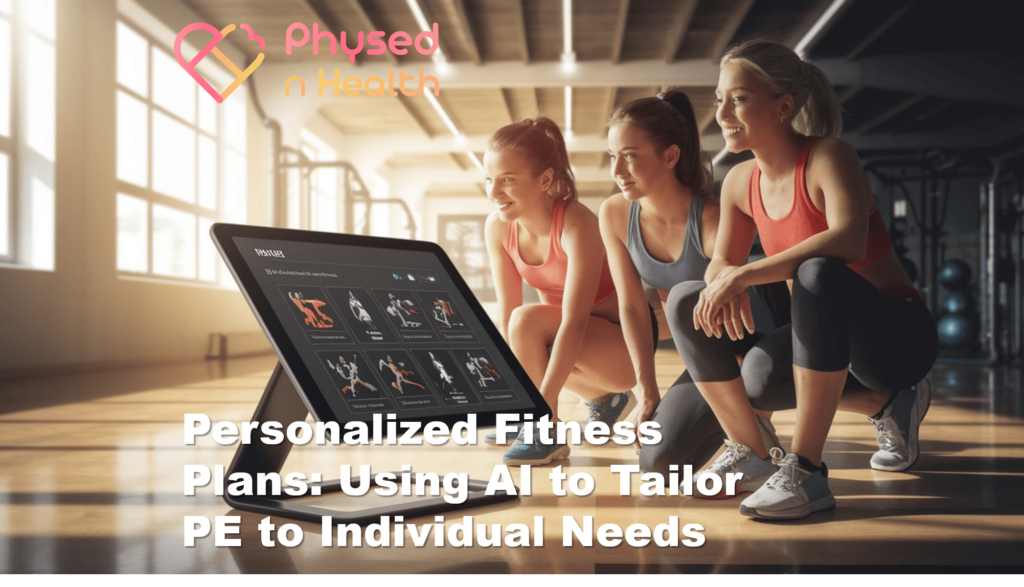
Personalized fitness plans are revolutionizing the way physical education (PE) is delivered, and artificial intelligence (AI) is at the forefront of this transformation. By using AI to tailor PE to individual needs, educators can create customized programs that cater to each student’s goals, abilities, and preferences. This blog explores how AI-powered fitness plans can enhance student engagement and success, provides sample AI prompts for creating personalized programs, and outlines a practical implementation strategy for schools. Why Personalized Fitness Plans Matter in PE Traditional “one-size-fits-all” fitness programs often fail to meet the diverse needs of students in PE classes. Personalized fitness plans address this issue by tailoring activities to individual goals, skill levels, and physical limitations. Using AI to tailor PE to individual needs allows educators to: How AI Enhances Personalized Fitness Plans AI-powered tools analyze data such as fitness goals, body metrics, and activity preferences to create tailored workout plans. These tools also adapt over time based on student progress, ensuring continued effectiveness. Key Benefits of Using AI in PE: Sample Detailed AI Prompts for Personalized Fitness Plans Safeguarding Student Privacy: A Top Priority When using AI to tailor PE to individual needs, protecting student data is paramount. Schools must ensure that personalized fitness plans are created and implemented without compromising student privacy or security. AI tools like ChatGPT can generate highly customized fitness plans using detailed prompts. Below are examples of base prompts and templates you can use: Base Prompt Template “Create a personalized 6-week fitness plan for a [age]-year-old [gender] at a [fitness level] level aiming to [fitness goal]. The program should include [specific types of exercises] while considering [injuries or limitations].” Sample Prompts Advanced Prompt Chain Example These prompts can be used with platforms like ChatGPT or other AI tools to quickly generate tailored plans that meet individual needs. Implementation Strategy for Schools Introducing personalized fitness plans using AI in schools requires careful planning and execution. Below is a step-by-step strategy: 1. Assess Student Needs Collect baseline data such as fitness levels, goals, injuries, and preferences using surveys or wearable devices. 2. Choose the Right Tools Select an AI platform that aligns with your school’s needs and budget. Options like PhysednHealth provide comprehensive solutions tailored specifically for schools. 3. Train Educators Provide professional development sessions on how to use AI tools effectively in PE classes. Resources like the SHAPE America website offer valuable training materials. 4. Pilot the Program Start with a small group of students to test the system’s effectiveness before scaling up school-wide implementation. 5. Monitor Progress Use AI analytics dashboards to track student progress over time and make adjustments as needed. Building Trust Through Proven Results At PhysednHealth, we’ve seen firsthand how personalized fitness plans can transform student outcomes when powered by AI. In 2024 alone: These results highlight the profound impact of using AI-driven personalized fitness plans in schools. Conclusion: Empowering Students Through Personalization The future of physical education lies in personalization—and using AI to tailor PE to individual needs is the key to unlocking every student’s potential. By implementing personalized fitness plans powered by AI, schools can create inclusive programs that foster engagement, improve health outcomes, and build lifelong habits. Ready to transform your PE program? Explore innovative solutions at PhysednHealth or learn more about how technology is reshaping education at PE Scholar. Take the First Step Towards Personalized Fitness Today!Sign Up for a Free Demo with PhysednHealth to discover how AI can revolutionize your school’s PE program. Click here to schedule your demo now and start empowering your students with tailored fitness plans that drive real results! You can also contact us at awesome@physednhealth.com. PhysednHealth is a leading physical education and student wellness technology platform designed to help schools modernize PE with smart, standards-based tools. Our easy-to-use physical education software empowers teachers to track student progress, set SMART fitness goals, and promote mental and physical well-being. Trusted by educators worldwide, PhysednHealth brings data-driven insights, AI-powered assessments, and personalized learning to PE programs—helping students build lifelong healthy habits. P.S. We are actively working on an AI Guide for PE K12 Schools. Email or drop a comment if you would like to see specific information covered in the guide.