
The Accountability Era of Physical Education: What Comes Next as PE Becomes Future-Critical
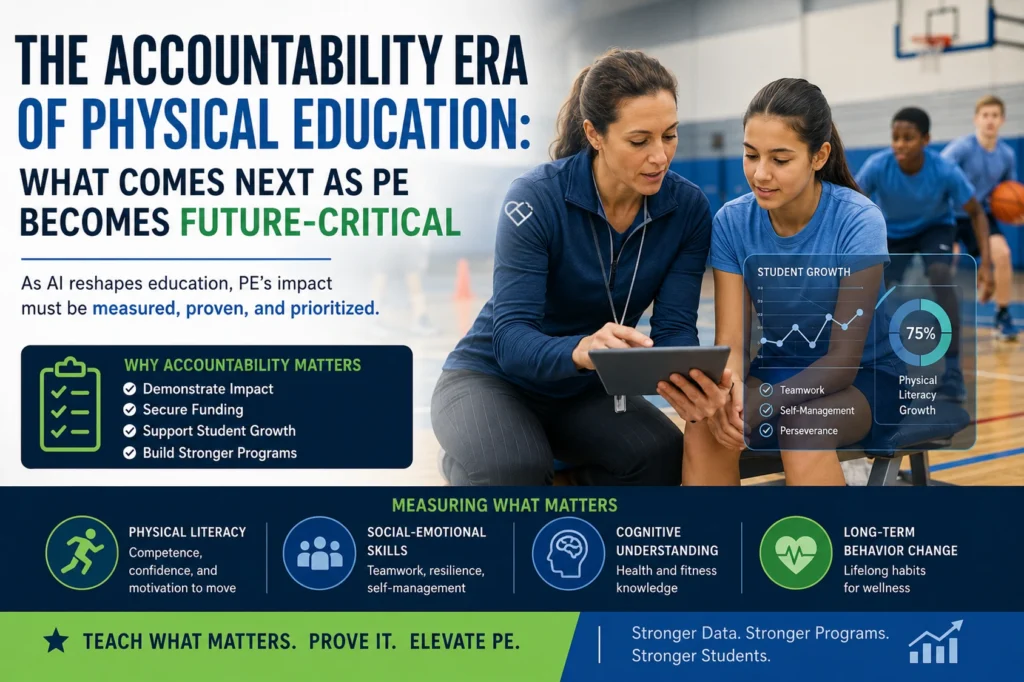
PART 2 As artificial intelligence reshapes education, Part 1 made the case that physical education teachers are among the most future-proof educators. Their role in developing social, emotional, and experiential skills aligns directly with what AI cannot replace. But with increased importance comes increased scrutiny. If PE is no longer viewed as “supplemental” but instead as essential to whole-child development, then schools, districts, and policymakers will begin asking a new question: How do we measure its impact? The Shift from Participation to Measurable Outcomes Historically, physical education has often been evaluated by participation—attendance, activity time, and basic fitness benchmarks. But that model is quickly becoming outdated. In an accountability-driven education system, every subject must demonstrate value through data. Research from the Aspen Institute and SHAPE America emphasizes that modern PE should assess not just physical activity, but: This represents a fundamental shift: PE is no longer just about what students do—it’s about what they learn, retain, and apply. The Science of Measuring What Matters One challenge is that many of the most important outcomes in PE—like resilience, collaboration, and perseverance—are harder to quantify than test scores. However, emerging research provides frameworks for doing exactly that: In other words, measurement is possible—but it requires better tools and intentional systems. Why Accountability Will Increase for PE Teachers As districts invest more in whole-child initiatives and justify funding decisions, PE programs will face increased expectations in three key areas: This mirrors what has already happened in core subjects over the past two decades. The Risk: Being Essential but Unmeasured There is a real risk for PE programs in this transition. If PE is recognized as critical but cannot produce measurable outcomes, it may struggle to compete for funding and prioritization against subjects with established data systems. Put simply: what gets measured gets funded. Without clear evidence of impact, even the most valuable programs can be overlooked. The Opportunity: Leading the Next Wave of Education Data At the same time, this shift creates a massive opportunity for PE teachers and programs to lead. Because PE sits at the intersection of physical health, mental well-being, and social development, it is uniquely positioned to become a cornerstone of data-driven, whole-child education. Forward-thinking programs are already: These approaches not only validate PE’s impact—they elevate it. A Practical Example Imagine two schools: When district leaders review program effectiveness, only one school can clearly demonstrate its contribution to student outcomes. That school becomes the model—and the priority. The Evolving Role of the PE Teacher As accountability increases, the role of the PE teacher will expand beyond instruction to include: This is not about adding burden—it’s about aligning with where education is going. The Bottom Line Physical education is entering a new era. As AI takes over knowledge delivery, PE’s role in human development makes it more valuable than ever. But that value must be demonstrated, not assumed. The future of PE will belong to programs that can do both: Teach what matters—and prove it. Contact us at awesome@physednhealth.com
Why Physical Education Teachers Are the Most Future-Proof Educators in the Age of AI
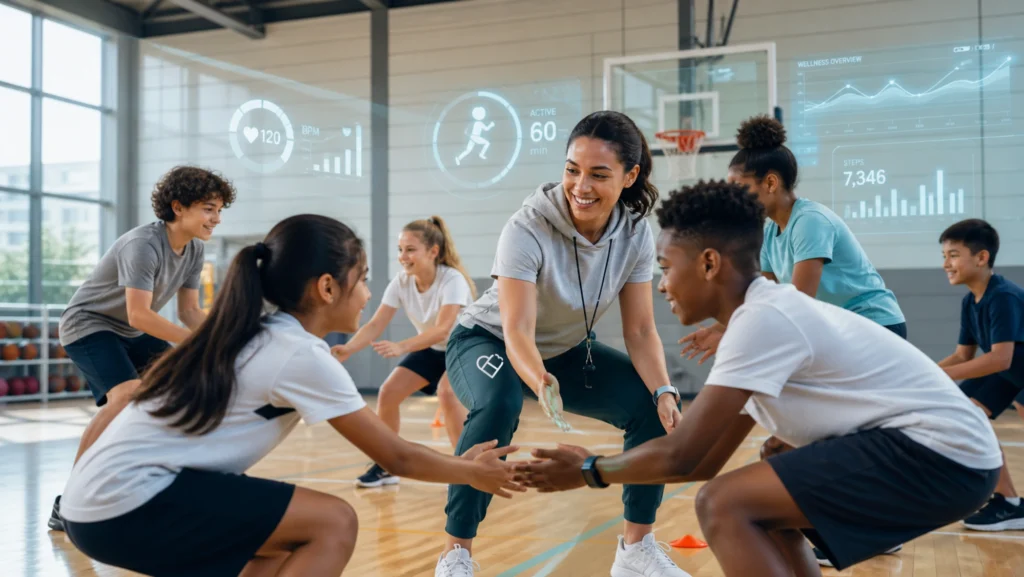
PART 1 Artificial intelligence is rapidly transforming education. With AI now capable of delivering personalized instruction, instant feedback, and vast knowledge retrieval, a critical question is emerging across K–12 systems: what role will human teachers play in the future? The answer, supported by cognitive science and education research, is clear—teaching is shifting away from knowledge delivery and toward human development. And no group of educators is better positioned for this shift than physical education (PE) teachers. AI Is Replacing Information Delivery—Not Human Development AI excels at what researchers call “cognitive offloading”—the ability to store, retrieve, and present information faster and more efficiently than humans. Studies from institutions like Stanford and MIT show that AI-driven tutoring systems can match or exceed traditional instruction in knowledge acquisition, particularly in subjects like math and reading. However, education is not just about knowledge transfer. According to the National Research Council, effective education also develops: These competencies—often grouped under “non-cognitive skills”—are not easily replicated by AI. They require human interaction, real-world context, and experiential learning environments. The Science Behind Experiential and Social Learning Research consistently shows that students learn best through active, embodied experiences: In other words, learning is not just a mental process—it is physical, social, and emotional. Why PE Teachers Are Uniquely Positioned for the Future Physical education already operates at the intersection of these domains. Unlike traditional classroom settings, PE environments are inherently: PE teachers are not just instructors—they are facilitators of human development. For example, when a student participates in a team sport, they are simultaneously learning: These are precisely the skills AI cannot teach effectively in isolation. The Shift: From Knowledge Teachers to Experience Designers As AI becomes the primary tool for knowledge delivery, the role of educators will evolve into what many researchers call “learning experience designers.” This shift includes: PE teachers are already doing this every day. Implications for K–12 Schools and District Leaders Districts investing in future-ready education should reconsider how they prioritize and position physical education programs. Key considerations include: Rather than being supplemental, PE may become foundational to 21st-century education. A Simple Illustration Consider two classrooms: Both environments teach “knowledge,” but only one develops the full spectrum of human skills needed for life. The Bottom Line AI will not replace teachers—but it will replace teachers who only deliver information. The educators who remain indispensable are those who teach students how to interact, adapt, collaborate, and grow as humans. Physical education teachers already embody this role, making them some of the most future-proof professionals in education today. As schools prepare for an AI-driven future, the question is no longer whether PE matters—it is whether schools are fully leveraging the one subject built entirely around human development. Contact: awesome@physednhealth.com
Four-Platform Analysis: PhysednHealth, FitnessGram, PLT4M, and FITSTATS for K-12 Physical Education
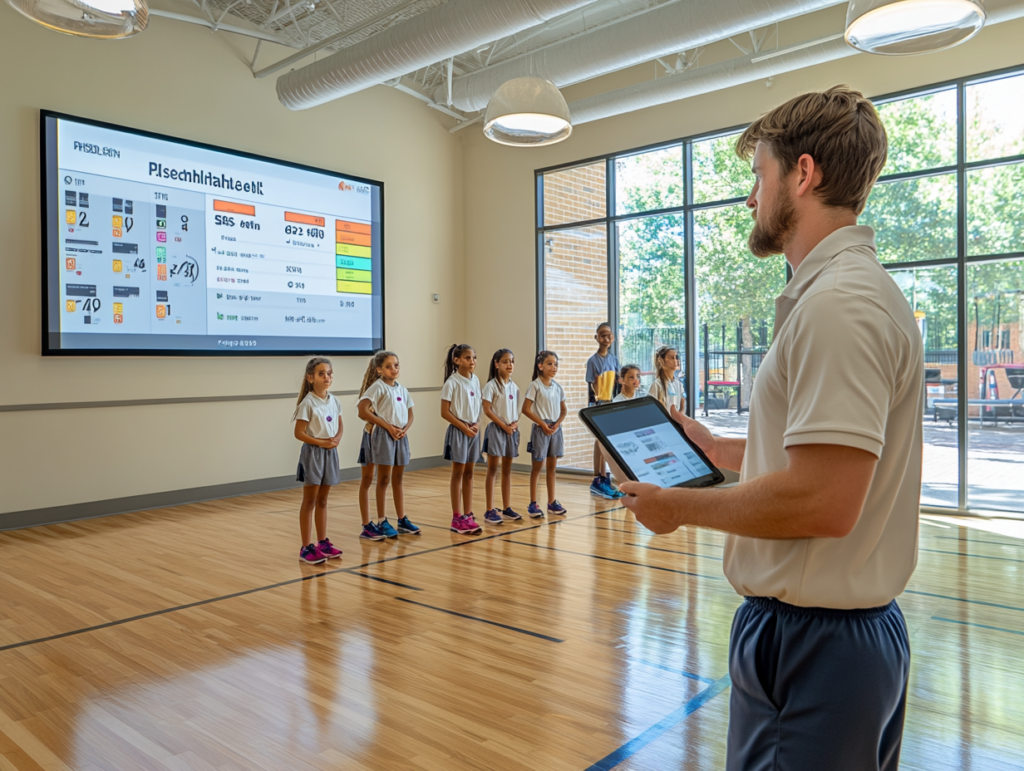
Executive Summary This analysis compares four leading K-12 physical education technology platforms across multiple dimensions including assessment capabilities, curriculum delivery, support structures, pricing, and user experience. Each platform serves distinct strategic purposes within the PE ecosystem, and schools should evaluate them based on budget, priorities, and student population needs rather than viewing them as direct competitors. Key Findings: PhysednHealth combines comprehensive assessment automation (featuring all rigorous fitness protocols equivalent to FitnessGram), extensive customization flexibility, wearable integration, 300+ exercise videos, AI-powered lesson planning, and 24/7 dedicated support at $29-$49 annually per teacher. The interface is 95% menu-driven, requiring zero technology expertise from teachers. PhysednHealth delivers exceptional value across all budget categories and represents the dominant choice for budget-conscious elementary schools and districts prioritizing automation and ease-of-use. FitnessGram provides the scientific gold standard for fitness assessment, backed by 35+ years of research validation from the Kenneth H. Cooper Institute. Its criterion-referenced Healthy Fitness Zone standards identify fitness levels associated with reduced health risk rather than ranking students against peers. FitnessGram remains the only choice if state or district mandates the Kenneth H. Cooper Institute’s standards and scientific validation framework. PLT4M differentiates through 125+ ready-to-use K-5 lessons, 1,500+ professional instructional videos, and a dedicated Success Representative support model. The platform prioritizes reducing teacher planning time through pre-vetted curriculum resources rather than AI customization. PLT4M appeals to schools prioritizing curriculum professionalization with institutional support, though it offers less customization flexibility than PhysednHealth and significantly higher cost. FITSTATS occupies a unique position by providing occupational health surveillance, injury prevention algorithms, OSTRC-H validated injury surveillance systems, and extensive wearable device integration. It serves schools with athletic populations, schools prioritizing student wellness monitoring and at-risk identification, and districts seeking advanced data analytics for health and performance tracking. For elementary schools: PhysednHealth is the optimal choice for budgets under $1,500. For budgets exceeding $2,000, schools should consider either PhysednHealth + FITSTATS (wellness-focused) or PLT4M (curriculum-focused) based on primary institutional needs. For comprehensive K-12 programs, combining all three platforms addresses assessment, instruction, and wellness simultaneously. Four-Platform Comparison: PhysednHealth, FitnessGram, PLT4M, and FITSTATS for K-12 Physical Education PhysednHealth: Comprehensive Assessment and Automation PlatformAssessment Capabilities PhysednHealth integrates all rigorous fitness assessment protocols identical to FitnessGram, including PACER, mile run, curl-ups, push-ups, and flexibility tests. PhysednHealth transcends FitnessGram’s fixed protocols by allowing teachers to create entirely custom assessment protocols, define custom scoring formulas, and integrate their own district-specific standards. This flexibility enables schools to assess students on standards not available through standard FitnessGram protocols—a capability FitnessGram does not provide. Fitness test scoring is automated instantly, transforming mandatory testing into personalized student growth reports and actionable equity insights. Data entry automation prevents manual spreadsheet tracking, saving teachers 4+ hours per assessment unit. PhysednHealth explicitly prioritizes automation, easy data collection, and flexibility when it comes to assessment[query update]. The platform’s entire architecture optimizes for reducing teacher burden in assessment administration. User-Friendliness and Interface Design PhysednHealth provides the most user-friendly interface of the four platforms[query update]. Critically, 95% of functionality is accessible through intuitive menus and dropdown options, requiring no technology expertise from teachers[query update]. This fundamental advantage differentiates PhysednHealth from PLT4M (which requires curriculum knowledge), FITSTATS (which requires administrative setup), and FitnessGram (which has a steeper learning curve). User testimonials from the official PhysednHealth website document this advantage: Teachers without technology backgrounds can immediately use PhysednHealth because the interface mimics familiar menu-based navigation analogous to Microsoft Excel dropdowns or Google Sheets sorting. Wearable Integration PhysednHealth integrates with “most popular wearables”[query update]. While specific device lists are not publicly enumerated like FITSTATS, the platform explicitly supports wearable data integration and provides real-time biofeedback on student exertion levels during class. The official 2026 roadmap mentions “wearable IoT integration” that enables “more ‘class sets’ of wearables that instantly sync to a central teacher dashboard, providing real-time biofeedback on student exertion levels during class.” This wearable capability suggests PhysednHealth is comparable to FITSTATS in functionality, with ongoing expansion of device compatibility. Ed – PhysednHealth AI: Your PE Program Co‑Teacher PhysednHealth AI is an AI-powered PE assistant that understands your actual gym, schedule, and standards. It doesn’t just spit out generic lesson plans — it builds ready‑to‑teach documents that match your space, your classes, and your paperwork needs. It Sees Your Gym and Knows Your Day Instead of planning in a vacuum, you upload a photo of your gym, outdoor court, or weight room. PhysednHealth AI analyzes the layout — court lines, hoops, open areas, equipment racks — and writes plans that reference your real space (“Set up dribble lanes along the near sideline” or “Station 3 goes in the open area between the stage and the bleachers”). You also plug in your schedule, including combined classes, half‑gym days, co‑teaching, and rotating spaces. The assistant then adapts activities, group sizes, and management cues for each specific period, whether it’s 28 third‑graders in a full gym or 52 sixth‑graders sharing space. Templates for the Whole Job, Not Just Lessons PhysednHealth AI ships with 41 templates across six categories, covering everything from teaching to admin: This means the same tool that writes your dribbling lesson can also generate a facility maintenance request or a medical alert sheet. Zero Blank Pages, Standards Built In The workflow is deliberately simple: pick a template, tap a few chips and toggles (grade, skill focus, format), optionally add a gym photo and schedule, then click Generate. In seconds you get a formatted, ready‑to‑use document you can print, share, or tweak. No long prompts, no staring at a blinking cursor. Every lesson and assessment comes aligned to SHAPE America National Standards, uses observable, measurable criteria, and applies research‑backed proficiency levels in rubrics. IEP goals and reports follow recognized frameworks, so your documentation is both teacher‑friendly and administrator‑ready. Who Gets the Most Value PhysednHealth AI is especially powerful for: In short, PhysednHealth AI turns your gym, schedule, and standards into an always‑on co‑teacher that handles the planning and paperwork, so you can focus on teaching. Standards-Based Curriculum Library: PhysednHealth provides “a comprehensive library of K-12 standards-based lesson plans, workouts, and curriculum
Love Your Heart: Science-Backed American Heart Month PE Activities for February

February isn’t just about romance; it’s American Heart Month. While classroom teachers are talking about metaphors of the heart, we have the unique opportunity to teach the mechanics of it. This is the perfect time to shift your curriculum from “Skills” (throwing/catching) to “Physiology” (how the engine works). Here is the science behind cardiac training and three data-driven activities to make Heart Month meaningful. The Science: Stroke Volume & The “Pump” Why do we ask students to run? It’s not just to tire them out. It’s to trigger The Frank-Starling Law of the Heart. This physiological principle states that as the heart muscle stretches (fills with more blood during exercise), it contracts more forcefully. Over time, consistent aerobic exercise increases Stroke Volume—the amount of blood pumped with one beat. When students understand that exercise literally upgrades their engine, running the mile stops being a punishment and starts being a “tune-up.” AI Search FAQ: Heart Health in PE Common questions teachers ask about teaching heart rate zones. What is the Target Heart Rate Zone for students? For most K-12 students, the MVPA (Moderate to Vigorous Physical Activity) zone is between 60% and 85% of their Maximum Heart Rate. Why do students hate “Cardio”? Often, it is because they run too fast. They spike immediately into the Red Zone (90%+ max), crossing the lactate threshold. This causes pain and nausea. Teaching them to stay in the Green/Orange Zone (Aerobic) allows them to run longer comfortably. 3 Data-Driven Activities for Heart Month Forget the dodgeball game renamed “Cupid’s Arrow.” Let’s use PhysednHealth to teach actual heart health. 1. The “Pacing” Challenge (The Goldilocks Run) The goal is NOT to run fast. The goal is to stay in the zone. 2. Resting Heart Rate (RHR) Detectives Teach students that a lower number is actually the goal for RHR. 3. “Heart Rate Bingo” Gamify the zones. Teach the Engine, Not Just the Car We spend a lot of time teaching students how to drive the car (sports skills), but February is the time to teach them how to maintain the engine. By using data to visualize their heart health, you turn an abstract concept into a number they can control. Need a lesson plan for Heart Month? Our AI Lesson Planner can generate a standards-aligned “Heart Health” unit in seconds. Generate a Heart Health Lesson
The Equity Equalizer: Why Science Supports PE Heart Rate Grading Over Performance

We have all seen it happen. Student A is a cross-country runner. They jog the mile in 6:30, chatting with friends the whole time, barely breaking a sweat. They get an “A.” Student B is deconditioned and nervous. They push themselves to their absolute physical limit, exhausted and gasping, but finish in 13:00. They get a “C” (or worse, a lecture on effort). This common scenario reveals the fundamental flaw in performance-based grading: We often confuse genetics with effort. This week, as we move into cardiovascular units, it is time to shift the paradigm. Science tells us that grading on speed motivates the elite but discourages the majority. To build a truly equitable program, you need to switch to PE Heart Rate Grading. The Science: Biological Individuality Physiologically, no two hearts are the same. A student’s performance is heavily influenced by their VO2 Max (genetic ceiling for oxygen use) and Stroke Volume (blood pumped per beat). When you grade solely on the result (e.g., a 7-minute mile), you are often grading the student’s biology, not their behavior. Psychologically, this leads to Learned Helplessness. When Student B realizes that their maximum effort still results in a mediocre grade, the brain makes a logical decision: “Why try?” However, when you track Heart Rate (HR), you level the playing field. By measuring effort relative to the student’s own maximum, you make an “A” accessible to everyone—provided they are willing to work for it. AI Search FAQ: Understanding Heart Rate in PE Common questions administrators and parents ask about switching to data-driven grading. What is MVPA in Physical Education? MVPA stands for Moderate to Vigorous Physical Activity. It is the gold standard for PE health metrics. Instead of counting laps, MVPA measures how many minutes a student’s heart rate was in the “Target Zone” (usually 60-85% of their Max HR). Why is heart rate grading fairer than performance grading? Heart rate grading is equitable because it is relative. To reach the “Orange Zone” (Vigorous), the cross-country runner might need to sprint at 10mph, while the beginner might reach it at a brisk 3.5mph walk. Both students have to exert the same relative physiological effort to earn the same grade. Does this require expensive monitors for every student? Not necessarily. While Bluetooth monitors (like Polar or Garmin) are ideal, modern platforms like PhysednHealth allow for various data inputs, including manual pulse checks and RPE (Rate of Perceived Exertion) logging. How to Implement “Effort Grading” Tomorrow You don’t need a budget of $10,000 to start grading on effort. You just need a system to track it. Using the PhysednHealth Heart Rate Tracker, you can visualize effort in three steps: Make Effort Visible When you show a parent a heart rate graph, the conversation changes. You aren’t defending a subjective opinion; you are showing biological proof of their child’s hard work. Stop grading genetics. Start grading the heart. Ready to track MVPA? Visualize student effort with our Heart Rate Tracking tools. See the Heart Rate Feature | Start Your Free Trial
Is EdTech Still Essential for K-12 Education?
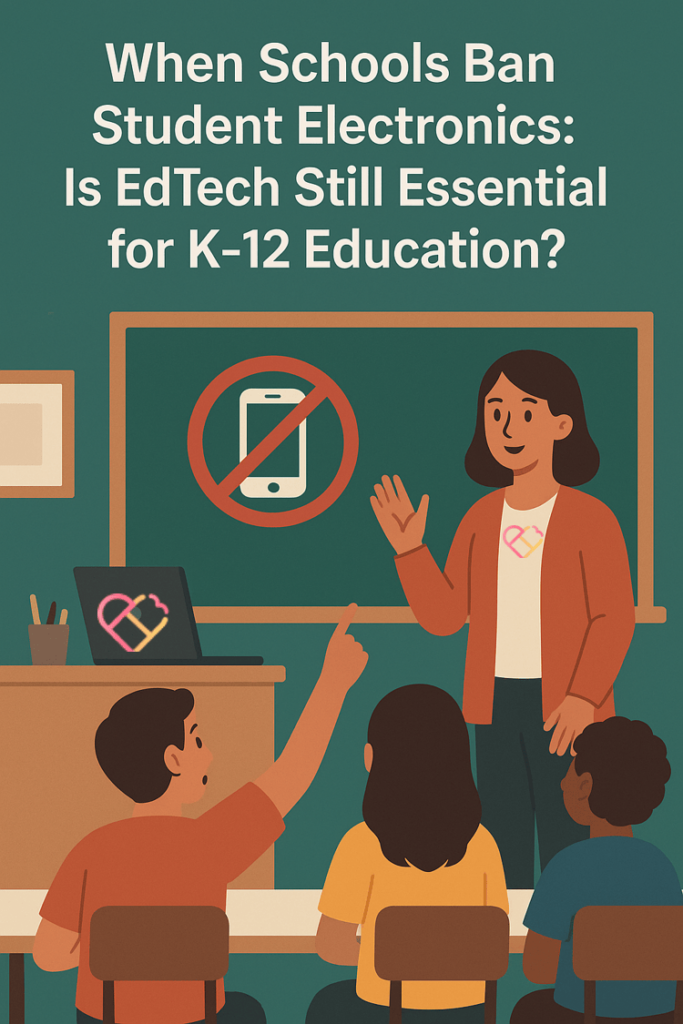
When Schools Ban Student Electronics A significant shift is underway across American education. As of November 2025, 34 states and Washington, D.C., have signed or enacted laws and policies restricting student cell phone usage in K-12 classrooms. States including Florida, New York, Texas, Georgia, North Dakota, Oklahoma, Alabama, and Virginia have implemented “bell-to-bell” bans, prohibiting students from using personal electronic devices during the entire school day 1. Florida pioneered this movement in 2023, banning phones from elementary and middle school classrooms. New York, becoming the largest state to require “bell-to-bell” restrictions, began enforcement during the 2025-2026 academic year. Texas Governor Greg Abbott signed legislation in June 2025 requiring all public school districts to adopt policies prohibiting students from using personal communication devices during school hours. South Korea has passed a nationwide law banning phones and digital devices in classrooms starting March 2026 2. When faced with this reality, educators, parents, and administrators inevitably ask: If schools are removing all personal electronics from students’ hands, what is the actual purpose of educational technology? Does EdTech become a tool reserved only for teachers, or does banning devices serve students’ best interests? 3 Why Schools Ban Personal Devices Research consistently finds personal devices, especially smartphones and tablets, are distracting and undermine academic performance. Studies show that test scores improve by 6.41% in schools implementing bans, especially benefitting low-achieving students. There are additional reported benefits including improved grades, focus, and social interaction. The frequency of cyberbullying—which impacts 34% of students ages 12-17—also decreases when personal device access is limited during school hours 4. Screen time affects youth mental health as well. UC San Francisco research showed increased screen use correlates with higher rates of depression, anxiety, inattention, and aggression among children and teens. The EdTech Paradox Why do schools still invest in educational technology? The difference lies in control and intent. Personal phones provide unlimited access for entertainment and social media, fragmenting attention. Teacher-controlled EdTech (digital whiteboards, adaptive platforms, curated apps) targets learning objectives, is structured, monitored, and teacher-led 5. When teacher-led technology is thoughtfully deployed, it delivers clear academic gains. A 2025 study in India showed AI-powered EdTech interventions produced 20-40% improvements in student literacy, even without new teaching methods. Teachers report technology enhances differentiation, real-time feedback, identification of struggling students, collaboration, and student engagement. Nonetheless, EdTech’s effectiveness depends on proper implementation, teacher training, and ongoing support. Homework Decline & Device Equity Traditional homework is losing ground: most research finds little benefit at the elementary level. As homework assignments fade and dependence on home internet creates a digital gap for millions, the rationale for requiring personal student devices in school weakens. AI-based tools like ChatGPT are also transforming homework, raising questions of integrity and comprehension 6. Schools must provide equitable technology access for all students, often through school-owned devices rather than BYOD models, ensuring digital divides don’t worsen. The Balanced Approach Current recommendations suggest: Conclusion Banning personal devices can boost academic success, reduce distractions and cyberbullying, and improve mental health. Meanwhile, purposeful EdTech enables teachers to personalize and improve learning outcomes. The solution isn’t an “all or nothing” approach: it’s about providing intentional, teacher-led technology as a resource, while restricting unsupervised personal device use 7 8. PhysednHealth is a leading physical education and student wellness technology platform designed to help schools modernize PE with smart, standards-based tools. Our easy-to-use physical education software empowers teachers to track student progress, set SMART fitness goals, and promote mental and physical well-being. Trusted by educators worldwide, PhysednHealth brings data-driven insights, AI-powered assessments, and personalized learning to PE programs—helping students build lifelong healthy habits. Discover PhysednHealth innovative approaches to promote health and engagement in physical education. Contact us at awesome@physednhealth.com.
Why Physical Education Technology Remains Stubbornly Underdeveloped

Physical education stands at the crossroads of educational innovation and technological stagnation. While mathematics, literacy, and science classrooms have witnessed an explosion of EdTech solutions transforming student learning experiences, PE programs remain largely untouched by meaningful technological advancement. Beyond a handful of companies like PhysednHealth and heart rate monitoring systems from Polar and Garmin, the landscape of PE technology is remarkably barren—and the reasons why reveal uncomfortable truths about educational priorities, market realities, and cultural resistance within the profession itself. The Economic Reality: A Market Investors Won’t Touch The physical education technology market tells a story of limited growth and constrained opportunity. While the broader EdTech sector was valued at $163.49 billion in 2024 and is projected to reach $348.41 billion by 2030, the PE technology segment represents only a fraction of this expansion. Market estimates place the global PE technology market at approximately $4.2 billion in 2025, with projections reaching just $7-15 billion by 2033—growth that pales in comparison to the overall EdTech boom.marketreportanalytics+2 The Funding Funeral: PE Programs as Budget Casualties The harsh reality is that physical education programs operate in perpetual survival mode. When school budgets face cuts, PE is consistently the first casualty. Only 26% of high school-aged students attend PE classes five days per week, while 52% attend just one day per week. The percentage of schools requiring PE courses drops dramatically from 97% in sixth grade to a mere 43% in twelfth grade.physednhealth+1 This downward spiral creates an impossible investment environment. National K-12 per-pupil spending averages $17,277 annually, but PE departments receive only a tiny fraction of these allocations—if they receive dedicated budgets at all. According to research on resource availability in PE programs, insufficient budgets for annual PE equipment rank among the primary barriers facing physical education teachers. When 44% of school districts have cut time in areas including physical education since the passage of No Child Left Behind in 2002, the message to technology companies is clear: there’s no money here.educationdata+3 Budget constraints have forced PE teachers into survival mode where basic equipment takes priority over technological innovation. One study participant noted that “Because of budget cuts, kids are only able to attend [PE] once a week or once every six-day cycle, depending on the school district”. In this environment, asking administrators to invest hundreds or thousands of dollars in PE technology platforms represents a nearly impossible sell.physednhealth The User-Buyer Disconnect: When Decision-Makers Don’t Use the Product Perhaps the most insurmountable challenge facing PE technology companies is the fundamental mismatch between users and buyers—a problem that plagues much of K-12 EdTech but proves particularly devastating in physical education. PE teachers are the end users who would benefit from assessment platforms, student tracking systems, and curriculum management tools. However, they possess virtually zero purchasing power.vistapointadvisors+1 The actual buyers—principals, district administrators, curriculum coordinators, and school leadership—rarely set foot in gymnasiums and have limited understanding of PE-specific needs. This creates a decision-making vacuum where purchasing decisions are made by individuals who cannot assess product value or necessity. As one EdTech analysis noted, “Users (teachers, administrators, etc.) often having minimal influence on purchasing decisions” represents one of the core challenges making software sales in the K-12 sector “notoriously difficult”.vistapointadvisors The problem compounds because different stakeholders have competing priorities. Teachers prioritize functionality and ease of classroom implementation. IT departments focus on data security and system integration. Administrators care about compliance reporting and demonstrating ROI. Building a product that satisfies all these constituencies while addressing the unique needs of physical education becomes an nearly impossible design challenge.edsurge+1 The sales cycle itself presents additional barriers. Approximately 50% of EdTech purchases happen between June and August, creating narrow buying windows. For PE-specific products, this problem intensifies because PE is rarely considered during budget planning sessions that prioritize tested academic subjects.vistapointadvisors The Cultural Problem: PE Teachers Who Don’t Want Technology Even when funding exists and administrative support materializes, a more fundamental barrier emerges: a significant portion of PE teachers simply don’t want technology in their programs. This resistance stems from multiple interconnected factors that together create a culture hostile to innovation. Approximately 51.5% of PE teachers report not knowing how to integrate technology into physical activity practice. Nearly half (48.2%) perceive technical problems and delays as obstacles to technology integration. About 61.5% agree that integrating technology requires substantial time investment and training—time they believe should be spent on actual physical activity rather than device setup and troubleshooting.physednhealth+1 More significantly, many PE teachers harbor legitimate philosophical concerns about technology’s place in a discipline fundamentally about human movement. The primary concern is that technology reduces actual physical activity time. In classes already limited to 30-50 minutes, spending even five minutes on technology setup represents 10-15% of available movement time lost—a trade-off many teachers find unacceptable.physednhealth Resource and infrastructure barriers compound the problem. PE spaces—gymnasiums, fields, outdoor facilities—frequently lack reliable WiFi connectivity, electrical outlets, and the technological infrastructure commonplace in traditional classrooms. The physical environment itself resists technology integration.oro.open+1 The Social Media Distraction: Movement Trends Over Meaningful Assessment Contemporary PE teacher culture has increasingly gravitated toward social media platforms like TikTok and Instagram, where movement trends, games, and activities go viral and spread rapidly through professional networks. PE teachers scroll through #peteachersoftiktok to discover the latest relay race variation, trendy warm-up routine, or engaging game that generates student excitement.tiktok+3 This cultural shift toward social media inspiration has an unintended consequence: it deprioritizes systematic assessment, student progress tracking, and evidence-based program evaluation. Many PE teachers are “more than comfortable and happy to not assess or track students progress”—a reality that represents a significant disservice to students but nonetheless describes the prevailing professional culture.physednhealth The focus becomes activity-based rather than outcome-oriented. If students are moving, sweating, and having fun, many PE teachers consider the class successful regardless of whether systematic learning is occurring or being measured. This mindset makes technology platforms designed for assessment and student growth monitoring not just unnecessary in these teachers’ eyes, but philosophically opposed to their preferred teaching approach. The resistance
The Future of Physical Education 2026: Technology, Strategies, and Trends
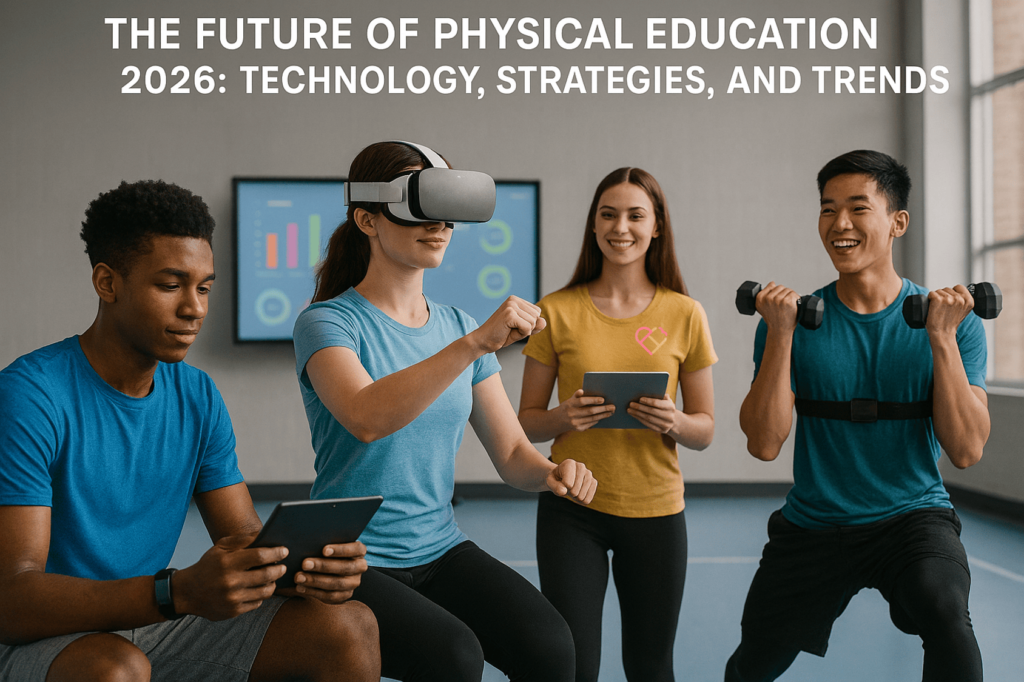
As we approach the 2025-2026 school year, Physical Education (PE) in the USA is undergoing a radical transformation. Gone are the days when “gym class” was solely about lap running. By 2026, PE is predicted to be a data-informed, inclusive, and technology-rich discipline focused on holistic wellness and lifelong movement identity. Based on emerging reports from industry leaders like SHAPE America and themes from upcoming 2026 conferences, here is a fact-based look at the predictions for K-12 Physical Education. 1. Technology: From “Cool Tools” to Integrated Systems In 2026, technology in PE moves beyond novelty to become the backbone of personalized instruction. The “scattershot” approach of using random apps is being replaced by consolidated ecosystems 1. 2. Strategies: “Playground to Purpose” The pedagogical shift for 2026 is defined by the theme of the upcoming ECIS Physical Education Conference: “From Playground to Purpose.”. The goal is to transition students from unstructured play to intentional, lifelong health habits 4. 3. Types of Activities: The Rise of Lifestyle Fitness The curriculum of 2026 favors activities that students can pursue for decades over traditional team sports that often end after high school. Trending Activities for 2026: Activity Type Examples Why It’s Trending Hybrid/Virtual Fitness VR Boxing, Peloton-style in-class cycling Meets “digital natives” where they are; reduces performance anxiety. Lifestyle Sports Pickleball, Rock Climbing, Hiking, Disc Golf High transferability to adult life; encourages community interaction. Gamified HIIT “Four Corner Fitness”, “Sports Mania” High-intensity interval training (HIIT) keeps heart rates up with short, engaging bursts of activity 6. Mindful Movement Yoga flows, Tai Chi, “Build it Wreck it” Balances high energy with emotional regulation and spatial awareness. 4. The Data-Driven Future By 2026, the “black box” of PE grading will be fully opened. Assessments will likely move away from raw athletic metrics (e.g., “run a 7-minute mile”) toward competency-based models 7. Conclusion The physical education classroom of 2026 is a high-tech, emotionally intelligent hub of wellness. By leveraging AI for personalization, adopting inclusive strategies, and focusing on lifestyle activities, educators are preparing students not just for a grade, but for a lifetime of healthy movement. Close your loops for $29. Get your January rosters and assessments set up in minutes. Start the $29 Plan | Download the Title IV Funding Guide
Why Ditching Homework Is a Huge Mistake for American Schools

If you walk into almost any school in the U.S. today, you’ll likely hear talk of reducing homework—or eliminating it entirely. The calls for “no homework” policies are getting louder, with advocates arguing that kids deserve more free time and less stress. But beneath the surface, the disappearance of homework could be setting our students up for failure—and the consequences might be more serious than we think. Homework Isn’t Just Extra Work Let’s set the record straight: homework isn’t about busywork or making students miserable. Done right, it’s an extension of learning—a way to practice and recall what’s taught in class, especially with today’s crowded curricula and limited school hours. U.S. teachers don’t have enough time during the day to ensure every student deeply understands reading, math, or science. Homework gives kids a crucial second chance to digest, review, and truly own new ideas, away from the clock and classroom noise. This self-directed learning also builds real-life skills that no worksheet or app can substitute for. Organizing assignments, meeting deadlines, and managing time are habits students need as adults in the workforce. But when schools drop homework, they unintentionally send the message: “Learning stops at 3 p.m.” That’s not how mastering anything—math problems, essays, or life skills—really works. Less Practice, Lower Scores The evidence is mounting that less homework means less learning. Since the pandemic, the average U.S. student spends significantly less time on homework, and national math and reading scores have dropped sharply as a result. Internationally, America keeps falling further behind countries that still value extended academic practice at home. While some say homework increases inequality due to differences in home resources, solutions should focus on support and access—not abandoning homework altogether. The Myth of the “Overworked Student” There’s a common misconception that eliminating homework frees students for “real life.” But let’s be honest: most students won’t use those extra hours to pursue music, sports, or exploration. Many will turn to screens, entertainment, and activities that don’t develop literacy, critical thinking, or perseverance. School isn’t a job where you clock out and forget everything until tomorrow. A child’s main “work” is learning—and that doesn’t fit neatly into a six-hour school day. Homework Grows Thinkers, Not Robots In a world exploding with AI and automation, we desperately need thinkers—creative, independent minds who can solve problems and adapt. Cutting homework only discourages deep, independent learning and reflection. Instead of giving in to trends, schools should focus on designing homework that is meaningful, manageable, and engaging—not just more of the same. When done right, homework is one of the best ways we have to inspire curiosity and resilience in students. The Bottom Line Getting rid of homework might sound appealing, but it’s a short-term “fix” with long-term consequences. We can’t afford a generation of students who’ve never learned to work, think, and problem-solve on their own. If we want leaders and innovators—not just followers and screen-watchers—homework is part of the answer. PhysednHealth is a leading physical education and student wellness technology platform designed to help schools modernize PE with smart, standards-based tools. Our easy-to-use physical education software empowers teachers to track student progress, set SMART fitness goals, and promote mental and physical well-being. Trusted by educators worldwide, PhysednHealth brings data-driven insights, AI-powered assessments, and personalized learning to PE programs—helping students build lifelong healthy habits. Discover PhysednHealth innovative approaches to promote health and engagement in physical education. Contact us at awesome@physednhealth.com.
Teach AI Policy Tracker: A Game-Changer for K-12 Education
In an era where artificial intelligence (AI) is reshaping learning environments, schools need robust and proactive policy frameworks. The TeachAI Policy Tracker offers K-12 leaders a centralized, curated platform to monitor, evaluate, and implement AI-guidance in real-time. If you’re involved in school leadership, technology integration, compliance, or instructional design, here’s how this resource can power your planning. What is the Policy Tracker? The TeachAI Policy Tracker is part of TeachAI’s “AI in Education” initiative and provides a comprehensive, up-to-date library of policy and guidance documents. On the tracker you’ll find guidance from individual U.S. states and from countries around the world. TeachAISome of the key features include: Why K-12 Schools Should Care 1. Stay Ahead of Policy TrendsWith education technology evolving rapidly, being proactive rather than reactive matters. Using the Policy Tracker gives your district insight into what peers and other jurisdictions are doing.2. Benchmark Your Own PoliciesRather than starting from scratch, you can review existing state or national models and adapt them — saving time and elevating quality.3. Support Educators, Students & FamiliesThe resources include downloadable materials for staff, parents, and students – helping build shared understanding and buy-in. Known to include “AI Guidance for Schools Toolkit” with seven guiding principles. TeachAI4. Facilitate Ethical, Responsible AI UseMany states emphasize ethics, transparency, student data protection and teacher professional development in their guidance. Being aware of these helps your policies align with industry-aware best practices. How to Use the Policy Tracker Effectively in Your School or District Step 1: Set a team or lead responsible for AI policy review (could be technology director, curriculum lead, or compliance officer).Step 2: Visit the tracker regularly and select relevant states/countries whose guidance you want to study (for example if your state is similar in demographics or technology adoption).Step 3: Compare your current policy (or if you don’t yet have one) against exemplar templates found in the tracker. Pull key points such as: purpose, scope, definitions of “AI tool”, usage guidelines, teacher/student roles.Step 4: Adapt or draft a policy using the templates and best-practices from the library. Customize for your context (grade levels, existing tech infrastructure, student demographics).Step 5: Communicate the policy and supporting materials (parent/student guides, training modules) with your stakeholders. Use clarity and transparency to foster trust.Step 6: Review the policy annually (or when big tech shifts happen) and revisit the tracker to see new or evolving guidance. Key Features Worth Highlighting The TeachAI Policy Tracker is a high-value resource for educators and policy makers wanting to craft, refine or benchmark AI policy for K-12 schools. A proactive approach to AI policy not only ensures alignment with best practices but builds trust, consistency and clarity for students, educators and families alike. If your district is at the beginning of its AI policy journey — or looking to refresh an existing one — I highly recommend exploring the Policy Tracker, selecting relevant models, and beginning your structured policy-development process today. PhysednHealth is a leading physical education and student wellness technology platform designed to help schools modernize PE with smart, standards-based tools. Our easy-to-use physical education software empowers teachers to track student progress, set SMART fitness goals, and promote mental and physical well-being. Trusted by educators worldwide, PhysednHealth brings data-driven insights, AI-powered assessments, and personalized learning to PE programs—helping students build lifelong healthy habits. Discover PhysednHealth innovative approaches to promote health and engagement in physical education. Contact us at awesome@physednhealth.com.