When students seem less enthusiastic about physical education in November, start with three practical adjustments: make it easy to begin moving, offer achievable challenges, and give students meaningful choices. These strategies address classroom routines and motivational needs rather than treating low participation as a problem that simply requires more pressure.psycnet.apa+1
You may recognize the scene: students take longer to get started, familiar activities receive a lukewarm response, and keeping everyone involved requires more prompting than it did in September.
Calling this the “November slump” can describe what you notice in your gym. It is not, however, a scientifically established decline that affects every class. Research documents seasonal differences in children’s physical activity, but those patterns vary by age and setting. One large study found seasonal differences among nine-year-olds but not among fifteen-year-olds.pubmed.ncbi.nlm.nih
That distinction matters. Instead of assuming the calendar explains disengagement, focus on what you can adjust: how students enter the lesson, how they experience the challenge, and how much ownership they have over participation.
The aim is engagement—not simply a louder or busier gym, but students taking part in purposeful movement and making progress toward the learning goal.
1. Make the First Few Minutes Easy to Enter
When a class is slow to get started, a familiar movement task gives students a clear first step.
Instant activities are short tasks students can begin with minimal instruction. SPARK recommends using familiar opening activities to get students moving and reduce management time once the routine is established.sparkpe
Try a Familiar Activity With a Small Twist
Choose an opening task students already understand, then change one feature to keep it interesting:
- Partner passing: Students select a starting distance and work toward a shared target.
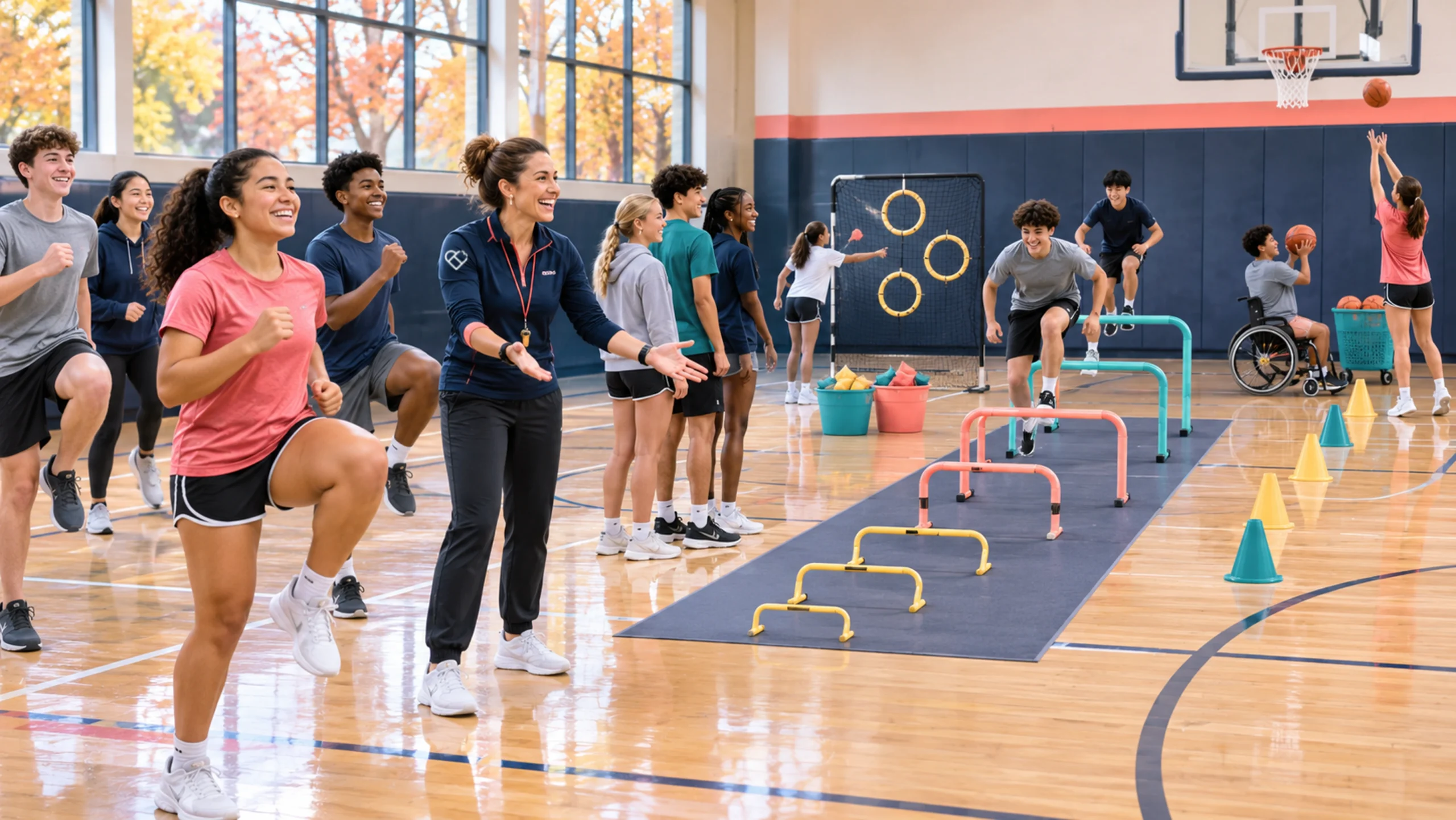
- Movement pathways: Students travel between markers using designated movement patterns.
- Skill stations: Students begin with a familiar dribbling, balance, or coordination task.
- Cooperative challenges: Small groups complete a movement sequence together.
These are suggested classroom applications, not individually tested solutions to a seasonal slump. Keep the activity appropriate for your students, available space, and safety procedures.
Keep the Opening Connected to the Lesson
Use the starter to rehearse something students will need later.
If the lesson focuses on passing and moving, begin with partner passing that includes repositioning after each attempt. If the objective is pacing, start with a simple movement task in which students practice selecting and maintaining an appropriate pace.
The planning question is straightforward: “Can students begin this task without waiting for a long explanation?”
An instant activity should create a clear entry into learning—not become an unrelated game that requires another lengthy transition.
2. Keep the Learning Goal, Adjust the Challenge
A student who hesitates to participate may need a more accessible starting point, not a different learning objective.
Research on motivation in PE consistently highlights competence: students’ sense that they can act effectively and make progress. A meta-analysis drawing on 265 studies found that satisfaction of competence, autonomy, and relatedness was strongly associated with autonomous motivation—participating through interest or personal value rather than external pressure alone.psycnet.apa
For lesson planning, that provides a useful principle: preserve the objective while offering more than one level of challenge.
Build a Starting Point and a Progression
For example:
| Learning objective | Accessible starting point | Optional progression |
|---|---|---|
| Improve passing accuracy | Pass over a shorter distance with suitable equipment | Increase distance or add movement |
| Maintain control while dribbling | Practice in an open space at a manageable pace | Add direction changes or passive opposition |
| Practice sustained movement | Select a manageable pace within the task | Adjust pace or duration while maintaining control |
| Apply a tactical skill | Practice in a simplified small-sided game | Add a tactical condition or greater opposition |
These options are practical examples of applying competence-supportive teaching, not a validated intervention package.
Recognize Specific Progress
Make feedback about what students did and what they can try next:
- “Your pass reached your partner more consistently when you stepped toward the target.”
- “You adjusted your pace and stayed involved throughout the task.”
- “You created space before asking for the ball.”
A recent umbrella review of school-based motivation interventions identified autonomy support, competence development, and positive feedback as recurring features of approaches that improved motivational outcomes.link.springer
The point is not to make every task easy. It is to give students a credible route into the challenge and a clear way to progress.
3. Give Students Meaningful Choices
When lessons feel repetitive, offer students some influence over how they work toward the objective.
Research supports autonomy-supportive teaching in PE. Autonomy means experiencing a sense of ownership or willingness; it does not mean removing structure or allowing students to opt out of learning. Reviews connect support for autonomy, competence, and relatedness with stronger student motivation.psycnet.apa+1
Offer Two Routes to the Same Goal
For a lesson on maintaining possession, students might practice through:
- A passing-and-moving challenge.
- A small-sided possession game.
For an individual skill lesson, students might choose:
- An appropriate equipment size.
- A practice distance.
- A starting challenge level.
- The order in which they complete two tasks.
Keep the objective and success criteria visible. Students should understand what they are learning regardless of the option they select.
Make the Choice Real—and Manageable
A useful choice changes something students experience, while remaining workable for you.
“Choose your starting distance, then move back when you meet the accuracy target” gives students a concrete decision within a clear structure.
You do not need six stations or separate lesson plans for every student. Two carefully designed options can provide a practical starting point for applying autonomy-supportive principles. The number of options is a planning decision, not a research-established formula.psycnet.apa
Put the Three Strategies Into One Lesson
The following example shows how the strategies can work together without adding a separate recovery lesson or unrelated seasonal activity.
Example: Passing and Moving to Create Space
Learning objective: Students practice moving into an available space after passing.
- Start with familiar movement.
Partners pass and reposition within a marked area. Display the task and essential safety reminders before students begin. - Offer an achievable challenge.
Students choose a suitable starting distance and equipment option. Add movement complexity as they demonstrate control. - Provide a meaningful choice.
Students practice through either a cooperative passing challenge or an appropriately designed small-sided possession activity. - Check the learning.
Ask: “Where did you move after passing, and how did that help your partner?”
This is an illustrative lesson structure. It applies research-informed principles of competence and autonomy alongside an established instant-activity approach; it has not been tested as a specific “November slump” intervention.psycnet.apa+1
Check Whether Participation Is Improving
Use a few simple observations to decide whether the changes are helping your class:
- Starting: Are students beginning the opening task with fewer prompts?
- Participation: Are previously hesitant students finding an appropriate way into the activity?
- Persistence: Do students continue practicing after an unsuccessful attempt?
- Learning: Can students demonstrate or explain the lesson objective?
- Feedback: What do students say helped—or prevented—them from participating?
These are informal classroom checks, not a validated engagement scale. Look for patterns across several lessons rather than judging the approach from one unusually energetic or difficult day.
Keep the monitoring manageable: choose one or two indicators, make a brief note after class, and use that information to adjust the next lesson.
Frequently Asked Questions
Is the November slump in PE a proven phenomenon?
No universal, month-specific drop in PE motivation is established by the evidence cited here. Studies show that physical activity can vary by season, but findings differ across ages and settings. Use the phrase to describe an observed classroom pattern rather than assume it explains every student’s behavior.pubmed.ncbi.nlm.nih+1
How can PE teachers support motivation without lowering expectations?
Keep the learning objective consistent while adjusting the entry point, challenge level, or practice format. Research supports teaching environments that help students feel capable, experience meaningful choice, and feel connected to others.psycnet.apa+1
Do these strategies require a completely new lesson plan?
Not necessarily. An instant activity can rehearse the day’s skill, and a familiar task can include different challenge levels or practice choices. These are ways to apply active-start and motivational principles within an existing lesson structure.psycnet.apa+1
Plan for Participation, Not Just Compliance
When student momentum feels lower, begin with the lesson experience rather than the calendar. Is the first task clear? Is the challenge accessible? Do students have a meaningful decision to make?
Start by changing one of those features. Keep the learning goal steady, observe who participates and progresses, and use what you see to shape the next lesson.