
Beyond the Rep: Teaching Strength in K–12 PE
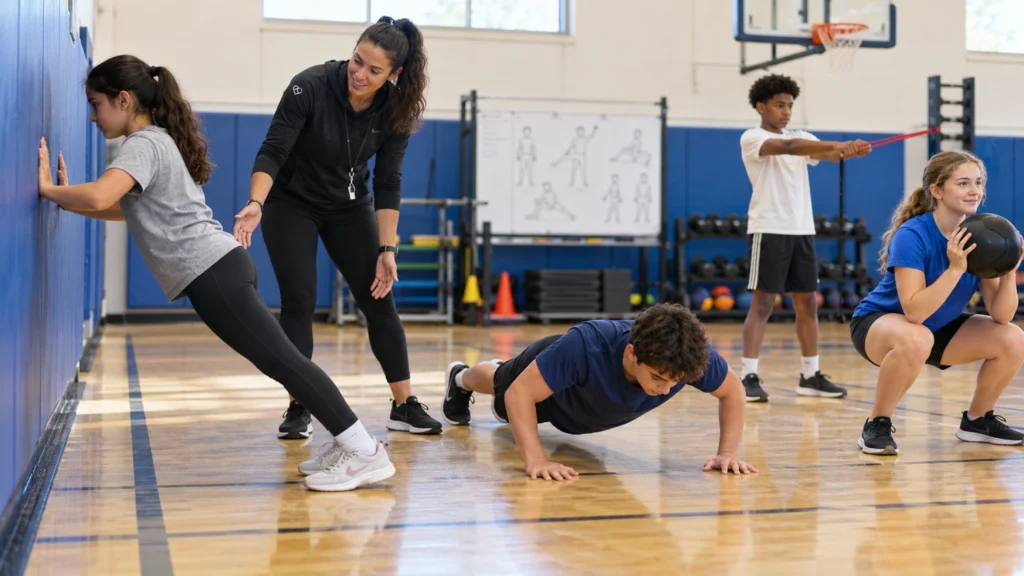
Teaching strength in K–12 PE is not about seeing who can lift the most. It is about helping students move with control, choose appropriate challenges, and understand how to build strength safely. A student finishes ten push-ups. Another completes five against a wall. Which student learned more? The repetition count cannot tell us. We would need to know whether each student understood the movement, selected an appropriate challenge, used feedback, and recognized when to stop. That is the case for strength training education in PE. The goal is not simply to make students exercise harder. It is to teach them how to build strength safely, understand their bodies, and make informed decisions about physical activity. Research supports that approach. The American Academy of Pediatrics’ 2020 clinical report describes youth resistance training as a worthwhile part of school physical education when qualified instruction, appropriate supervision, and technique-driven progression guide participation. Strength training can include bodyweight movements, resistance bands, and other suitable equipment—not just lifting weights.ncys The most important word is education. What Is Strength Training Education in PE? Strength training education in PE teaches students how muscles work against resistance and how to participate safely and effectively. Resistance can come from their own body weight, elastic bands, free weights, or other appropriate equipment.ncys An educational approach goes beyond assigning squats, push-ups, or a circuit. Students learn to: These are proposed learning goals, not a requirement to turn every PE lesson into a weight-room session. A student who can explain why a wall push-up is the right starting point has learned something useful. So has a student who chooses a lighter resistance because the heavier option changes their technique. What Does the Science Say About Youth Strength Training? Children can gain strength before puberty The idea that strength training offers little benefit until adolescence is not supported by the evidence summarized in the AAP report. Children can increase strength before puberty. Early improvements occur largely through neurological adaptations: the nervous system becomes better at recruiting and coordinating the muscles needed for a task. Strength gains do not require large increases in muscle size.ncys For PE teachers, this distinction matters. A strength lesson does not need to pursue bigger muscles to have value. Learning to produce and control force is a meaningful outcome. Appropriately designed training has not been shown to stunt growth Concern about growth plates has shaped many conversations about children and weights. However, the AAP’s review reports that appropriately designed resistance training has no apparent negative effect on linear growth or growth-plate health.ncys That does not mean every exercise, load, or training environment is appropriate. It means the useful question is not, “Are children allowed to strength train?” It is, “Is this activity appropriate for these students, with the instruction and supervision available?” Safety depends on how the program is taught Research summarized by the AAP supports low injury rates in well-supervised youth resistance training that emphasizes correct technique. Poor supervision, inappropriate increases in training load, and unsafe equipment use remain important concerns.ncys “Strength training is safe” is therefore an incomplete message. A more accurate message is: youth strength training can be safe and effective when the program matches students’ abilities and qualified adults teach, supervise, and progress it appropriately.ncys Why Strength Training Education Belongs in PE—not Just Athletics School athletics reaches students who join teams. Physical education has a broader responsibility. The AAP report explicitly discusses resistance training for nonathletes as well as athletes and identifies benefits extending beyond sports performance, including muscular fitness, motor skill development, and physical literacy.ncys That gives PE a different purpose from a competitive strength program. Students do not need to pursue a lifting record to benefit from understanding resistance exercise. They need opportunities to learn what a manageable challenge feels like, how to improve a movement, and how to make responsible choices. Strength training education in PE should therefore be organized around access and learning: The curriculum question is not, “Who is strongest?” It is, “What should every student understand about developing strength?” Strength Training Can Support Confidence—Without Making Appearance the Goal Strength training offers students a concrete way to notice improvement: a movement becomes more controlled, a previously difficult exercise becomes manageable, or a student learns to use unfamiliar equipment. There is research behind the confidence connection. A 2019 systematic review by Collins and colleagues included seven studies involving young people ages 10–16. Its meta-analysis found improvements in resistance-training self-efficacy—confidence in performing resistance training—as well as perceived strength, physical self-worth, and global self-worth.pmc.ncbi.nlm.nih The findings need perspective. Only four studies contributed to the pooled analysis, study quality varied, and the review did not find clear improvements in every outcome, including perceived sport competence or body attractiveness.pmc.ncbi.nlm.nih The practical implication is not that a strength unit will automatically transform every student’s confidence. It is that strength training can provide opportunities to develop confidence in a specific, learnable activity. Teachers can build lessons around evidence students can recognize: “I can choose a variation that works for me.” “I know how to use feedback.” “I can explain when I am ready for a harder challenge.” That is a more useful educational target than asking students to judge their bodies in the mirror. How Strength Training Connects to Lifelong Physical Literacy Physical literacy involves moving with confidence and competence across activities and environments. The AAP identifies resistance training as one component of a broader approach to developing that capacity.ncys In PE, that connection becomes practical when students learn more than an exercise sequence. Consider two outcomes: The second outcome is knowledge the student can apply elsewhere. However, lifelong participation should remain a goal—not an outcome schools promise from a short unit. Research supporting improvements in strength or confidence does not establish that a few PE lessons will produce lifelong exercise habits. The educational opportunity is to give students skills and understanding they can carry forward. What Should Strength Training Look Like Across K–12? The following progression is a curriculum example informed by youth resistance-training principles,