
Why Students Need to Experience Productive Struggle in PE
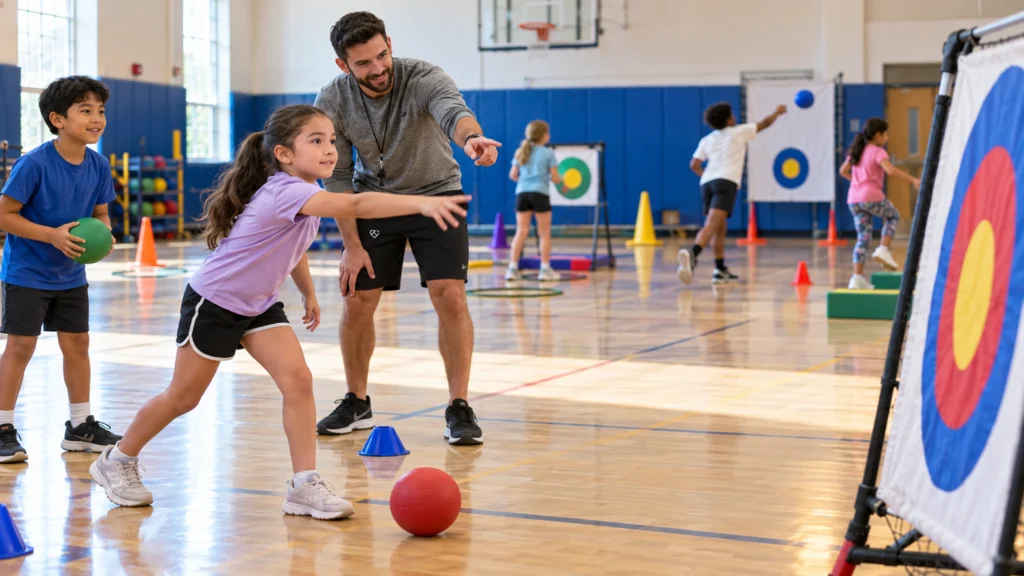
A student misses the catch, retrieves the ball, and tries again. Another misses the catch, looks around to see who noticed, and stops participating. Both students experienced difficulty. Only one is still in a position to learn from it. That difference matters. Productive struggle in PE is not about making activities harder or asking students to tolerate repeated failure. It means giving students a meaningful challenge, a realistic way forward, and enough support to make progress. Motor-learning research and research on student motivation support that combination—not difficulty for its own sake.pubmed.ncbi.nlm.nih+1 The goal is progress, not struggle. What Is Productive Struggle in PE? Productive struggle in PE is a manageable learning challenge in which students can attempt a movement skill, notice what happened, adjust their approach, and try again with appropriate support. For example, a student learning to throw accurately might miss a target, receive a useful cue, move closer, and begin making more controlled throws. The skill still requires effort, but the student has something specific to work on. This approach fits the challenge point framework developed by motor-learning researchers Mark Guadagnoli and Timothy Lee. Their central idea is that the same task presents different challenges to learners with different abilities. A task’s learning value depends on the interaction between its difficulty, the learner’s skill, and the information available during practice.pubmed.ncbi.nlm.nih A basketball pass across the gym might be routine for one student and overwhelming for another. Giving everyone the same task does not give everyone the same learning opportunity. Why Supported Challenge Helps Students Learn 1. Challenge gives students something useful to solve When students already perform a task comfortably, repeating it may serve a purpose—but it may offer little new information. When the task is far beyond their current ability, they may struggle to understand what to change. The challenge point framework proposes that useful practice sits between those extremes: students encounter enough difficulty to learn, without receiving more information than they can interpret and use. It is a framework for designing practice, not a formula that identifies one perfect difficulty level for every student. In PE, that means adjusting the task rather than simply demanding more effort: These are practical applications of the framework. The question is not, “How hard can I make this?” It is, “What challenge can this student learn from?” 2. Confidence grows from evidence of improvement Encouragement matters, but students also need evidence that their actions can produce success. Psychologist Albert Bandura’s self-efficacy theory describes how people develop beliefs about their ability to complete particular tasks. Successful experiences—often called mastery experiences—are an especially influential source of those beliefs. Repeated failure, particularly before confidence is established, can have the opposite effect. That helps explain why supported struggle can build confidence while unsupported struggle can undermine it. Consider a student learning to jump rope. Asking for 20 consecutive jumps immediately may produce repeated failure. Beginning with a single controlled jump, then linking two or three, gives the student a way to experience improvement while still working toward a challenging skill. The useful message is not, “You succeeded because you are naturally athletic.” It is: “You changed your timing, and that helped you clear the rope.” The student now has a reason to believe that a strategy—not luck—can improve the next attempt. 3. Motivation depends on how students experience the challenge Students are not more motivated simply because an activity is difficult. A systematic review and meta-analysis of 265 studies in school physical education found that satisfaction of students’ needs for autonomy, competence, and relatedness was strongly associated with autonomous motivation: participating because an activity feels interesting or personally valuable.findresearcher.sdu For PE teachers, those needs translate into three useful questions: A challenging activity can support these needs when students can select an appropriate starting level, understand the goal, and receive respectful help. Difficulty without those conditions is not the same instructional experience. The evidence supports need-supportive teaching, not the claim that harder tasks automatically increase motivation.findresearcher.sdu 4. Challenge creates opportunities to practice resilience-related skills A missed shot or an unsuccessful balance attempt can become an opportunity to practice responding to a setback: These are useful teaching opportunities, but teachers should avoid overstating the research. A difficult PE lesson does not automatically create lasting resilience or transfer coping skills into every area of a student’s life. Research on the Teaching Personal and Social Responsibility model treats effort, self-direction, supportive relationships, and transfer beyond PE as explicit instructional goals. The implication is important: teachers need to teach and discuss these skills, not assume that physical activity or struggle will develop them on its own.zaguan.unizar Productive Struggle vs. Discouraging Overload A missed attempt does not automatically mean the activity is too difficult. A completed task does not necessarily mean the student felt safe or learned something. The distinction is whether the student still has an accessible route forward. The following table is a practical observation guide informed by motor-learning and motivation research—not a validated diagnostic checklist. What to observe Productive struggle Possible discouraging overload Understanding The student knows the goal and can identify a next step. The student remains confused about what to do or change. Attempts The student tries again and experiments with an adjustment. Attempts become random, rushed, or stop altogether. Feedback The student can use a cue or demonstration. Additional instructions do not help the student act. Progress There are signs of better control, understanding, or consistency. Repeated attempts show no usable progress despite support. Emotional response Frustration occurs, but the student can recover with support. Distress, embarrassment, or withdrawal persists. Student voice The student can explain what feels difficult. The student reports that the task feels impossible, unsafe, or humiliating. Do not treat these observations as labels. A student who withdraws may need clearer directions, an equipment adjustment, less public attention, or a different way to access the activity—not a lecture about persistence. Ask a specific question: “Is the hardest part controlling the ball, understanding the task, or doing it while others watch?”