
Why Your PE Class Keeps Stopping—and What to Do Instead.
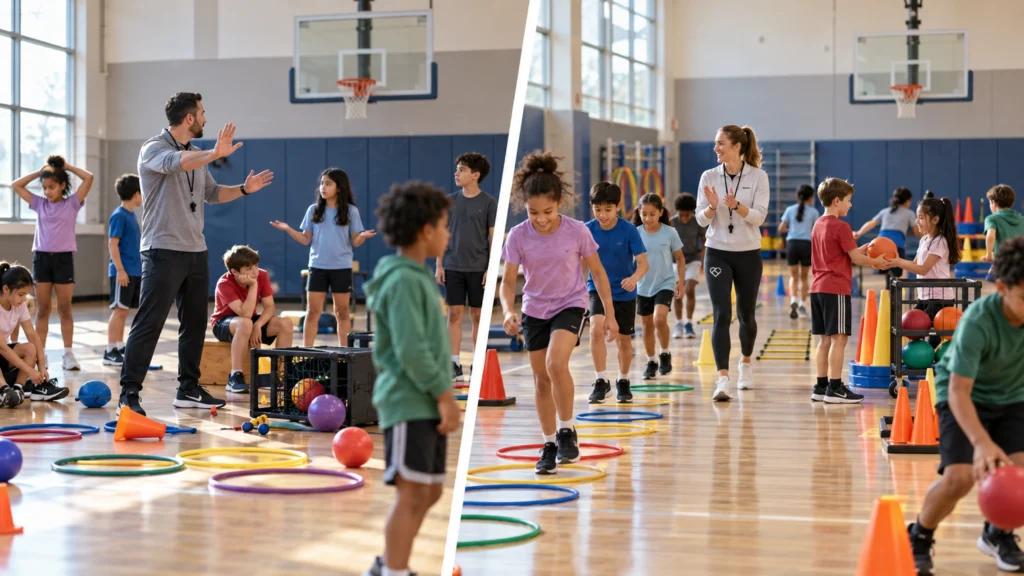
You planned 30 minutes of PE. But students need multiple reminders to enter safely, stop when the signal sounds, listen to directions, share equipment, or transition to the next activity. Before long, a lesson designed to get students moving has turned into a series of stops, corrections, and restarts. If your PE class is losing minutes, the answer is not necessarily to become louder or stricter. The solution is to teach the routines that make active learning possible—then give students enough opportunities to practice them until they become automatic. Whether you teach kindergarten, elementary PE, middle school physical education, or a mixed-grade class, the same truth applies: class management is part of instruction. Students cannot fully participate in a game, skill practice, fitness activity, or station lesson until they know how to enter the space, respond to a signal, handle equipment, transition, work with peers, clean up, and rejoin instruction. This guide explains evidence-based PE classroom management strategies that help teachers protect instructional time without turning physical education into a constant cycle of corrections and consequences. Why PE Classroom Management Is Different Every teacher manages behavior. Physical education teachers manage behavior while students are moving, sharing equipment, navigating space, talking with peers, and making quick decisions. That is especially challenging when PE takes place: In a traditional classroom, students may stay seated in defined locations. In PE, students are expected to move. The goal is not silence or stillness. The goal is safe, purposeful, and increasingly independent movement. That requires a different mindset. The question is not, “How do I make students perfectly quiet?” The question is, “How do I build routines that allow students to move safely, listen briefly, transition efficiently, and stay engaged?” Evidence-based classroom-management frameworks emphasize establishing predictable structure, explicitly teaching expectations, actively supervising students, reinforcing appropriate behavior, and responding to errors in a calm and planned way.dropoutprevention+1 Treat Routines as Skills to Teach Many PE behavior problems are actually routine problems. A student may know that they are supposed to freeze when they hear a whistle. But knowing the rule and performing it successfully are different things. Can the student stop while dribbling a basketball? Can they stop while talking with a friend? Can they stop when excited about a game? Can they stop outdoors, with distractions happening across the field? Those are skills that need to be modeled, practiced, reinforced, and retaught. Instead of assuming students understand expectations after hearing them once, directly teach the procedures that determine whether PE runs smoothly. Essential PE routines to teach Focus first on the routines that protect the most activity time: Use a small number of positively stated expectations that work across every activity and setting. For example: Then define what those expectations look like during the actual routines students perform. PE routine “Be safe” looks like “Be ready” looks like “Be respectful” looks like Stop signal Freeze body and control equipment Eyes on teacher or signal Give others space to stop Transition Walk in the designated area Move directly to the next spot Keep hands and equipment to self Partner work Use equipment safely Stay with assigned partner Take turns and use encouraging words Cleanup Carry equipment safely Put equipment in the correct place Help without grabbing or pushing Research-based PBIS guidance recommends defining a small number of positively stated expectations, explicitly teaching those expectations in the settings where students must use them, and providing continuous reteaching and reinforcement.dropoutprevention+1 Stop Talking So Students Can Move Long explanations are one of the fastest ways to lose a PE class. This does not mean teachers should skip instruction. It means instruction must match the setting, activity, and students’ developmental readiness. Young students—and many older students during highly stimulating activities—often struggle to retain a long sequence of directions before they have a chance to move. A more effective structure is: For example, instead of explaining every detail of a dribbling game before students receive a ball, begin with the simplest action: “Find your own space. Dribble below your waist. Keep your eyes up.” After students have moved for a short period, add the next expectation: “When you hear the whistle, freeze your body, stop the ball, and look at me.” Then practice it. This approach turns listening from a passive demand into an active skill. Students hear a direction, show they understand it, receive feedback, and try again. Keep directions short and visible For many PE activities, students need only three pieces of information before they begin: If students need to remember more than that, consider whether the activity is too complex for the group right now—or whether the directions can be taught in stages. A simpler activity with high participation is usually more valuable than a complicated game that requires constant stopping, clarifying, and redirecting. Practice Procedures Without Turning PE Into Punishment When a class cannot transition, stop safely, or listen long enough for directions, it is reasonable to pause and reteach. That is not wasted time. It is an investment in future activity time. The key is to make reteaching short, specific, and active. Avoid: “You are not listening. We have talked about this a hundred times. Sit down until everyone can behave.” Try: “We need to practice our stop signal again. When you hear one whistle, freeze your body, make your equipment still, and look this way. Let’s show it in five seconds.” Then let students try again. Use “do-over” practice A do-over is not a punishment. It is simply another chance to perform a routine correctly. Examples include: The message should be clear: “We practice routines because they help us have more safe time to move.” That wording matters. Students should understand that following routines does not take away PE. It protects PE. Use Active Supervision, Not Distant Supervision PE teachers cannot manage an active class effectively from one fixed location. Active supervision means deliberately moving, scanning, and interacting while students participate. It is especially important in outdoor spaces, cafeterias, playgrounds, shared gyms, and large