
Integrating Emotional Intelligence in Every PE Session
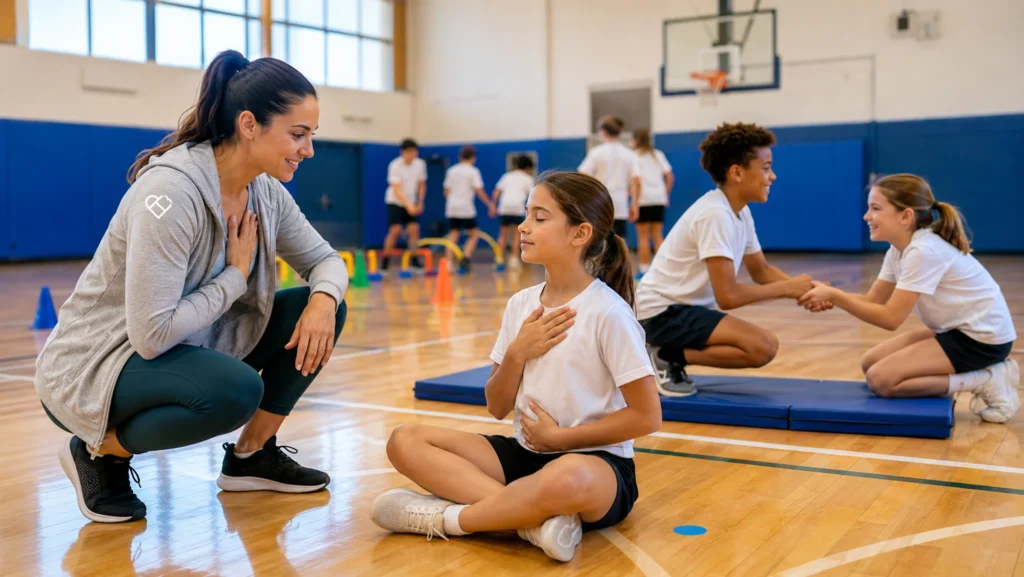
Physical education has evolved far beyond simply developing motor skills and physical fitness. Today’s PE curriculum demands a more holistic approach that nurtures students’ emotional, social, and psychological well-being alongside their physical development. Integrating emotional intelligence (EI) into every PE session represents a transformative shift that can significantly enhance student outcomes across multiple domains. Why Emotional Intelligence Matters in Physical Education The Scientific Foundation Recent research reveals compelling evidence for the critical role of emotional intelligence in physical education. A comprehensive 2025 study involving over 498 university students demonstrated that mindfulness practices and emotional self-regulation significantly reduce cognitive load stress while enhancing physical performance. The study found that students with higher emotional intelligence showed improved stress management, better focus during physical tasks, and enhanced overall performance outcomes. Multiple research studies confirm that physical education creates an emotionally-charged environment where students continuously face performance pressures, social interactions, and personal challenges. In this context, emotional intelligence serves as a protective factor that helps students navigate these challenges while maximizing their learning potential. The Mind-Body Connection Physical education uniquely positions educators to strengthen the mind-body connection. Our emotions are literally “feelings” that manifest in physical sensations throughout our bodies. When students learn to recognize these emotional cues during physical activity, they develop crucial self-awareness skills that extend far beyond the gymnasium. A 2025 study on primary school children found that physical exercise directly enhances social-emotional competence, with effects mediated through improved peer attachment and emotional regulation. Academic and Life Benefits The integration of emotional intelligence in PE yields benefits that extend throughout students’ academic and personal lives: Evidence-Based Benefits of Emotional Intelligence Integration Cognitive Domain Benefits Research demonstrates that emotional intelligence integration in PE enhances cognitive functioning through several mechanisms: Stress Reduction: Mindfulness practices and emotional regulation techniques reduce cognitive load, freeing up mental resources for learning and performance. Students learn to manage performance anxiety and maintain focus during challenging activities. Enhanced Decision-Making: Emotionally intelligent students make better strategic decisions during games and sports, as they can regulate their emotional responses and think more clearly under pressure. Improved Attention and Focus: EI training helps students maintain concentration during instruction and practice, leading to more efficient skill acquisition. Emotional and Social Benefits Self-Awareness Development: Students learn to recognize their emotional states, triggers, and responses during physical activities. This awareness becomes a foundation for emotional regulation throughout their lives. Empathy and Social Skills: Cooperative learning activities in PE naturally develop empathy as students work together, support teammates, and navigate interpersonal challenges. Research shows moderately strong associations between cooperative learning and all dimensions of emotional intelligence. Conflict Resolution: PE provides authentic opportunities to practice conflict resolution skills in real-time situations, from disagreeing with referee calls to managing competitive tensions. Stress Management: Physical activity combined with emotional intelligence training provides students with healthy coping mechanisms for managing stress and difficult emotions. Physical Performance Benefits Improved Athletic Performance: Athletes with higher emotional intelligence demonstrate better sports performance through enhanced stress management, emotional regulation, and team dynamics. Body Awareness: Students develop stronger proprioceptive awareness and learn to listen to their bodies’ signals for fatigue, stress, or optimal performance states. Motivation and Persistence: Emotionally intelligent students show greater intrinsic motivation for physical activity and higher persistence when facing challenges. Science-Backed Strategies for Implementation 1. Cooperative Learning Approaches Research consistently demonstrates that cooperative learning is one of the most effective methods for developing emotional intelligence in PE. A landmark 2020 study involving 1,332 students found positive and significant associations between cooperative learning and all dimensions of emotional intelligence. Implementation Strategies: Specific Activities: 2. Mindfulness and Body Awareness Integration Recent neuroscientific research reveals that mindfulness practices enhance emotional regulation by strengthening neural pathways associated with self-control and stress management. Pre-Activity Mindfulness: During-Activity Awareness: Post-Activity Reflection: 3. Emotion Vocabulary and Recognition Training Building emotional literacy is fundamental to emotional intelligence development. Research shows that students who can accurately identify and articulate emotions demonstrate better emotional regulation and social relationships. Emotion Check-ins: Emotion-Action Connections: 4. Social-Emotional Learning Through Game Modification Traditional PE activities can be modified to emphasize emotional intelligence development while maintaining physical benefits. Modified Rules for EI Development: Conflict Resolution Protocols: 5. Self-Regulation Skill Development Research demonstrates that self-regulation amplifies the benefits of mindfulness and emotional awareness, making it a crucial component of EI integration. Goal-Setting and Self-Monitoring: Stress Management Techniques: Practical Implementation Framework Daily Structure Integration Opening Routine (5 minutes): During Activities (Throughout class): Closing Routine (5 minutes): Assessment and Progress Monitoring Effective integration requires systematic assessment of both emotional intelligence development and traditional PE outcomes. Formative Assessment Strategies: Summative Assessment Options: Professional Development Considerations Teachers implementing EI integration need specific preparation and ongoing support: Essential Teacher Competencies: Implementation Support: Addressing Common Challenges Time Constraints Many PE teachers worry about losing instructional time for physical skills. Research demonstrates that EI integration actually enhances physical learning by improving focus, reducing behavioral disruptions, and increasing engagement. Solutions: Student Resistance Some students, particularly older ones, may initially resist emotional discussions in PE. Solutions: Administrative Support Successful implementation requires understanding and support from administrators and parents. Solutions: Measuring Success and Impact Student Outcome Indicators Short-term Indicators: Long-term Indicators: Program Evaluation Methods Quantitative Measures: Qualitative Measures: Conclusion: The Future of Physical Education Integrating emotional intelligence into every PE session represents more than an educational trend—it’s a research-backed approach to developing well-rounded, resilient, and emotionally healthy individuals. The scientific evidence clearly demonstrates that this integration enhances not only students’ physical development but also their academic performance, social relationships, and mental health. As educators, we have the opportunity and responsibility to use the unique environment of physical education to foster emotional intelligence alongside physical literacy. The strategies presented here provide a practical, science-based framework for creating PE programs that truly serve the whole child. The future of physical education lies in recognizing that the mind and body are inseparable in learning and development. By integrating emotional intelligence into our daily practice, we prepare students not just for physical activity, but for success in all areas of their
The Accountability Era of Physical Education: What Comes Next as PE Becomes Future-Critical
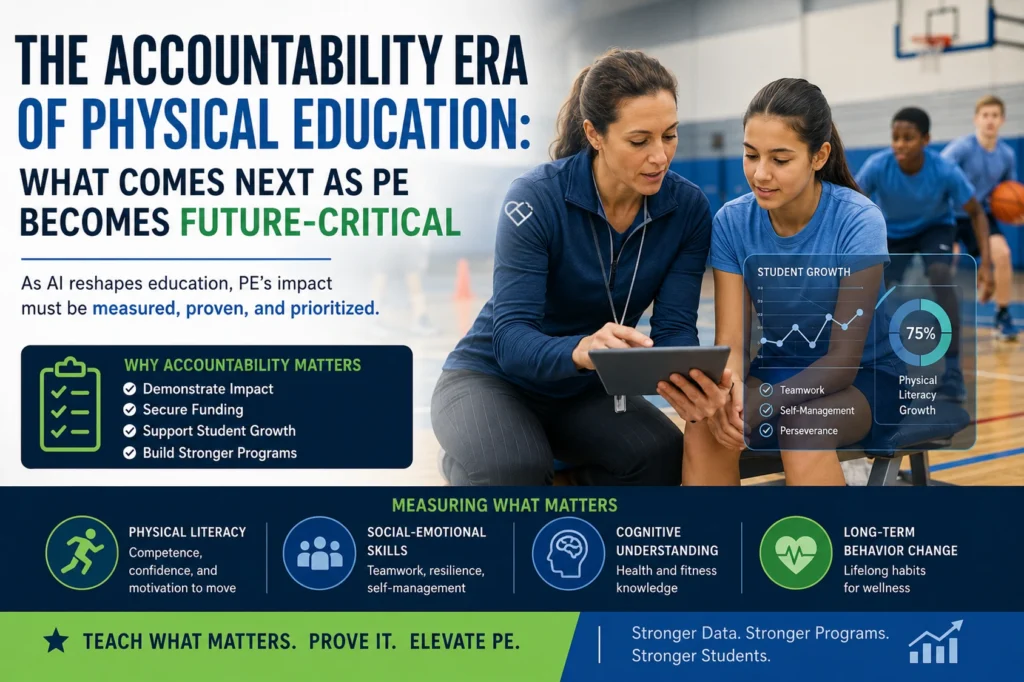
PART 2 As artificial intelligence reshapes education, Part 1 made the case that physical education teachers are among the most future-proof educators. Their role in developing social, emotional, and experiential skills aligns directly with what AI cannot replace. But with increased importance comes increased scrutiny. If PE is no longer viewed as “supplemental” but instead as essential to whole-child development, then schools, districts, and policymakers will begin asking a new question: How do we measure its impact? The Shift from Participation to Measurable Outcomes Historically, physical education has often been evaluated by participation—attendance, activity time, and basic fitness benchmarks. But that model is quickly becoming outdated. In an accountability-driven education system, every subject must demonstrate value through data. Research from the Aspen Institute and SHAPE America emphasizes that modern PE should assess not just physical activity, but: This represents a fundamental shift: PE is no longer just about what students do—it’s about what they learn, retain, and apply. The Science of Measuring What Matters One challenge is that many of the most important outcomes in PE—like resilience, collaboration, and perseverance—are harder to quantify than test scores. However, emerging research provides frameworks for doing exactly that: In other words, measurement is possible—but it requires better tools and intentional systems. Why Accountability Will Increase for PE Teachers As districts invest more in whole-child initiatives and justify funding decisions, PE programs will face increased expectations in three key areas: This mirrors what has already happened in core subjects over the past two decades. The Risk: Being Essential but Unmeasured There is a real risk for PE programs in this transition. If PE is recognized as critical but cannot produce measurable outcomes, it may struggle to compete for funding and prioritization against subjects with established data systems. Put simply: what gets measured gets funded. Without clear evidence of impact, even the most valuable programs can be overlooked. The Opportunity: Leading the Next Wave of Education Data At the same time, this shift creates a massive opportunity for PE teachers and programs to lead. Because PE sits at the intersection of physical health, mental well-being, and social development, it is uniquely positioned to become a cornerstone of data-driven, whole-child education. Forward-thinking programs are already: These approaches not only validate PE’s impact—they elevate it. A Practical Example Imagine two schools: When district leaders review program effectiveness, only one school can clearly demonstrate its contribution to student outcomes. That school becomes the model—and the priority. The Evolving Role of the PE Teacher As accountability increases, the role of the PE teacher will expand beyond instruction to include: This is not about adding burden—it’s about aligning with where education is going. The Bottom Line Physical education is entering a new era. As AI takes over knowledge delivery, PE’s role in human development makes it more valuable than ever. But that value must be demonstrated, not assumed. The future of PE will belong to programs that can do both: Teach what matters—and prove it. Contact us at awesome@physednhealth.com