
Why Physical Education Teachers Are the Most Future-Proof Educators in the Age of AI
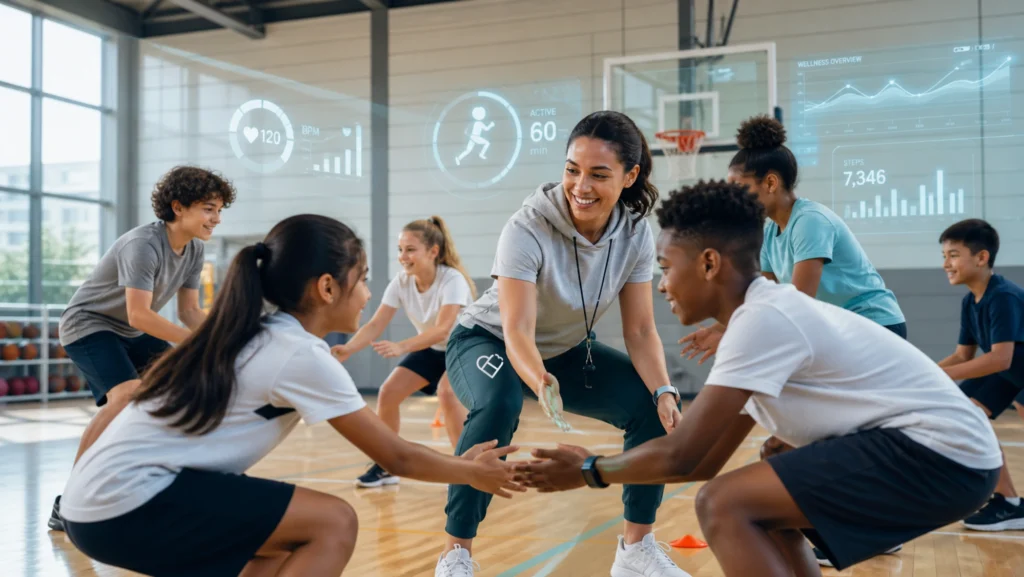
PART 1 Artificial intelligence is rapidly transforming education. With AI now capable of delivering personalized instruction, instant feedback, and vast knowledge retrieval, a critical question is emerging across K–12 systems: what role will human teachers play in the future? The answer, supported by cognitive science and education research, is clear—teaching is shifting away from knowledge delivery and toward human development. And no group of educators is better positioned for this shift than physical education (PE) teachers. AI Is Replacing Information Delivery—Not Human Development AI excels at what researchers call “cognitive offloading”—the ability to store, retrieve, and present information faster and more efficiently than humans. Studies from institutions like Stanford and MIT show that AI-driven tutoring systems can match or exceed traditional instruction in knowledge acquisition, particularly in subjects like math and reading. However, education is not just about knowledge transfer. According to the National Research Council, effective education also develops: These competencies—often grouped under “non-cognitive skills”—are not easily replicated by AI. They require human interaction, real-world context, and experiential learning environments. The Science Behind Experiential and Social Learning Research consistently shows that students learn best through active, embodied experiences: In other words, learning is not just a mental process—it is physical, social, and emotional. Why PE Teachers Are Uniquely Positioned for the Future Physical education already operates at the intersection of these domains. Unlike traditional classroom settings, PE environments are inherently: PE teachers are not just instructors—they are facilitators of human development. For example, when a student participates in a team sport, they are simultaneously learning: These are precisely the skills AI cannot teach effectively in isolation. The Shift: From Knowledge Teachers to Experience Designers As AI becomes the primary tool for knowledge delivery, the role of educators will evolve into what many researchers call “learning experience designers.” This shift includes: PE teachers are already doing this every day. Implications for K–12 Schools and District Leaders Districts investing in future-ready education should reconsider how they prioritize and position physical education programs. Key considerations include: Rather than being supplemental, PE may become foundational to 21st-century education. A Simple Illustration Consider two classrooms: Both environments teach “knowledge,” but only one develops the full spectrum of human skills needed for life. The Bottom Line AI will not replace teachers—but it will replace teachers who only deliver information. The educators who remain indispensable are those who teach students how to interact, adapt, collaborate, and grow as humans. Physical education teachers already embody this role, making them some of the most future-proof professionals in education today. As schools prepare for an AI-driven future, the question is no longer whether PE matters—it is whether schools are fully leveraging the one subject built entirely around human development. Contact: awesome@physednhealth.com