
You’re Right – PE Assessment Is Harder Than Classroom Assessment. That’s Exactly Why You Need The Zone Approach
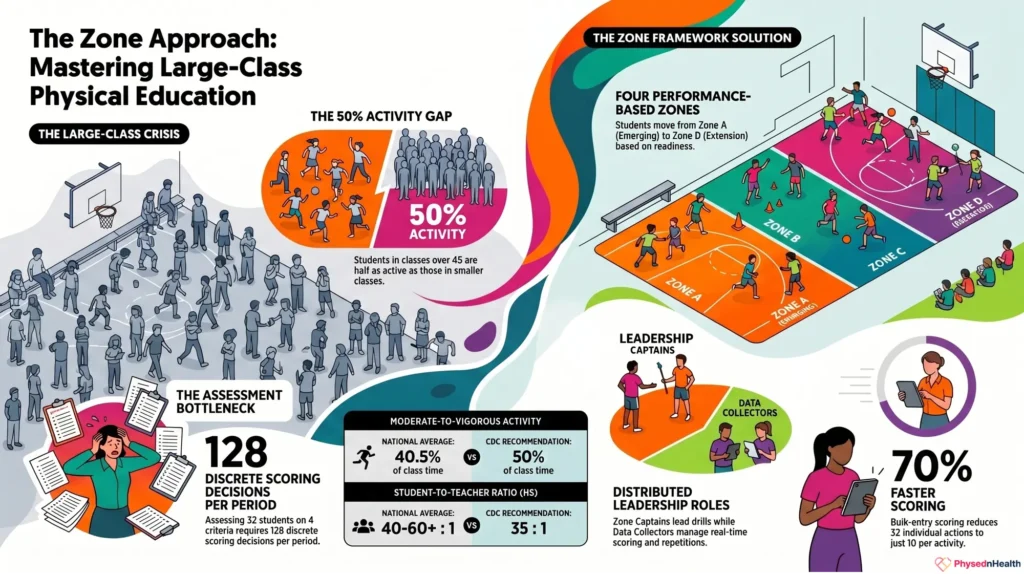
A PE teacher recently posted something on Reddit that stopped us in our tracks: “I think it is easier to write a report of the class than grade because in order for grading to be meaningful and accurate, it will take time. Classroom teachers have a much easier time with assessments because they can be done without the teacher observing in real time. PE we have to observe in real time to actually assess.” This teacher is not wrong. They’re describing a real structural problem, and it’s one that every PE professional with 30+ students has felt in their bones. But the conclusion they’ve reached—that individual grading is too hard, so class-level reports are the only realistic option—is a surrender to the logistics, not a solution to them. Let’s talk about why, and what the alternative looks like. The Real-Time Observation Problem Is Real Here’s the fundamental asymmetry that makes PE assessment different from every other subject in the building: A math teacher distributes a test. Students work independently. The teacher collects papers. That evening or the next day, the teacher grades them one at a time, with coffee, at their own pace. The assessment and the scoring are separated by hours or days. The teacher has time to think, compare, reconsider. A PE teacher needs to watch a student dribble a basketball, evaluate hand position, eye focus, ball control, and athletic posture, assign a score on a 1–4 scale across four criteria, and record it—all while 31 other students are also dribbling, some are chasing loose balls, two are arguing about teams, and one just sat down claiming a stomachache. The assessment is the observation. And the observation window is measured in seconds. So when this teacher says grading in PE requires the teacher to observe in real time, they’re identifying the exact constraint that makes PE assessment orders of magnitude harder than classroom assessment. We agree with every word of the diagnosis. We disagree with the treatment. Why Class-Level Reports Aren’t Enough The instinct to write a class report rather than individual grades is understandable. It’s also dangerous for the long-term health of your PE program. A class-level report tells an administrator something like: “The 6th grade demonstrated developing proficiency in locomotor skills, with most students performing at or near grade-level expectations.” That’s useful context. But consider what it cannot do: This isn’t a criticism of the teacher who wrote that Reddit post. It’s a description of the institutional reality: programs without individual student data are vulnerable programs. PE already fights an uphill battle for time, funding, and respect. Giving up on individual assessment, however understandable the reasons, makes that battle harder. The Cognitive Bottleneck: Why 32 Feels Impossible To understand why the zone approach works, you first need to understand why observing 32 students individually doesn’t. When you scan a gymnasium of 32 students performing the same skill, your brain is attempting to do 32 independent evaluations in parallel. Cognitive science tells us this is essentially impossible. Human working memory holds roughly 4–7 discrete items at once. You can observe 4–6 students with reasonable accuracy before the earlier observations start degrading in memory. So what actually happens in practice? One of three things: None of these approaches is the teacher’s fault. They’re the predictable result of asking one human to simultaneously observe and evaluate 32 moving bodies with no structural support. The zone approach provides that structural support. How the Zone Approach Changes the Math The zone approach organizes students into 4 groups of roughly 8, based on approximate performance readiness. The groups are called zones, and they persist across a unit of instruction. Here’s how that changes the assessment equation: Instead of 32 Independent Evaluations, You Make 4 Group Judgments + Exceptions When you look at a zone of 8 students who are all at a similar developmental level, you don’t need to evaluate each one from scratch. You make one baseline judgment for the group: “Zone B is generally performing at a 2 on this rubric.” That’s 8 students scored in one cognitive action. Then you spend 30 seconds scanning for exceptions. Maybe one student is clearly performing at a 3. Another is struggling and looks more like a 1. You override those two. That’s 3 total scoring decisions for 8 students. Do that four times—once per zone—and you’ve assessed the entire class of 32 with roughly 12–16 decisions instead of 128 (32 students times 4 rubric criteria). The observation time drops from “impossible” to about 4–5 minutes of focused attention. Pattern Detection Replaces Parallel Evaluation Here’s the cognitive science behind why this works: when students are grouped by ability, you’re no longer asking your brain to evaluate 32 individuals in parallel. You’re asking it to detect deviations from a pattern. “Does anyone in this group of 8 look different from the rest?” Your brain is exceptionally good at this. Spotting the one kid in a group of 8 who’s performing differently is a perceptual task, not a memory task. It’s fast, automatic, and reliable. It’s the same cognitive process that lets you spot a typo in a paragraph or notice one student sitting while the rest are moving. Without zones, you’re asking your brain to do 32 recall-based evaluations. With zones, you’re doing 4 pattern-detection scans. The underlying cognitive task changes from impossible to intuitive. The Grid Is the Override Surface Teachers who hear about zone-based scoring sometimes worry it means every student in a zone gets the same grade. It doesn’t. The zone baseline is a starting point, not a final score. Every individual cell in the scoring grid remains editable. The teacher confirms or overrides each score based on direct observation. Think of it like a spreadsheet autofill: you fill a column with a default value, then go back and change the cells that need changing. The autofill saves time. The manual overrides preserve accuracy. Both happen on the same surface. For the Skeptics: Five Honest Objections and Straight Answers 1.