
What PE Teachers Need to Know About Proving Student Growth
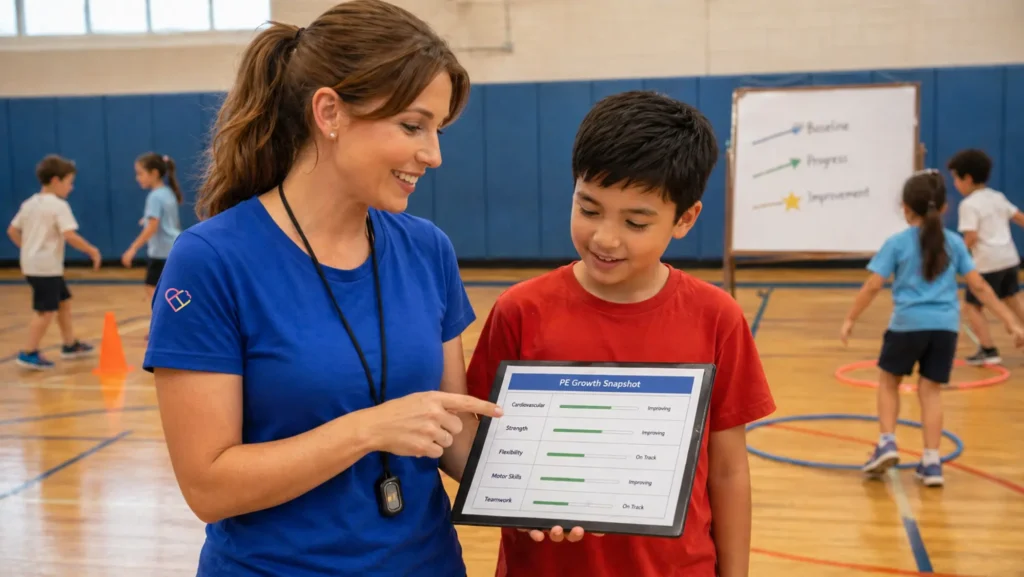
In PE, “student growth” often gets talked about as if it should be obvious. But for many teachers, that is the problem. They know students are improving. They see better movement patterns, stronger effort, more confidence, smarter decisions, and more consistent participation in learning. What is harder is proving that growth in a way families and administrators can understand quickly and trust. SHAPE America’s guidance makes that expectation clear: physical education assessment should be aligned to standards and grade-level outcomes, measure achievement across instruction, and be communicated to students and parents through school and district reporting protocols (SHAPE). That is why proving student growth in PE is not just an assessment issue. It is also an advocacy issue. The stronger your evidence, the easier it is to show that PE is not random activity. It is real teaching, real learning, and real student development. SHAPE America’s 2024 National Physical Education Standards framework explicitly positions the standards as a tool used by teachers, administrators, and policymakers to shape curriculum, instruction, and the assessment of student achievement and progress (SHAPE). First, what actually counts as evidence of growth in PE? A lot more than one final test score. SHAPE America says PE assessment should be standards-aligned and should measure student achievement in all areas of instruction, including physical fitness. It also describes PE assessment as a sequence that can include preassessment, formative assessment, and summative assessment. That means evidence of growth in PE should show how a student moves from a starting point to a later point in learning, not just where they finished on one day (SHAPE). In practical terms, strong evidence of progress in PE can include: The key idea is simple: evidence of growth should match what you say you teach. If your program values fitness knowledge, skill development, self-management, and personal progress, then your evidence should reflect those things too. Why one score is usually not enough One score can be part of the picture, but it is rarely the whole picture. A student may still be below class average in a fitness task and yet show strong growth from baseline. Another student may still not be “advanced” in a skill but may have made clear progress in form, control, or confidence. If teachers only report the final score, they hide much of the actual learning. SHAPE America’s standards-based student progress report was created specifically to help teachers report assessment results to students and families in a way that aligns with standards and grade-level outcomes, which is a signal that PE progress should be reported more comprehensively than a single number. That matters for advocacy because administrators and families often understand PE best when teachers show growth over time, not isolated moments. A helpful way to think about proof in PE When you need to prove student growth, try organizing evidence into three simple buckets: 1. Growth in fitness This is often the easiest category for schools to understand. Examples include improvement in endurance, muscular endurance, recovery, movement efficiency, or consistency across a unit. SHAPE explicitly includes physical fitness within PE assessment, which makes fitness progress valid evidence when it is aligned to curricular outcomes. 2. Growth in skill This includes progress in movement competence, technique, tactical decision-making, and application of cues. Because SHAPE’s standards framework centers what students should know and be able to do within a learning progression, skill growth is one of the clearest forms of evidence a PE teacher can present. 3. Growth in learning behaviors tied to standards This is where many PE teachers under-report what students are actually learning. If students improve in self-management, safe behavior, cooperation, communication, or giving and using feedback, that can count as evidence when those outcomes are part of the standards and your curriculum. The 2024 SHAPE standards include learning indicators related to communication, feedback, respect, teamwork, safety, and problem-solving in physical activity settings. That does not mean grading kids for “being good.” It means documenting growth in standards-based behaviors and competencies that are explicitly part of PE learning. How to make growth easier to communicate to administrators Administrators usually do not need more raw data. They need a clearer story. The best story is usually: Here is where students started.Here is the evidence of what improved.Here is how that improvement connects to standards and instruction. That framing works because SHAPE’s standards are designed to support curriculum, instruction, and assessment together, and SHAPE’s own “How to Demonstrate My Effectiveness” guidance tells teachers to assess students according to curricular objectives and standards, then share results with principals and parents. A strong administrator-facing growth update might include: For example: “Students in Grade 5 began the striking unit with an average rubric score of 1.8 on contact and follow-through. By the end of the unit, the average rose to 3.1, with most students independently applying cues in game-like practice. This aligns to our grade-span PE learning indicators for skill application and feedback.” That kind of language helps PE sound like what it is: instruction with measurable outcomes. How to make growth easier for families to understand Families usually care about different questions than administrators. They want to know: SHAPE’s student progress report template was created specifically to help teachers report PE assessment results to students and families in a user-friendly, standards-based format. SHAPE’s instructional practice guidance also says parents and guardians should receive regular reports of student progress using continuous, formative evidence, not just a report-card letter. That means family communication in PE works best when it is: A family-friendly progress note might sound like: “Your child has improved in pacing and endurance during our cardiovascular fitness unit. They also show stronger understanding of how to manage effort during continuous activity. Next, we are working on helping them recognize when to adjust pace earlier.” That is much more meaningful than “B in PE.” What stronger PE tracking actually looks like Better tracking does not mean collecting everything. It means collecting the right evidence consistently. Usually, that means teachers have