
Why Confidence in PE Is Built Through Progress, Not Praise Alone
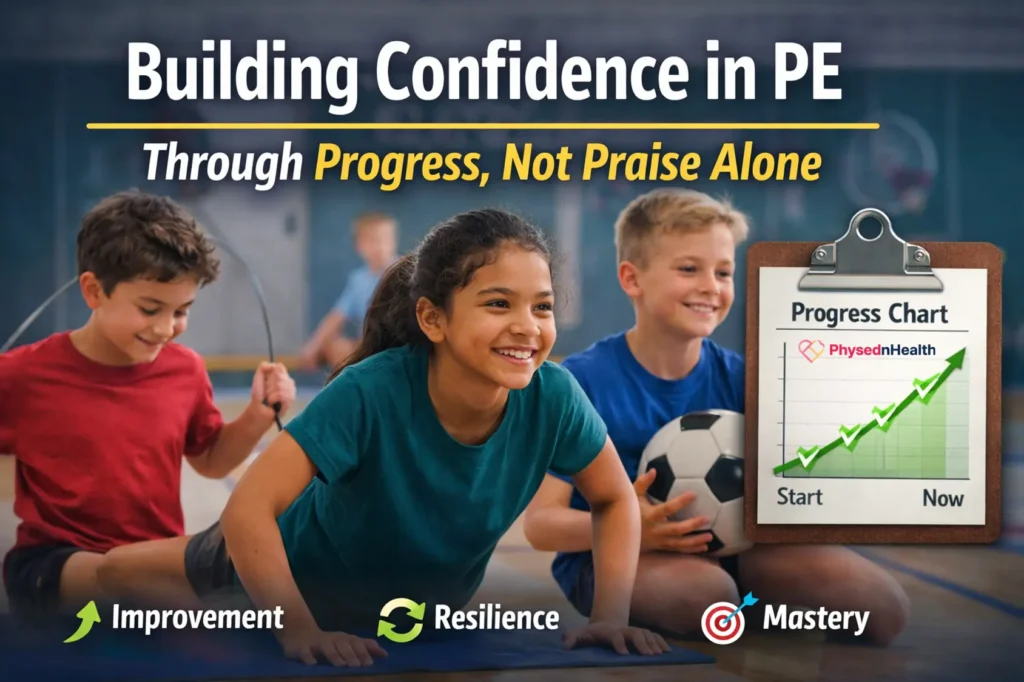
A lot of students hear praise in PE. “Nice job.” “You’ve got this.” “Good effort.” That matters—but praise by itself is usually not enough to build lasting confidence. What builds real confidence is progress students can feel and see. In psychology, this is close to self-efficacy: a student’s belief that they can successfully perform a specific task. Self-efficacy grows from several sources, including mastery experiences, models, verbal persuasion, and emotional state. In school settings, students also persist more and process learning more deeply when they adopt mastery goals—focused on improvement and learning—rather than performance goals centered on proving ability (NCBI). That distinction matters in PE. If a student thinks confidence means “I am naturally good at this,” then confidence becomes fragile. One missed catch, one slow lap, one awkward skill attempt, and it disappears. But if a student learns that confidence comes from improving, adjusting, and recovering from mistakes, then confidence becomes more durable. CASEL’s school guidance notes that believing “I can succeed at this” creates a positive loop between hard work, mastery, and increased self-efficacy, and it recommends framing mistakes as learning opportunities rather than threats (Casel Shcoolguide) . What confidence in PE actually looks like Confidence in PE is not the same as being the best athlete in class. A confident student might still be developing skill. They might still be slower, less coordinated, or newer to movement experiences than their peers. What changes is that they begin to believe they can improve, try again, and handle challenge without shutting down. SHAPE America’s PE/SEL crosswalk ties physical education directly to self-awareness, self-management, a well-grounded sense of confidence, optimism, and a growth mindset. SHAPE also frames PE as part of students’ holistic development, not just skill display (SHAPE). That is why empty encouragement can only take students so far. Verbal persuasion is one source of self-efficacy, but it works best when it is paired with actual experiences of progress. When students have evidence that they are getting better, teacher encouragement lands differently because it feels true. Why progress matters more than praise alone Praise tells students, “Someone believes in me.” Progress tells students, “I have proof.” That proof is powerful. The APA reports that mastery-oriented learning supports persistence and deeper processing, and it has also highlighted evidence that monitoring progress toward goals more frequently increases the likelihood of reaching them. In PE, that means confidence grows when students can compare where they started to where they are now—not just when they hear positive words after a performance. This is one reason visible improvement matters so much in physical education. A student who can see that they added two push-ups, improved their dribbling control, or participated more consistently over time is not relying on borrowed confidence from the teacher. They are building earned confidence through experience. SHAPE America’s essential components document emphasizes that PE assessment should track student progress over a learning sequence using preassessment, formative assessment, and summative assessment—not just isolated final outcomes. Why mistakes are part of confidence-building Many students think confidence means never messing up. In reality, confidence gets stronger when students learn that mistakes are survivable, normal, and useful. CASEL explicitly recommends honoring productive struggle and framing mistakes as learning opportunities. Its guidance also notes that thoughtful scaffolding and high expectations help students stretch safely without feeling abandoned. That is especially important in PE because mistakes are often public. A missed serve, a poor throw, or a failed attempt can feel highly visible. If students interpret those moments as proof that they “just aren’t good at PE,” confidence drops. If they interpret them as information—what to adjust next, what cue to focus on, what part is improving—confidence can actually grow after mistakes instead of collapsing because of them. That is a practical application of mastery-oriented motivation and growth-focused feedback. What this looks like in PE In PE, confidence grows fastest when teachers make improvement visible across more than one kind of success. A student can build confidence through: That broader view fits SHAPE America’s guidance that physical education assessment should measure progress across the learning sequence and address cognitive, affective, and psychomotor learning, not just one final performance score. So the student who goes from avoiding a task to attempting it consistently is making real progress. The student who still is not “top level” but now understands cues, self-corrects, and sticks with challenge is making real progress. The student who moves from embarrassment to effort is making real progress. And progress is what confidence can grow on. 5 ways PE teachers can build confidence through progress 1. Start with a baseline Confidence is easier to build when students know where they started. Preassessments, simple check-ins, and quick initial skill observations help create a reference point for future success. SHAPE America recommends preassessments at the start of a learning sequence, and IES describes formative assessment as a process of gathering and using evidence during instruction to facilitate further learning. 2. Make progress visible Use charts, personal best trackers, cue checklists, reflection prompts, or simple before-and-after comparisons. The APA notes that more frequent progress monitoring is linked to greater goal success, which helps explain why visible progress can be so motivating for students. 3. Give feedback that points to the next move “Good job” feels nice, but “Your plant foot was in a better position that time—try following through toward the target next” builds competence. IES describes formative assessment as creating feedback loops that allow midcourse, just-in-time adjustments to help students learn. 4. Normalize retries and revision Students build confidence when they know they will have another attempt, another rep, another chance to adjust. CASEL recommends framing mistakes as learning opportunities and supporting productive struggle rather than treating errors as failure. 5. Pair encouragement with evidence Keep praising effort and persistence—but connect that praise to something real the student is doing better. That combination matters because self-efficacy is strengthened not only by verbal persuasion but also by mastery experiences and a student’s interpretation of their own progress.