
Why PE Assessment Should Measure Growth, Not Just Performance
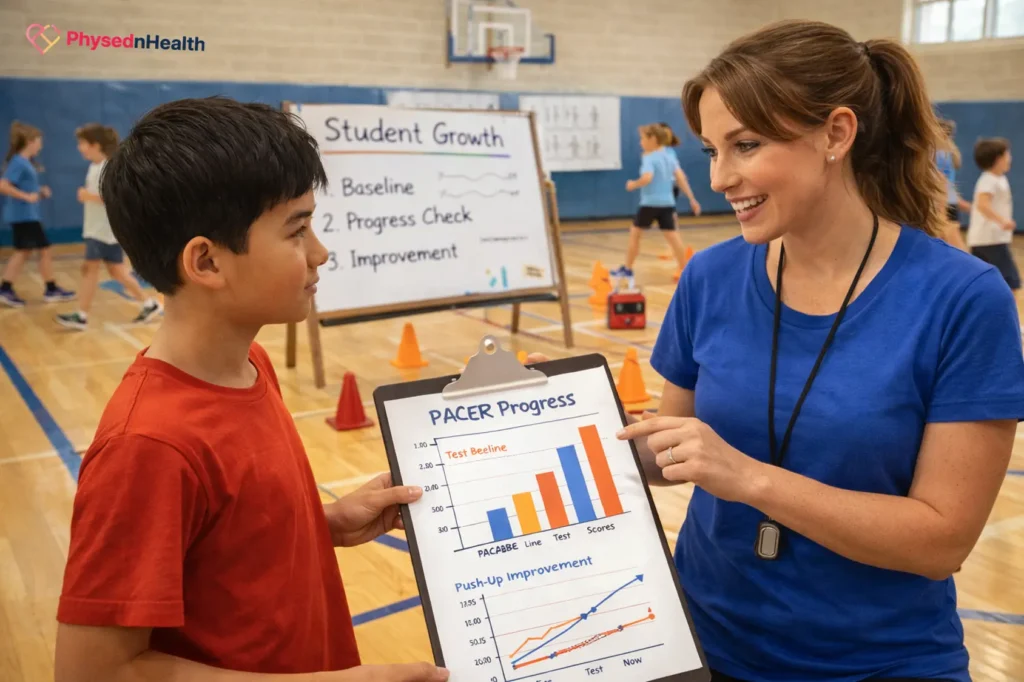
A lot of PE assessment still gets reduced to a single moment: one test, one score, one grade, one snapshot. A student runs the PACER once. Holds a plank once. Performs a skill once. Then that score becomes the story. But in physical education, that is rarely the full story. A student who starts far behind but improves steadily may be learning more, building more confidence, and developing better long-term habits than a student who begins with high performance and stays flat. SHAPE America defines student assessment in physical education as gathering evidence about achievement and making inferences about student progress, not just recording isolated outcomes. SHAPE also describes assessment in PE as including preassessments, formative assessments during instruction, and summative assessments at the end of a unit or sequence. That is why growth-based PE assessment matters. It shifts the question from “How good is this student right now?” to “How is this student progressing over time, and what does that tell us about learning?” Why one-time scores are not enough A one-time performance score can be useful. Teachers do need checkpoints. Students do need opportunities to demonstrate what they can do. But a single score does not always capture effort, improvement, confidence, understanding, or the effect of quality instruction over time. That is especially true in PE, where students enter class with very different backgrounds, confidence levels, access to activity outside school, motor skill development, and prior experiences with movement. SHAPE guidance says student assessment in physical education should align with standards-based grade-level outcomes and measure progress across the psychomotor, cognitive, and affective domains. In other words, PE is not just about the final number. It is also about what students learn, how they improve, and how they grow in skill, knowledge, and self-management. Why growth is more motivating for students There is also a motivation reason to assess growth. The American Psychological Association notes that students tend to persist more and process learning more deeply when they adopt mastery goals rather than performance goals. Mastery goals focus on improving competence and learning; performance goals focus more on proving ability relative to others. That matters in PE. When students believe success means being the fastest, strongest, or most naturally skilled person in the class, many disengage quickly. But when success includes visible improvement, personal bests, better technique, stronger habits, and progress toward goals, more students can see a path to success. Growth-based PE assessment gives students that path. It tells the student who went from 8 push-ups to 14 that the work mattered. It tells the student who still struggles with overhand throwing that cleaner form and better sequencing count. It tells the student who used to avoid class that dressing out consistently, participating more fully, and reflecting honestly are meaningful wins too. That approach fits both SHAPE’s emphasis on student progress and APA’s research-based distinction between mastery-oriented and performance-oriented motivation. What growth-based PE assessment looks like Growth-based assessment does not mean lowering standards. It means measuring student learning in a way that reflects how learning actually happens. In PE, that usually means using more than one point of evidence: That structure closely matches SHAPE America’s description of preassessment, formative assessment, and summative assessment in physical education, and it aligns with IES guidance that formative assessment is a process of gathering, interpreting, and using evidence during instruction to support further learning. Example 1: Fitness progress Imagine two students taking the PACER. Student A scores high on day one and finishes the unit with almost the same result. Student B starts much lower but improves significantly, learns how to pace effort, and can explain what cardiovascular endurance is and why it matters. If you only grade the final score, Student A may appear more successful. If you assess growth, Student B’s learning becomes visible too. A growth-based approach might look at baseline-to-final improvement, pacing strategy, recovery awareness, effort consistency, and student understanding of the fitness concept being taught. That better reflects PE’s cognitive and psychomotor goals than a single score alone. Example 2: Skill development Now think about a skill unit. A student may not reach “advanced” performance in dribbling, striking, or throwing by the end of the unit. But that same student might show clear improvement in body control, movement sequence, cue recall, and decision-making. That is learning. If assessment only rewards the polished final product, teachers miss the instructional story. If assessment captures progression, feedback, and improving execution, students are rewarded for developing competence rather than just arriving with it. SHAPE’s standards-based assessment approach and IES’s emphasis on using evidence to make midcourse instructional adjustments both support this broader view of learning. Example 3: Personal goal progress Some of the most important growth in PE is personal. A student who begins the semester avoiding participation may set a goal to engage in every warm-up. Another may aim to improve recovery habits, monitor effort more honestly, or contribute more positively in partner work. Those gains matter because PE is not only building performance. It is building self-awareness, confidence, and habits that support lifelong physical activity. SHAPE’s guidance that assessment should address cognitive, affective, and psychomotor domains supports including these kinds of goals in a strong PE assessment system. How PE teachers can shift toward growth-based assessment The shift does not have to be complicated. Start with four simple moves. 1. Use a baseline before instruction Do not make the first score the final judgment. Use it to understand starting points. 2. Add checkpoints during the unit Quick observations, skill cues, exit reflections, and mini-conferences help teachers adjust instruction and help students notice progress. That is the heart of formative assessment. 3. Measure more than the final performance Include technique, understanding, consistency, goal progress, and reflection where appropriate. That better reflects PE’s full learning goals. 4. Show students their progress Growth becomes motivating when students can actually see it. APA’s motivation guidance suggests that a mastery-oriented approach supports persistence and deeper engagement. Why this is more educationally meaningful Growth-based