
Beyond the Latest Trend: Why Physical Education Should Prioritize Lifetime Skills Over Social Media-Driven Activities
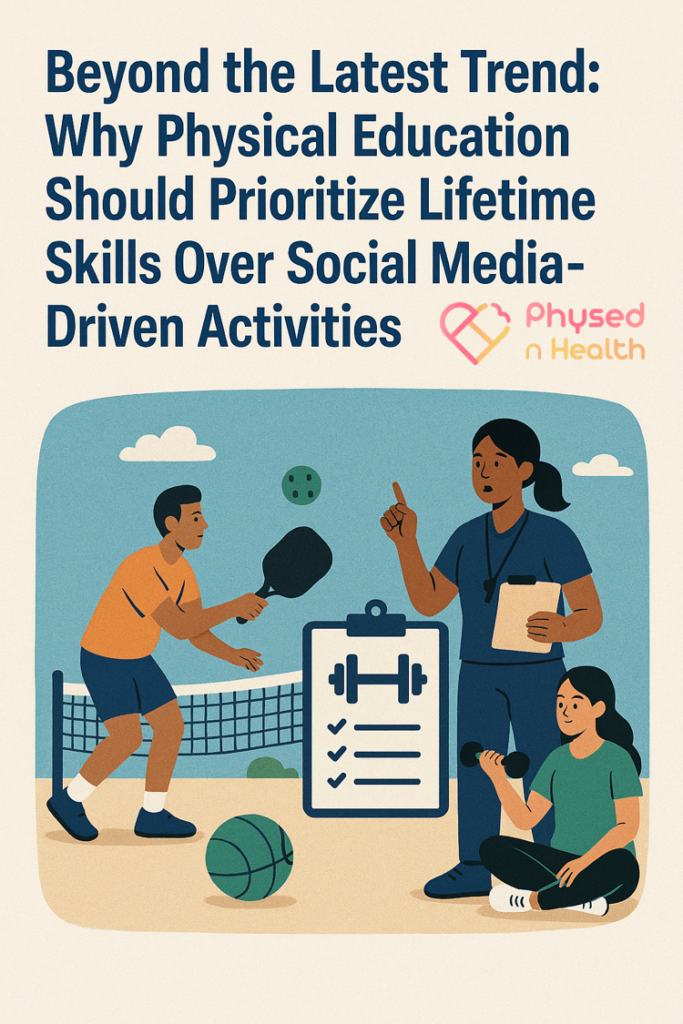
While it may seem fashionable for physical education teachers to incorporate the latest social media-driven sports and activities into their curriculum, research consistently demonstrates that PE programs should prioritize teaching accessible, lifetime fitness skills that students can realistically pursue beyond school grounds. This approach not only ensures equitable access for all students but also promotes long-term physical activity habits that extend well into adulthood. The Accessibility Challenge of Trendy Sports Physical education faces a fundamental challenge when adopting popular sports like pickleball, which has gained significant social media attention and popularity among adults. While pickleball is increasingly promoted as an inclusive sport, significant accessibility barriers remain. Many communities lack proper facilities, with courts often requiring specialized surfaces, equipment, and maintenance that may not be available to all students after graduation.(greenfly) Research reveals that community access to sports facilities remains highly inequitable. Students from disadvantaged backgrounds already face substantial barriers to physical activity participation, including limited access to recreational facilities, financial constraints, and poor transport links. Teaching sports that require specific courts, equipment, or club memberships can inadvertently widen these gaps rather than bridge them. (pmc.ncbi.nlm.nih) The Science Behind Lifetime Fitness Activities Extensive research supports prioritizing lifetime fitness activities over trendy sports. A comprehensive study examining physical education’s long-term impact found that students who participated in daily PE programs remained more physically active even four years after the program ended. Most importantly, the study revealed that intensive participation in general physical activity during school years was more predictive of adult activity levels than participation in specific sports. (eurapa.biomedcentral) The lifetime fitness approach focuses on activities that can be performed throughout one’s entire life, such as: Research demonstrates that these activities provide superior long-term benefits because they can be adapted to any fitness level, require minimal equipment, and remain accessible regardless of socioeconomic status or community resources.(plt4m) Student Engagement Through Variety, Not Trends The concern that teaching fundamental fitness skills becomes boring is valid, but research offers evidence-based solutions. A comprehensive study on student motivation in physical education found that perceived variety-support significantly enhances student engagement. However, this variety doesn’t need to come from trending activities but rather from diverse teaching methods, equipment usage, and modified approaches to fundamental movements. (frontiersin) Effective engagement strategies include: The Evidence for Long-Term Impact Multiple longitudinal studies demonstrate the superiority of lifetime fitness education over sport-specific training. Research tracking students across decades shows that individuals who learned fundamental movement patterns and fitness principles during school years maintained higher activity levels throughout adulthood. (frontiersin) Conversely, studies reveal that most people discontinue the sports they played in childhood, with only 25% of adults continuing sports they participated in as children. This stark statistic underscores why PE should prioritize transferable skills over specific sport competencies. (plt4m) A landmark meta-analysis examining after-school physical activity programs found that interventions focusing on general physical activity skills provided more sustainable long-term benefits than sport-specific programs. The study concluded that programs emphasizing fundamental movement skills, cardiovascular fitness, and strength training produced participants who remained active across various life transitions. (niost) Addressing Community Access Inequities Physical education serves a crucial equity function by providing all students, regardless of background, with essential fitness knowledge and skills. When PE teachers choose activities based on social media popularity rather than accessibility, they may inadvertently disadvantage students from lower socioeconomic backgrounds. (pmc.ncbi.nlm.nih) Research consistently shows that students from disadvantaged communities face multiple barriers to sports participation, including: By focusing on bodyweight exercises, basic cardiovascular activities, and fundamental movement patterns, PE teachers ensure that every student can continue their fitness journey regardless of their post-graduation circumstances. Creating Sustainable Excitement Through Progressive Mastery Rather than relying on trendy activities to maintain student interest, research supports a progressive mastery approach that builds long-term engagement. This method involves: 1. Foundational Skill Building: Starting with basic movement patterns and gradually increasing complexity (rwu) 2. Personal Goal Setting: Helping students establish and track individual fitness objectives (pmc.ncbi.nlm.nih) 3. Autonomy Support: Allowing students to choose how they apply fundamental principles to their personal interests (ebsco) 4. Competence Development: Ensuring students master core skills before progressing to advanced variations Studies show that students who develop intrinsic motivation through competence and autonomy are significantly more likely to maintain physical activity habits throughout their lives. (rwu) The Role of Physical Literacy The concept of physical literacy – the motivation, confidence, physical competence, knowledge, and understanding to value and engage in a physically active lifestyle – provides the theoretical foundation for prioritizing lifetime skills. Research demonstrates that physical literacy development during childhood and adolescence is the strongest predictor of lifelong physical activity. (eurapa.biomedcentral) Trendy sports, while potentially engaging in the short term, often fail to develop comprehensive physical literacy. They may emphasize sport-specific skills that have limited transfer to other activities or life situations. In contrast, lifetime fitness activities develop fundamental movement patterns, cardiovascular endurance, muscular strength, and flexibility – components that transfer to any physical activity a person might choose to pursue. (finalsite) Practical Implementation Strategies PE teachers can maintain student engagement while prioritizing lifetime skills through several evidence-based strategies: Circuit Training Variety: Design different circuit stations using basic equipment to teach cardiovascular fitness, strength training, and flexibility in engaging formats (pmc.ncbi.nlm.nih) Progressive Challenges: Create tiered challenges that allow students of all fitness levels to experience success and growth (rwu) Real-World Applications: Connect fitness principles to activities students might encounter outside school, such as hiking, recreational sports, or occupational demands (plt4m) Peer Teaching: Allow students to demonstrate and teach exercises to classmates, building both competence and social connection (rwu) Technology Integration: Use fitness apps, heart rate monitors, or simple tracking tools to help students monitor their progress and understand fitness principles (pmc.ncbi.nlm.nih) Conclusion While incorporating trending activities may seem like an effective way to engage students, the scientific evidence strongly supports prioritizing accessible lifetime fitness skills in physical education. This approach ensures equitable access for all students, promotes long-term physical activity habits, and provides the foundational physical literacy necessary for lifelong wellness. The goal of physical education should